National conversations about government spending go back at least as far as the New Deal. Every so often, they attain front-burner status. but lately we seem to have become so inured to spending's effect on our future and the changing relationship between the state and the individual that even the recent uptick on attention to it doesn't seem to garner much buzz beyond the worlds of news and punditry. It's not exactly coffee-shop fodder.
But government profligacy's steadily gathering momentum under administrations of both major parties gets easier as its enthusiasts are ever-more able to say, quite correctly, that when those who have a record of saying that they want to see a reversal gain control of a branch or branches of government, there is only continued acceleration. This is why Donald Trump's election and the takeover of the Republican Party by Trumpists has been particularly pernicious. They demonstrably don't care about the size, scope, intrusiveness and insolvency of the federal government. One could point to the tax cuts of 2017, but tariffs soon countered the cuts' beneficial effects.
There are several components to the current round of attention to the matter. There's the tax aspect, the debt-and-deficit aspect, the statism-on-steroids aspect, and the inflection point at which Democrats find themselves.
Taxation inherently produces tension in a society founded on the primacy of human freedom. It's considered bad form to bring up the basics of what taxation is; that's for subtlety-lacking libertarian types to chime in with, according to modern perception. But it merits spelling out plainly on occasion: It is government using its monopoly on the legitimate use of force to take that which belongs to citizens and the organizations they form. Obviously, the functions of government envisioned by Madison need to be financed somehow, and healthy debate about how to go about raising that revenue ought to be encouraged.
That's not what we have now. Taxes of various sorts are proposed as a way too demonize certain categories of people and organizations. The broadest target of this effort is "the rich," who are still, at this late date, accused of not paying their "fair share."
According to the latest IRS data for 2018—the year following enactment of the Tax Cuts and Jobs Act (TCJA)—the top 1 percent of taxpayers paid $616 billion in income taxes. As we can see in Figure 1, that amounts to 40 percent of all income taxes paid, the highest share since 1980, and a larger share of the tax burden than is borne by the bottom 90 percent of taxpayers combined (who represent about 130 million taxpayers).[2]
In case you are thinking, “Well, the rich make more, they should pay more,” the top 1 percent of taxpayers account for 20 percent of all income (AGI). So, their 40 percent share of income taxes is twice their share of the nation’s income.
Similarly, in 2018, the top 0.1 percent of taxpayers paid $311 billion in income taxes. That amounted to 20 percent of all income taxes paid, the highest level since 2001, as far back as the IRS data allows us to measure. The top 0.1 percent of taxpayers in 2018 paid a greater share of the income tax burden than the bottom 75 percent of taxpayers combined.
Under current law, the United States statutory corporate tax rate of 25.8 percent (21 percent federal statutory rate plus the average of state and local corporate tax rates) is slightly below the OECD average (weighted by GDP) of 26 percent. The METR [marginal effective tax rate] on corporate investment in the United States, under current law, is 18.3 percent, 2.9 percentage points higher than the OECD average. The AETR [average effective tax rate] in the United States is 23.4 percent, which is roughly in line with the OECD average of 22.8 percent.
The Biden administration has proposed raising the statutory corporate income tax rate to 28 percent, while the House Ways and Means Committee has approved a proposal to raise the corporate tax rate to 26.5 percent. Lawmakers have also proposed reforming the tax treatment of foreign profits of US multinational corporations and repealing or reforming the low tax rate on foreign-derived intangible income (FDII). Their goals are to increase federal revenue, increase the tax burden on capital income, and reduce profit shifting by US multinational corporations.
The Biden and House proposals would raise the statutory and effective tax rates to either the highest or nearly the highest in the OECD (see the table below). Both proposals increase the tax burden on corporate investment, reduce the incentive to invest in the United States, and increase the incentive to shift profits and high-return assets into low-tax jurisdictions.
The central thesis of Treasury’s article is that business owners are the primary source of all tax cheating in the U.S. According to the article, “about half of the individual income tax gap accrues to income streams from proprietorships, partnerships, and S-corporations, where there is either little or no information available to the IRS to verify the veracity of tax filings.” Put differently: Unless the IRS has third-party information to verify the claims made by self-employed people, they will systematically cheat on their tax returns.
This claim is based primarily on IRS audit results; yet as I’ve written in the past, these data are simply unreliable. It is well-documented that the IRS’s audit results are wrong between 60 to 90 percent of the time, depending on the issue. Moreover, because IRS auditors are themselves undertrained in tax law, they often misapply the proper legal standards to their audit decisions. Even worse, auditors routinely use tactics of bluff and intimidation, misinformation, and disinformation, and even outright lie to citizens during audits to coerce taxpayers into accepting audit results that are simply not accurate.
Your government would like you to believe that it is only going to go after "the rich," and that the noble intentions of the non-rich will not be disrespected. Are you buying it?
The author of the article continues to advance the party line that Biden’s tax plan will not affect anyone earning less than $400,000 per year. Consider this statement:
It is important to understand what this improved information reporting proposal is not: It is not about using new financial account information reports to increase enforcement scrutiny on lower-income taxpayers. The Administration has been clear that audit rates will not rise relative to recent years for those with under $400,000 in actual income. Instead, these proposals are about targeting enforcement actions where they belong: on higher earners who do not fully report their tax liabilities.
In light of the claim that the underreporting is attributable to “proprietorships, partnerships, and S-corporations,” it is — to use a kind word — disingenuous to suggest that self-employed individuals operating under one of these entity forms will not be targeted for enforcement action. The vast majority of self-employed people operate under one of these entities, and the vast majority of them earn under $400,000 annually. The reality is that, as a whole, the money in America is largely in the hands of the middle class. You can be sure, then, that’s where the IRS attacks will be targeted.
Propaganda is what it is, and so I was unsurprised to read in the article the claim that we have a “two-tiered tax system.” The author claims that our tax system contains “two sets of rules: one for regular wage and salary workers who report virtually all the income they earn; and another for wealthy taxpayers, who are often able to avoid a large share of the taxes they owe.”
This is not so. There are absolutely not two sets of rules in the tax code. The Internal Revenue Code applies to all taxpayers equally. A person earning a small amount of income must report all of it and pay whatever tax is owed after the application of allowed deductions, credits, etc. The same is true for high-income people.
This is merely a thinly veiled attempt to use class envy as a device to persuade lower-income people that while they must pay through the nose on their taxes, high-income people are permitted to systematically cheat on theirs. In that case, the former will likely countenance any plan to attack the latter without considering the possibility that they also might be harmed. But that’s exactly what will happen since there are simply not enough high-income earners available to raise the revenue needed to support the trillions of dollars in proposed spending and deficits.
There are a number of counter-arguments to be made against the assertion that we could afford all the statist designs of the overlords if the cheats could be brought to heel. It really boils down to one essential point: those statist designs are the problem:
In truth, though, your taxes are high and getting higher for one reason only: Congress spends way too much of your money, without any incentive to stop . . . To suggest that policy-makers engage in some level of intellectual “give and take” over the friction between higher deficits and lower spending is complete nonsense.
Anybody who’s spent any time studying these policy issues knows full well that Congress sets its spending agenda first. That agenda is determined by the social and political issues of the day. It then sets tax policy based on the same considerations. At no point does Congress say: “We have X dollars to spend, so how do we allocate those funds?”
If the $3.5 trillion Democratic reconciliation bill becomes law in anything close to current form — including paid parental and sick leave, universal preschool, some free college, and an annual check to households with younger children — it would be a big step toward turning the United States into a European-style comprehensive welfare state. Many progressive Democrats speak highly of the Scandinavian social democracies, in particular. As Bernie Sanders has put it: “I think we should look to countries like Denmark, like Sweden and Norway and learn what they have accomplished for their working people.”
But those loving glances toward Team Nordic often produce fuzzy vision. They typically miss something really important: how those countries pay for those massive welfare states. As Wall Street Journal columnist Greg Ip notes:
Yet if other countries’ welfare states are a template for American progressives, their taxes aren’t. In Germany, the typical worker pays 49% of her labor compensation in income and payroll taxes (including the employer’s contribution); in France, the proportion is 47%, in Sweden, 43%. In the U.S., it is just 30%. The U.S. alone, among major advanced economies, doesn’t impose a value added tax on consumers of goods and services.
On that last point: Denmark, Sweden and Norway all have VAT rates of 25 percent, according to the Tax Foundation, with each collecting close to 10 percent of GDP through the levy. Yet Democrats have made a big deal about not raising taxes on households earning less than $400,000 a year. (There are some exceptions as Ip notes: “Smokers, for example, will pay a higher cigarette tax, and middle-class stockholders will indirectly bear some of the higher corporate tax rate.”)
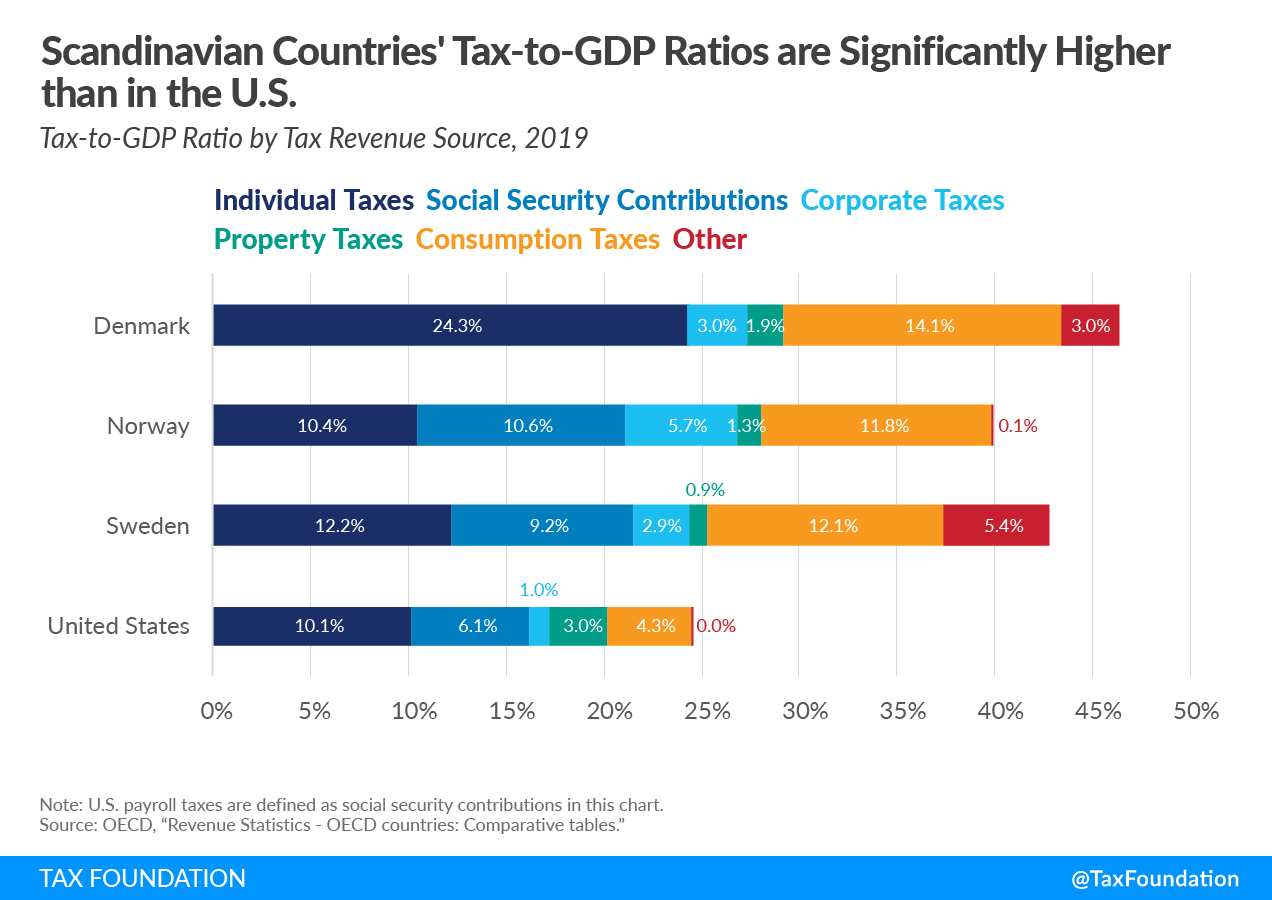
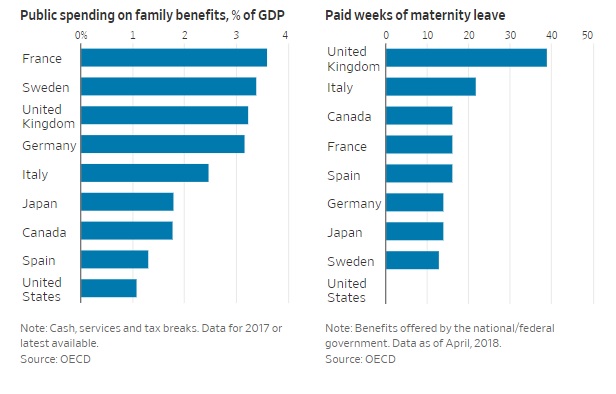
One could argue that there’s still plenty of room to fund more social spending through higher corporate taxes and higher top income-tax rates before talking about an economy-wide VAT. That, especially given higher income inequality in the US. But clearly creating Nordic America is going to require lots of additional revenue, whether through a VAT, carbon taxes, or a combination of both. Again the Tax Foundation: “In 2019, Denmark’s tax-to-GDP ratio was at 46.3 percent, Norway’s at 39.9 percent, and Sweden’s at 42.8 percent. This compares to a ratio of 24.5 percent in the United States.” And these WSJ charts highlight the current gap in social spending and spending commitments between the US and Europe:
It’s hard to avoid the reality — unless you’re a progressive politician, perhaps — of a fundamental mismatch between the left’s spending dreams and the economics of taxation. One caveat, which I point out in a recent The Week column:
Unless of course, Democrats adopt novel theories of macroeconomic policy that suggest significantly less need to pay for government spending. But there’s little evidence that anyone outside deeply left progressive politics or EconTwitter takes such ideas seriously. Certainly there’s no evidence that Federal Reserve Chairman Jerome Powell does, and he’s likely to be renominated for another term as boss of the central bank. If the far left really wants a transformational presidency — whether Biden’s or someone else’s — the lives of all Americans would need to fundamentally change.
Now, to the specifics of the current situation.
Manchin and Sinema have much of the rest of the Democratic Party pulling its hair out.
It's been somewhat amusing to read the columns and essays purporting to ascribe motives such as ego and political calculation to their reluctance to sign onto both an infrastructure bill that, for all its pork and statism, at least addresses actual infrastructure, as that term is commonly understood, and then, on the heels of the passage of that, a $3.5 trillion (hopefully you're not so numb that the magnitude of that figure didn't get your attention) reconciliation bill. According to these theories, they are merely getting a kick out of tweaking progressives' noses, or they are kowtowing to the red-statish inclinations of their constituents with no real convictions on the concerns they raise.
The good news for post-Americans who still prioritize the sovereignty of the individual is that those two Senators are going to make it, for all intents and purposes, impossible for the Democrats to impose this new degree of statist intrusion into our lives and get away with the fiscal peril it entails.
There's still a Herculean task before us, though. Way too many people in this country would be fine with a Nordic model, in which government would take a good half or more of everything someone busts his or her ass to earn, in return for a set of services and benefits in such areas as health care, education, and retirement that government would dispense at a level of quality and within a range of what it deemed suitable for you to choose from.
This is a major step on the way to reducing us to the status of cattle.
There's a reason why the telephone, the airplane, the television and the personal computer all originated in the United States of America. Our government honored ingenuity. It turned loose the basic human impulse to improve one's lot. The more government has moved away from that, the more saddled with debt we've become, and, more to the point, the less we think about the value of freedom.
It has its valid points. Corporate woke-ism is a real thing. The nation's largest companies are indeed ate up with preoccupation with "equity," inclusiveness and the global climate.
Where his piece unravels is when he conflates concern about that with the kind of nostalgic yearning for the thriving factory towns of a bygone era that was a key component of Trumpism, trotting out the protectionist lines about "moving good jobs out of our nation," "prioritizing offshoring" and "with the profits came a corporate duty to care for the strength of the nation and its citizens." Where in the federal code is that found? Those were the whines of the populists well before the woke-ism element became such a problem.
I understand that US companies being so entwined with China is problematic and even has national security implications, but that's a specific situation that ought to be targeted for examination. The idea that it's, generally speaking, somehow "greedy" for corporations to offshore is something that has a more-than-faint leftist odor about it. Government - as in elected lawmakers such as Rubio - ought to be steering policy toward a free-market footing. Whether Republicans have ever been anywhere close to purists about that is debatable, but given that their party is ostensibly the repository for conservative principles on the national landscape, they should be.
Rubio frames the low-corporate-taxes stance Republicans have taken as part of a transaction:
Cutting corporate taxes, and especially investment taxes, makes sense if US companies are going to invest in American industry. But if they’re instead prioritizing offshoring operations or simply returning windfalls to shareholders, then policymakers are going to start being more careful in how we structure tax cuts.
Sorry, Senator, the reason for keeping corporate taxes low is the same as it is for any kind of taxes: the money belongs to the person or organization earning it, not the government.
He winds up his argument with this humdinger. There's no way around it; it sounds downright Mussolini-esque:
America’s laws should keep our nation’s corporations firmly ordered to our national common good.
Corporations, like mom-and-pop shops or any other form of organization that exists to show its owners a return on their investment, are not obligated to hew to anybody's concept of the "national common good." Who the hell gets to define that?
Yes, corporations ought to get out of the business of weighing in on transgender bathrooms, election laws and police shootings, but they ought to continue to set up their facilities and supply chains in the most cost-efficient manner possible, free of pressure from government to do otherwise.
Senator Rubio, when did you get this idea that tax law is a legitimate instrument of leverage?
I'd looked over the highlights of her career to date when Biden selected her to be Treasury secretary and nothing stood out as particularly egregious.
But as John Tamny at Real Clear Markets shows, this move to institute a global corporate income tax shows a complete lack of understanding of how wealth is created and how societies advance.
Tamny's not only a keen economic mind, he's a great writer. He sets the table for making his point thusly:
What’s the most common "people" sight in any public place, anywhere? At this point in our evolution the answer is easy: hunched over individuals tapping away on smartphones. It doesn’t matter one bit if the locale is rich or poor. The gadgets are everywhere.
The other day at the library your writer spied a homeless man, surrounded by presumably all of his worldly possessions. Those possessions included a smartphone. He had it hooked up to a power source outside the library’s main entrance.
Please think about this for minute or two. A homeless American man was charging a communications device that wasn’t available in capability and speed to the richest of the rich probably even five years ago. Certainly not ten.
It’s a reminder that what the rich enjoy exclusively is always and everywhere a preview of what we’ll all eventually enjoy if markets remain free, and wealth largely stays where it’s created: in the private sector.
About wealth more broadly, its creation is largely a consequence of entrepreneurs mass producing the former baubles of the rich. Those who wring their hands about inequality unwittingly expose themselves as doltish, and heartless too. In truth, a soaring wealth gap is the surest sign of a shrinkinglifestyle gap. See the homeless man at the library in 2021 America.
Now, he's ready to get to Yellen's global-tax idea and how it's going to create a "level playing field" among the world's national economies' treatment of companies that do business in them:
Up front, Yellen’s implicit acknowledgement is that members of the American right were correct all along. Businesses are people, and people respond to tax rates. If they become too onerous, people migrate away from them. It turns out people are mobile, which means corporations are.
Yellen wants to ensnare corporations. This explains her call to allegedly avoid a “race to the bottom” whereby corporations take their wealth and talent to the tax situation that most protects the wealth of their shareholders. In other words, if non-U.S. countries would just stop competing with the U.S. by lowering their corporate tax rates, Yellen et al needn’t fear U.S. companies exiting the U.S. Yes, Yellen aims to trap U.S. businesses.
It speaks to how simplistic and mean-spirited is her seriously expressed view about taxation. Yellen wants the U.S. Treasury to own more of the profits of U.S. companies, but she doesn’t want to have to compete. Better if other countries pursue tax mediocrity of the U.S. kind. If other countries are not dynamic, and aren’t forward thinking in their approach to taxes, then the U.S. won't have to be.
To be elear, dynamic and correct when it comes to corporate taxation is a zero tax rate. To understand why, never forget that corporations as taxpaying entities are a fiction. Shareholders pay taxes. By definition. They have shares because they saved a portion of their after-tax income. Which means a corporate tax amounts to double taxation of individual earnings.
He in no uncertain terms makes it clear that Yellen hasn't a clue about some very basic things:
People want money for what it can be exchanged for, and it’s increasingly true that very little money can be exchanged for staggering value. See the ubiquity of smartphones yet again.
All of which speaks to the abject foolishness behind Yellen’s plea to other countries to join the U.S. in overtaxing corporations. She’s calling for the confiscation of the very wealth that is relentlessly pushed to higher uses in order to create more and more once-out-of-reach goods for the masses. The U.S.’s poorest have smartphones today, so what will it be tomorrow?
That’s the unknown question. The only thing the mildly sapient know is that if Yellen gets her way, that tomorrow won’t be as abundant as it should be. It won’t because Yellen believes her boss and his lieutenants in Congress are better at allocating resources than the world’s greatest companies. That’s really sad.
Now, wait a minute, Barn, wasn't your most recent LITD post about how corporate wokeness is making it damn hard for free-market champions to defend corporations against this kind of nonsense?
Indeed it was, but this exemplifies a basic free-market principle: It's nice if both parties in an economic exchange are admirable. In fact, for an economic environment to thrive in the long run, it's essential. But the principle on which a basic exchange hinges - both parties coming away from an agreement each has freely entered into feeling that they have achieved real value - applies in any case.
Taxing corporations even if they are woke doesn't solve anything. All it does is hamper human advancement.
Your fortnight-long wait is over! Episode 4 Season 2 is here! Welcome back to the Libation Station! Pour yourself something bracing and pull up a stool and join us for an hour of examination of matters on the nation’s plate. Clyde provides the libertarian perspective, Barney the conservative view.
In this installment, we discuss
1 - You'll Never Be Woke Enough: Joachin Phoenix's bizarre speech at the Oscars 2 - Meanwhile, Back in Athens: A local property Tax referendum has us pondering the broader implications of property taxes and whether their fundamental existence means that property rights don't exit. 3 - The VSG Unleashed: Trump's behavior since his acquittal 4 - No Room for Moderates: Bernie's rise to become the top contender among the Democrats. Until Next Fortnight.... Stay vigilant about your freedom!
As is often the case nowadays when leftists gather with the purpose of indulging in identity-politics preening, there was an eat-their-own moment when protestors disrupted the proceedings to demand that justice or something be done for "trans women of color."
Not sure what the nation's conservatives were doing last night. They didn't hold any big gatherings or protests thereof. I suppose they were helping their kids with homework, or pursuing their hobbies, or attending Bible study. Making something wonderful for dinner. Walking the dog.
The rabid hordes wouldn't have been interested in anything they'd have to say, anyway.
The latest wince-inducing stunts from the Very Stable Genius. (Well, one' from a couple of years ago, but it's just now coming to light.)
There's the photo of the Iranian rocket that exploded on its launch pad that is ostensibly highly classified, but leave it to the VSG to disseminate it to one an all on Twitter.
“I’m not supposed to see stuff this good. He’s not supposed to share it. I’ve honestly never seen an image this sharp,” said Melissa Hanham, deputy director of the Open Nuclear Network and director of the Datayo Project at the One Earth Future Foundation.
Hanham suspected the shot was taken from a high-altitude aerial vehicle using tracking technology, such as an RC-135S Cobra Ball or a similar aircraft.
“This will have global repercussions,” said Joshua Pollack, a nuclear proliferation expert and editor of the Nonproliferation Review.
“The utter carelessness of it all,” Pollack said. “So reckless.”
In 2017, Lonnie G. Bunch III, now Smithsonian Secretary, gave the VSG a private tour of the African-American History Museum. He recalls this little episode:
“The president paused in front of the exhibit that discussed the role of the Dutch in the slave trade,” Bunch writes. “As he pondered the label I felt that maybe he was paying attention to the work of the museum. He quickly proved me wrong. As he turned from the display he said to me, ‘You know, they love me in the Netherlands.’ All I could say was let’s continue walking.”
“A middle-class tax cut would be: Don’t impose the tariffs on China,” said Marc Goldwein at Comm for a Responsible Federal Budget, which advocates lower deficits, last week. “That’d be an easy middle-class tax cut Trump doesn’t even need Congress for.”
As always, it's going to be interesting to see the shills spin this, which they will.
Welcome back to the Libation Station! Pull up a bar stool and get in on the fortnightly and forthrightly delivered exchange of libertarian (Clyde) and conservative (Barney) perspectives on the weighty matters of the day. Specifically:
1. Elections in Denmark swing back left but take the Danish right-wing party's identitarian madness to the next level...
2. The Left just can't be satisfied with destroying only 99% of Louis CK's career...
3. Employees of Wayfair stage a walkout to ensure that beds, blankets, and pillows don't make it to children at the border.
4. From the Democratic debates to Trump accusers, we can't believe they said THAT!
Don't miss it!
Send your feedback to barneyandclydeshow@gmail.com
There are some who want very much to position her as such, as a hedge in case Joe Biden flames out. Alas, it seems really unlikely that most voters are going to be anything but creeped out by her having "a plan for that."
On Thursday, presidential hopeful Sen. Elizabeth Warren (D-MA) came out in favor of legislation that has been equated to "gay reparations." Under the Refund Equality Act, same-sex couples would be able to amend their past taxes, readjusting with jointly-filed tax returns and accepting refunds from the IRS.
“The federal government forced legally married same-sex couples in Massachusetts to file as individuals and pay more in taxes for almost a decade,” Warren said in a statement, according to NBC News. “We need to call out that discrimination and to make it right — Congress should pass the Refund Equality Act immediately.”
"It wasn’t until marriage equality became law that gay & lesbian couples could jointly file tax returns—so they paid more in taxes," the Democratic presidential candidate posted to Twitter on Sunday. "Our government owes them more than $50M for the years our discriminatory tax code left them out. We must right these wrongs."
Yo, toots, you're talking about matters internal to the state of Massachusetts. Us taxpayers elsewhere in the country aren't the least bit interested in ponying up to "right these wrongs."
She's not done:
. . . the far-left Democrat outlined her plan to "cancel" student loan debt for some 42 million Americans. "The ambitious student loan forgiveness plan would cancel student loan debt for more than 95% of borrowers, and would entirely cancel student loan debt for more than 75% of Americans with student loan debt," Forbes reported.
Plus, asreportedby CNBC, Warren wants to “eliminate tuition and fees at all two-year and four-year public universities through a federal partnership with states to ‘split the costs of tuition and fees and ensure that states maintain their current levels of funding on need-based financial aid and academic instruction.’”
Kirsten Gillibrand . . . [and] Elizabeth Warren [ran into each other] on the campaign trail [and went in for a demonstration of candidate comity] . . . [at] that big Dem Planned Parenthood town hall.
The end of [the video] clip where Warren says, “What better way to celebrate my birthday than right here with Planned Parenthood?”
Moderate alternative? To what? She basically said to the nation, "Hello, I am a spiritually grotesque monster."
Joe Biden has chosen some interesting themes to focus on in the short time since he's announced his run for president. He started out talking about Charlottesville, which gave him an opportunity to perpetuate the lie that Trump meant Nazis when he said "decent people on both side."
Now, on the heels of the great jobs and economic numbers for April, he chooses to announce that he'd come after your money:
Democrat presidential candidate Joe Biden threatened to raise taxes during a speech in Colombia, South Carolina this Saturday.
“First thing I’d do is repeal those Trump tax cuts,” said Biden.
I guess he hasn't been reading the New York Times or the Washington Post lately:
A repeal of the Tax Cuts and Jobs Act would impose a large tax increase on the American people. Thanks to the tax cuts, a typical family of four earning the median family income of $73,000 saw a tax cut of over $2,000– a 58% reduction in federal taxes. A single parent with one child with annual income of $41,000 saw a tax cut of $1,304 -- a 73% reduction in federal taxes.
As noted by the New York Times: “Most people got a tax cut.” The NYT also stated: “To a large degree, the gap between perception and reality on the tax cuts appears to flow from a sustained — and misleading — effort by liberal opponents of the law to brand it as a broad middle-class tax increase.” Biden is a key part of this misleading effort.
Biden also repeated a lie he made during his campaign kickoff speech, claiming only high-income households received a tax cut. The Washington Post gave this claim four Pinocchios, noting it was “clearly false.” The Post also stated: “Most Americans received a tax cut.”
More evidence of the benefits flowing from the tax cuts can be found in a recent H&R Block report, which stated, “overall tax liability is down 24.9 percent on average.” In Biden’s home state of Delaware, the report found that residents received a 24.8% tax cut. In the state where Biden made the tax hike threat – South Carolina – residents received a 23.2% tax cut.
Setting aside the whole matter of how people getting to keep more of their money visibly translates into robust economic activity, the general lack of judgement shown here really has to give pause to any undecided voters out there. What on Earth prompted him to think this would be a good message at this particular time?
Welcome back to the bar! Pour yourself something bracing, pull up a chair and join our discussion about
1 - The real reason for high health care costs,
2 - Tax Cuts: How they've boosted the economy, but will they outpace inflation and interest on debt?
3 - Resurrection of dead shopping malls: Is it fair for people all over the country to have their money stolen to support a dying, minor entity in Columbus Indiana of all places?
The benefits of the Trump tax cuts have been powerful and broad. A whopping 82 percent of middle-class Americans saw a tax cut last year, with an average savings of more than $1,260. A full 90 percent of workers saw an increase in pay after the IRS adjusted withholding tables to reflect the new law. Last year, wages grew an average of 3.3 percent, the best in a decade. The Republican tax cuts accelerated job growth by nearly 25 percent and opportunity zones led investors to put their money into distressed communities. Finally, the Trump tax cuts doubled the child tax credit, saving working families an estimated $100 billion.
These aren't just Republican talking points. The Tax Policy Center estimated that 82 percent of middle-income Americans will receive a tax cut for an average reduction of individual income taxes of $1,260 in 2018, increasing after-tax incomes by 1.7 percent. Lower-middle-class households saw the largest tax cut as a percentage of their income, The Wall Street Journalreported. The new withholding tables lower the amount of money employers withhold from workers' paychecks, according to USA Today. According to the Treasury Department, 90 percent of Americans saw an increase in their take-home pay. The Bureau Of Labor Statistics reported a 3.3 percent average wage increase.
CNBC reported the wage growth for October and December 2018 was tied for the best since April 2009. The Bureau Of Economic Analysis reported that real GDP grew by 3.1 percent from the fourth quarter of 2017 to the fourth quarter of 2018. The opportunity zones provision is helping struggling communities, and the child tax credit is tailored to help lower-income families.
Yet Americans are skeptical of the Trump tax cuts. According to the RealClearPolitics average, only 36.3 percent of Americans approve of the cuts, while 40.8 percent disapprove of them, giving the Trump tax cuts a negative 4.5 percent. Only 17 percent of Americans think their taxes were cut, according to a Wall Street Journal poll from earlier this month.
How could so many post-Americans be so misinformed to come to such a dim conclusion?
Matthew Yglesias, a liberal writer for The American Prospect, The Atlantic, Slate, and a co-founder and editor at Vox, bragged about orchestrating this misinformation campaign.
"Nobody likes to give themselves credit for this kind of messaging success, but progressive groups did a really good job of convincing people that Trump raised their taxes when the facts say a clear majority got a tax cut," Yglesias tweeted.
Scumbags.
Nancy Pelosi is trying to have it both ways re: AOC, dismissing her and her House freshmen radical buddies as marginal, yet appearing with them on that Rolling Stone empowered-women cover.
One can't help but give at least a little fist pump for Tiger Woods, coming back from sex addiction, a divorce, a DUI, back surgery and a resultant opioid addiction to win the 2019 Masters. Quite a testament to human determination.
The American Enterprise Institute's James Pethokoukis makes some observations about a recent interview of Pete Butigieg by CNBC's John Harwood, and they're worth your considering, but I have my own, which I'll share momentarily.
First, the relevant part of the interview:
Democratic presidential candidate Pete Buttigieg, mayor of South Bend, Indiana, said some confusing things — or at least some things that confused me — in an interview with CNBC reporter John Harwood. Here is part of their exchange:
Buttigieg: … The economy is not some creature that just lumbers along on its own. It’s an interaction between private sector and public sector. And public sector policies, for basically as long as I’ve been alive, have been skewed in a direction that’s increasing inequality. And a lot of this is the consequence of what you might call the Reagan consensus. There was a period where even Democrats seemed to operate in this framework that assumes that the only thing you’d ever do with a tax is cut it. That those tax cuts were assumed to pay for themselves. The empirical collapse of that supply side consensus, I think, is one of the defining moments of this period that we’re living through.
Harwood: Why do you ascribe it to the Reagan consensus as opposed to technological change, globalization, movement of capital?
Buttigieg: Well, all of these forces interact. But none of these forces automatically have to make our society more unequal. If anything, globalization was supposed to create more equality among nations.
Harwood: Well actually it has created more equality in the world. It’s taken millions of people out of poverty.
Buttigieg: Sure, it’s lifted so many out of poverty. And by the way, there are ways that it can work for us at home, too. But again, we’re seeing a concentration of wealth and power that skews things in the opposite direction. The fundamental truth is, it turns out a rising tide does not lift all boats. Not on its own. Especially if some of the boats are sort of tethered to the ocean floor. And that’s the kind of pattern that we’ve been on.
As I say Pethokoukis then makes observations - six of them - that are incisive. I particularly resonated with number four:
Fourth, kudos to Harwood for correcting Buttigieg on the impact of globalization on inequality since Buttigieg is seemingly unaware that inequality between nations is experiencing an unprecedented decline. And as Harwood also correctly mentioned, market liberalization across the developing world — particularly China — has brought a billion humans out of extreme property.
But I wish Pethokoukis had addressed the even more fundamental problem with Buttigieg's thinking.
The economy is not primarily an "interaction between private sector and public sector." The private sector is the economy. Even within the purview of what government puts in place - stuff that is the product of its proper Madisonian function, such as infrastructure, courts, law enforcement and the military - as well as all the stuff that most definitely is not the product of its proper Madisonian function, such as involvement in health care, agriculture and education, it is the private sector that provides the goods and services with which government does its thing. I see this in the countless county commissioners, county council, city council and board of works meetings I attend. To a large extent, they consist of approving contracts with privately owned organizations that do stuff and make stuff.
See, Mayor Pete, the public sector is - or at least ought to be - minuscule in comparison to the private sector. So minuscule that it ought to be folly to juxtapose them. The private sector is really just the sum total of millions of daily agreements made between people and organizations regarding the market value of millions of goods and services.
Which brings me to his trotting out of that business of tax cuts "paying for themselves." That's not the point, never has been, and never should be. The whole argument about government being too big is valid and one important reason why it's wrong to speak in such terms.
But it's not the primary reason why that's wrong. The primary reason is that, to repeat something that LITD says so often that I have to be careful that it doesn't turn into a formulaic talking point,
government ought to have to puke all over itself to justify taking the first penny from any of us, rich, middle-class or poor.
There is a justification to be made for a small degree of taxation. See the above-enumerated proper functions under a Madisonian framework.
But that's it. The rest of the money you have ought to be yours and immune to government seizure.
Maybe being raised by a Marxist obscured this simple moral truth for Mayor Pete.
But maybe he can get schooled in the process of running for president.
“There is no realistic chance that Social Security will ‘fix itself’ via higher economic growth or other changes to the underlying factors that affect the program’s finances,” American Enterprise Institute’s Andrew G. Biggs told Congress earlier this month while blaming the federal government for poor stewardship. “The question…is whether America needs Social Security benefit increases. While targeted benefit increases may be warranted, the evidence supporting across-the-board benefit increases is far weaker.” (emphasis mine)
The Democrats’ bill would be an across-the-board benefit increase for Social Security earners – on the backs of the rich and, more importantly, workers and small business owners.
The Social Security 2100 Act would increase payroll taxes on workers from the current 6.2% to 7.4% by 2043. Businesses would also see their payroll tax go up from 6.2% to 7.4%. This means the payroll tax would jump over two-percentage points to a total of 14.8% by 2043. The hike slightly cuts into gains taxpayers and businesses made through the 2017 tax cuts.
Economics 101 says businesses will do all they can to keep making a profit. This means layoffs, not even bothering hiring new workers, and keeping wages low. Social Security 2100 Act would actually destabilize the economy and probably put even more people on welfare.
Small business owners – which include independent contractors i.e. freelance workers – would be hurt even more. Larson wants to increase taxes from the already-too-high current 12.4% to 14.8%. They are already taxed at 34.94% under current federal law – thanks to a 17.4% deduction in the 2017 tax cuts. This payroll tax increase would actually encourage more freelancers to take up a full-time job with a larger business, so they won’t be hit by the extra taxes. Of course, if businesses aren’t hiring workers because of the extra payroll tax, then there won’t be any other jobs to be had.
Way to encourage entrepreneurship, government! Note sarcasm.
House Democrats are mostly trying to gloss over this tax increase by focusing on soaking the rich. The proposal – which should hit the full House at some point this year – would start taxing people who make over $400K each year.
The problem with Larson’s idea? Inflation.
“Since that $400,000 threshold is not indexed for inflation while the Social Security payroll tax ceiling (currently $132,900) rises each year along with nominal wage growth, eventually the payroll tax would apply to all earnings,” Biggs told Congress. “This means a nearly 15 percentage point effective marginal tax increase not merely on millionaires and billionaires, but on upper-middle-class households looking to pay off their mortgage, fund college for their kids or save for retirement.”
The Social Security Act adjusts taxes automatically each year based on the average wage index. It’s gone up each year since 1950 – meaning it will eventually hit $400K, although it probably won’t be in our lifetime. This means every American will have to pay the $400K threshold rate if it isn’t adjusted for inflation – and Americans would probably head for the tar and feathers in anger.
Notice the point that I put in boldface. I am a freelancer. I write magazine articles and do radio news on a freelance basis. I have chosen to arrange my worklife that way of my own volition.
The tax code should not be used for behavior modification purposes. It should not be deliberately designed to influence my choices about how to work.
She wants to insert government into the finances and relationships of post-American households in an unprecedentedly intrusive way, with a universal child-care plan that would use her recently proposed wealth tax to guarantee that no matter how many kids a family had, the family would never have to spend more than 7 percent of its household income on child care.
Warren’s plan would cost taxpayers $70 billion per year, according to an analysis by Moody’s Analytics economists Mark Zandi and Sophia Koropeckyj. It would be paid for with some of the revenue from an annual wealth tax Warren has proposed on assets above $50 million, the person said.
The proposal would “substantially increase the number of children able to receive formal child care” from 6.8 million (or one-third of those under 5 years old) to 12 million (or 60 percent of children under 5), the economists said. It would cut formal care costs for families with young children by about 17 percent.
Two glaringly obvious reasons why this is sinister and must be opposed by decent normal people who love their freedom:
One is that using the tax code to punish wealth is tyranny of the rankest sort. People have the right to make or have as much money as they damn well want to, and should be free of the anticipation that the state might seize a greater percentage of it than it did when they made or had less.
The other is that the last thing we need in this country is yet more of a push to hand over young children to the state or the "child care" institutions it enlists in its mission to destroy the basic building block of a functional, happy, safe society.
Whenever this comes up - in face-to-face conversations or in online exchanges - we must be prepared to argue forcefully from the standpoint of these two reasons.
Don't let jackboots like Warren claim the prerogative of framing this in any other way.