You didn't think I was going to change my mind when the day arrived, did you? The choices before me were a little like those before Poland in late summer 1939: would you rather be occupied by Germany or the Soviet Union?
As I've mentioned before, a number of people in my own city had implored me to at least weigh in at the polling place on some local races, particularly for school board. And, indeed, those races, as was the case with school board races around the country, were ground zero for some key culture-war issues. And in our city, the not-with-my-kid's-noggin-you-don't folks lost to the progs. Not surprising. It's very much a flyover community: a manufacturing-based economy, high population of people whose families have been in the area since the nineteenth century, a tendency to vote Republican generally speaking. But it is also the world headquarters of a Fortune 200 company that is, as they all are, ate up with DEI and climate alarmism. Mainline Protestant churches, whose own congregations are bleeding membership to the point that one has closed its doors, have an outsized presence in civic affairs. So, count me dismayed but not surprised.
But let's broaden our scope to the national level.
The surest way to lose in these midterms was to be a politician endorsed by Trump.
This is not hyperbole.
Except for deep red states where a Republican corpse would have beaten a Democrat, voters choosing in actually competitive races — who everyone expected would behave like midterm voters usually do and lean toward the out party — took one look at Trump’s hand-picked acolytes and gagged.
Okay, that handles that factor.
Why are the results still so messy two days out? Why hasn't the Arizona governor's race been decided yet? Why is a runoff for the Senate race in Georgia going to be necessary? Why was the Senate race in Wisconsin such a squeaker?
It's a reflection of our national disunity. The United States is a big, messy complex country that no longer has a common culture to bind it. Nothing rallies us around the flagpole anymore.
DeSantis, of course, has proved himself to be the most successful Republican governor who has aspirations beyond his present position. He won handily.
I would advise him to now focus on the more mundane victories he's racked up in Florida so far, such as property insurance reform. Yes, voters have indeed been on his side on the culture-war stuff, such as education, and even his dustup with Disney. But as he maneuvers onto the national stage, he's going to encounter the Left's vitriol big-time if he puts those issues front and center.
Would I vote for him in 2024? That probably depends on how he handles himself over the next year-plus, both as Florida governor (he handled Hurricane Ian well and got right on this current storm as well) and as a presidential candidate, should he choose to be one. (Will he have what it takes to deal with what the VSG would certainly dish out?) If he comports himself well, I might be willing to overlook his endorsement of some of this cycle's losers.
Now, let's cross the border to the north and look at the state of Georgia. Georgia, it seems to me, reflects the national messiness I alluded to earlier. Brian Kemp has been a solid governor (albeit with a little of that gotta-be-on-my-party's-bandwagon mentality that I loathe). Brad Raffensperger has been likewise an exemplary secretary of state. He handled that hour-long-call with the VSG on January 2, 2021 superbly. But what is up with Marjorie Taylor Greene's district? There's clearly still a concentration of people in at least one place who didn't, to use Podhoretz's term, gag. But given the rest of the state's fairly level-headed voting behavior on Tuesday, I suppose it's to be expected that Warnock and Walker, both of whom are, shall we say, unpalatable to all except the ate up on the Left and Right, would be neck and neck.
So the whole thing gives us a pretty accurate snapshot of post-America in the present moment.
I'm just glad the eternal record book shows I didn't contribute to either kind of damage to our beleaguered land.
Let me say first off that I am among those who consider President Biden to be handling the Ukraine crisis admirably overall. His performance stands in stark contrast to the debacle in Afghanistan last August. Biden's played a particularly effective role in fostering Western unity, which has been strengthening in heartening ways.
But Biden's overall choice of policies to prioritize for focus is hampering his administration from being even more effective, particularly with regard to energy. While he is not a member of the rabidly left wing of his party, the fact is that the party has been aggressively moving left for decades. The likes of Joe Manchin are pariahs in their party in the same way that Adam Kinzinger and Liz Cheney are pariahs in theirs. And Joe Biden is a stalwart Democrat.
A Democrat need not sign on to the Green New Deal to make plain his or her basic concurrence with the underlying belief of the preponderance of his or her fellows - namely, that the planet is undergoing a climate crisis that requires an abrupt abandonment of the fuels that have catalyzed human advancement over the last 150 years.
The most glaring example so far in this crisis of how this plays out in administration priorities has been the pathetic remarks by John Kerry during a BBC interview in which he said he hoped that Russia's invasion of Ukraine would not affect Putin's supposed interest in being part of the international effort to address climate change. He also jaw-droppingly lamented the increase in greenhouse gas emissions brought on by war.
When asked this morning about the possibility of reversing course on nixing the Keystone XL pipeline and opening up more land for oil and gas leases, White House press secretary Jen Psaki said that even if such a reversal began today - and she added that Biden has myriad reasons for sticking with his position on the pipeline - it would be years before it bore fruit as a major contributor to America's energy picture. She also said that energy companies are not "tapping into" areas for which they currently have leases.
Assuming she has a point on both counts, the rejoinder would be that going forward with the pipeline and making more leases available is better commenced today than tomorrow, and that there is significant value in the optics of the United States getting serious about pursuing energy independence.
The carve-outs for Russia allowing it to continue selling oil and gas on the world market, even as sanctions are imposed in other areas, does not serve to project an image of seriousness to the countries we want on board to counter Russia. It also makes petroleum products and natural gas more expensive for consumers. Still, we're subjected to Chuck Schumer's blather about oil-company price gouging at a moment of existential crisis.
The president has done a number of things right since last Thursday, but in this area, he has yet to demonstrate the requisite serious in a situation in which doom breathes down our necks.
National conversations about government spending go back at least as far as the New Deal. Every so often, they attain front-burner status. but lately we seem to have become so inured to spending's effect on our future and the changing relationship between the state and the individual that even the recent uptick on attention to it doesn't seem to garner much buzz beyond the worlds of news and punditry. It's not exactly coffee-shop fodder.
But government profligacy's steadily gathering momentum under administrations of both major parties gets easier as its enthusiasts are ever-more able to say, quite correctly, that when those who have a record of saying that they want to see a reversal gain control of a branch or branches of government, there is only continued acceleration. This is why Donald Trump's election and the takeover of the Republican Party by Trumpists has been particularly pernicious. They demonstrably don't care about the size, scope, intrusiveness and insolvency of the federal government. One could point to the tax cuts of 2017, but tariffs soon countered the cuts' beneficial effects.
There are several components to the current round of attention to the matter. There's the tax aspect, the debt-and-deficit aspect, the statism-on-steroids aspect, and the inflection point at which Democrats find themselves.
Taxation inherently produces tension in a society founded on the primacy of human freedom. It's considered bad form to bring up the basics of what taxation is; that's for subtlety-lacking libertarian types to chime in with, according to modern perception. But it merits spelling out plainly on occasion: It is government using its monopoly on the legitimate use of force to take that which belongs to citizens and the organizations they form. Obviously, the functions of government envisioned by Madison need to be financed somehow, and healthy debate about how to go about raising that revenue ought to be encouraged.
That's not what we have now. Taxes of various sorts are proposed as a way too demonize certain categories of people and organizations. The broadest target of this effort is "the rich," who are still, at this late date, accused of not paying their "fair share."
According to the latest IRS data for 2018—the year following enactment of the Tax Cuts and Jobs Act (TCJA)—the top 1 percent of taxpayers paid $616 billion in income taxes. As we can see in Figure 1, that amounts to 40 percent of all income taxes paid, the highest share since 1980, and a larger share of the tax burden than is borne by the bottom 90 percent of taxpayers combined (who represent about 130 million taxpayers).[2]
In case you are thinking, “Well, the rich make more, they should pay more,” the top 1 percent of taxpayers account for 20 percent of all income (AGI). So, their 40 percent share of income taxes is twice their share of the nation’s income.
Similarly, in 2018, the top 0.1 percent of taxpayers paid $311 billion in income taxes. That amounted to 20 percent of all income taxes paid, the highest level since 2001, as far back as the IRS data allows us to measure. The top 0.1 percent of taxpayers in 2018 paid a greater share of the income tax burden than the bottom 75 percent of taxpayers combined.
Under current law, the United States statutory corporate tax rate of 25.8 percent (21 percent federal statutory rate plus the average of state and local corporate tax rates) is slightly below the OECD average (weighted by GDP) of 26 percent. The METR [marginal effective tax rate] on corporate investment in the United States, under current law, is 18.3 percent, 2.9 percentage points higher than the OECD average. The AETR [average effective tax rate] in the United States is 23.4 percent, which is roughly in line with the OECD average of 22.8 percent.
The Biden administration has proposed raising the statutory corporate income tax rate to 28 percent, while the House Ways and Means Committee has approved a proposal to raise the corporate tax rate to 26.5 percent. Lawmakers have also proposed reforming the tax treatment of foreign profits of US multinational corporations and repealing or reforming the low tax rate on foreign-derived intangible income (FDII). Their goals are to increase federal revenue, increase the tax burden on capital income, and reduce profit shifting by US multinational corporations.
The Biden and House proposals would raise the statutory and effective tax rates to either the highest or nearly the highest in the OECD (see the table below). Both proposals increase the tax burden on corporate investment, reduce the incentive to invest in the United States, and increase the incentive to shift profits and high-return assets into low-tax jurisdictions.
The central thesis of Treasury’s article is that business owners are the primary source of all tax cheating in the U.S. According to the article, “about half of the individual income tax gap accrues to income streams from proprietorships, partnerships, and S-corporations, where there is either little or no information available to the IRS to verify the veracity of tax filings.” Put differently: Unless the IRS has third-party information to verify the claims made by self-employed people, they will systematically cheat on their tax returns.
This claim is based primarily on IRS audit results; yet as I’ve written in the past, these data are simply unreliable. It is well-documented that the IRS’s audit results are wrong between 60 to 90 percent of the time, depending on the issue. Moreover, because IRS auditors are themselves undertrained in tax law, they often misapply the proper legal standards to their audit decisions. Even worse, auditors routinely use tactics of bluff and intimidation, misinformation, and disinformation, and even outright lie to citizens during audits to coerce taxpayers into accepting audit results that are simply not accurate.
Your government would like you to believe that it is only going to go after "the rich," and that the noble intentions of the non-rich will not be disrespected. Are you buying it?
The author of the article continues to advance the party line that Biden’s tax plan will not affect anyone earning less than $400,000 per year. Consider this statement:
It is important to understand what this improved information reporting proposal is not: It is not about using new financial account information reports to increase enforcement scrutiny on lower-income taxpayers. The Administration has been clear that audit rates will not rise relative to recent years for those with under $400,000 in actual income. Instead, these proposals are about targeting enforcement actions where they belong: on higher earners who do not fully report their tax liabilities.
In light of the claim that the underreporting is attributable to “proprietorships, partnerships, and S-corporations,” it is — to use a kind word — disingenuous to suggest that self-employed individuals operating under one of these entity forms will not be targeted for enforcement action. The vast majority of self-employed people operate under one of these entities, and the vast majority of them earn under $400,000 annually. The reality is that, as a whole, the money in America is largely in the hands of the middle class. You can be sure, then, that’s where the IRS attacks will be targeted.
Propaganda is what it is, and so I was unsurprised to read in the article the claim that we have a “two-tiered tax system.” The author claims that our tax system contains “two sets of rules: one for regular wage and salary workers who report virtually all the income they earn; and another for wealthy taxpayers, who are often able to avoid a large share of the taxes they owe.”
This is not so. There are absolutely not two sets of rules in the tax code. The Internal Revenue Code applies to all taxpayers equally. A person earning a small amount of income must report all of it and pay whatever tax is owed after the application of allowed deductions, credits, etc. The same is true for high-income people.
This is merely a thinly veiled attempt to use class envy as a device to persuade lower-income people that while they must pay through the nose on their taxes, high-income people are permitted to systematically cheat on theirs. In that case, the former will likely countenance any plan to attack the latter without considering the possibility that they also might be harmed. But that’s exactly what will happen since there are simply not enough high-income earners available to raise the revenue needed to support the trillions of dollars in proposed spending and deficits.
There are a number of counter-arguments to be made against the assertion that we could afford all the statist designs of the overlords if the cheats could be brought to heel. It really boils down to one essential point: those statist designs are the problem:
In truth, though, your taxes are high and getting higher for one reason only: Congress spends way too much of your money, without any incentive to stop . . . To suggest that policy-makers engage in some level of intellectual “give and take” over the friction between higher deficits and lower spending is complete nonsense.
Anybody who’s spent any time studying these policy issues knows full well that Congress sets its spending agenda first. That agenda is determined by the social and political issues of the day. It then sets tax policy based on the same considerations. At no point does Congress say: “We have X dollars to spend, so how do we allocate those funds?”
If the $3.5 trillion Democratic reconciliation bill becomes law in anything close to current form — including paid parental and sick leave, universal preschool, some free college, and an annual check to households with younger children — it would be a big step toward turning the United States into a European-style comprehensive welfare state. Many progressive Democrats speak highly of the Scandinavian social democracies, in particular. As Bernie Sanders has put it: “I think we should look to countries like Denmark, like Sweden and Norway and learn what they have accomplished for their working people.”
But those loving glances toward Team Nordic often produce fuzzy vision. They typically miss something really important: how those countries pay for those massive welfare states. As Wall Street Journal columnist Greg Ip notes:
Yet if other countries’ welfare states are a template for American progressives, their taxes aren’t. In Germany, the typical worker pays 49% of her labor compensation in income and payroll taxes (including the employer’s contribution); in France, the proportion is 47%, in Sweden, 43%. In the U.S., it is just 30%. The U.S. alone, among major advanced economies, doesn’t impose a value added tax on consumers of goods and services.
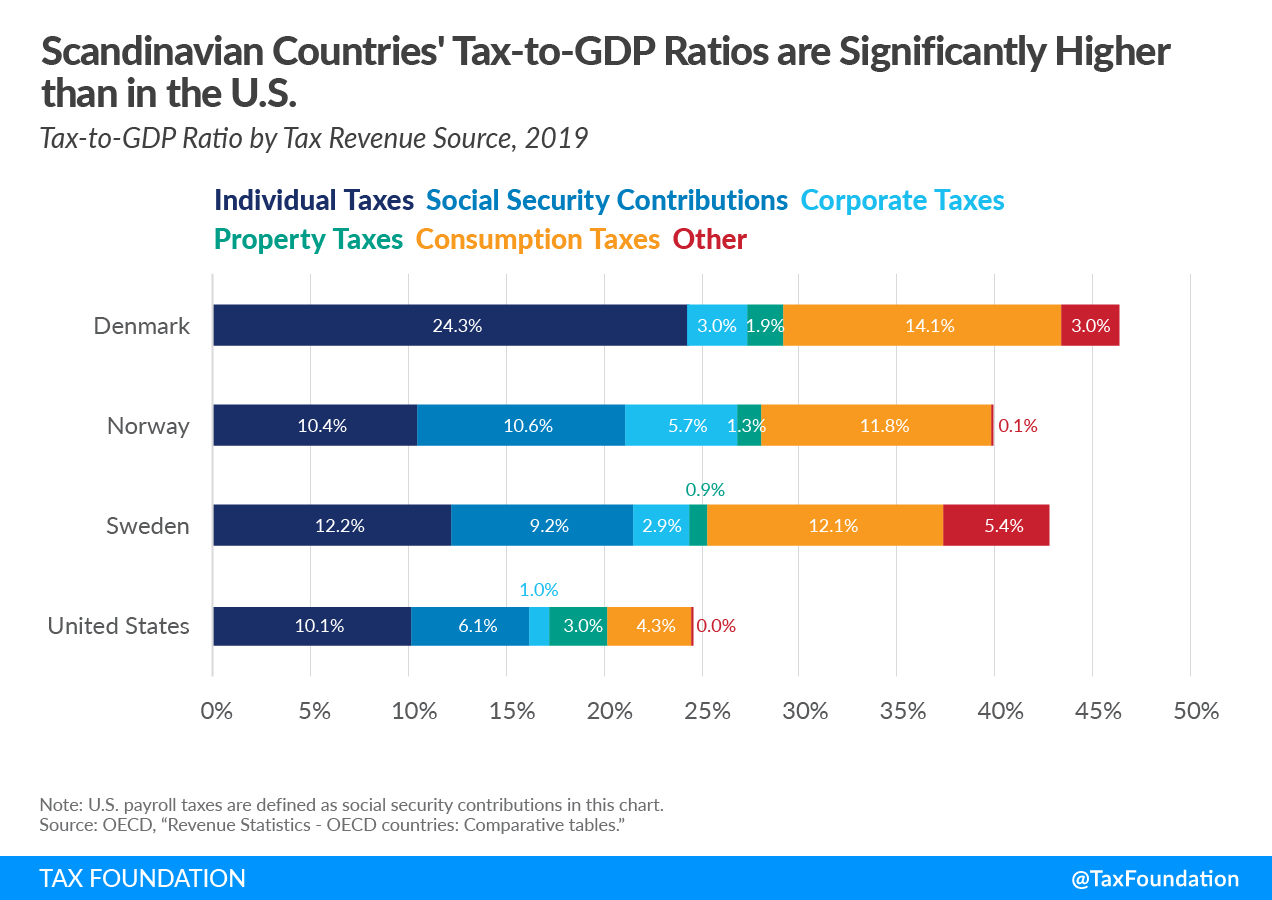
On that last point: Denmark, Sweden and Norway all have VAT rates of 25 percent, according to the Tax Foundation, with each collecting close to 10 percent of GDP through the levy. Yet Democrats have made a big deal about not raising taxes on households earning less than $400,000 a year. (There are some exceptions as Ip notes: “Smokers, for example, will pay a higher cigarette tax, and middle-class stockholders will indirectly bear some of the higher corporate tax rate.”)
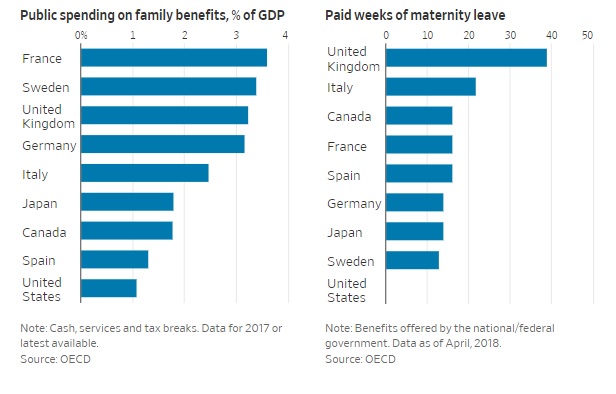
One could argue that there’s still plenty of room to fund more social spending through higher corporate taxes and higher top income-tax rates before talking about an economy-wide VAT. That, especially given higher income inequality in the US. But clearly creating Nordic America is going to require lots of additional revenue, whether through a VAT, carbon taxes, or a combination of both. Again the Tax Foundation: “In 2019, Denmark’s tax-to-GDP ratio was at 46.3 percent, Norway’s at 39.9 percent, and Sweden’s at 42.8 percent. This compares to a ratio of 24.5 percent in the United States.” And these WSJ charts highlight the current gap in social spending and spending commitments between the US and Europe:
It’s hard to avoid the reality — unless you’re a progressive politician, perhaps — of a fundamental mismatch between the left’s spending dreams and the economics of taxation. One caveat, which I point out in a recent The Week column:
Unless of course, Democrats adopt novel theories of macroeconomic policy that suggest significantly less need to pay for government spending. But there’s little evidence that anyone outside deeply left progressive politics or EconTwitter takes such ideas seriously. Certainly there’s no evidence that Federal Reserve Chairman Jerome Powell does, and he’s likely to be renominated for another term as boss of the central bank. If the far left really wants a transformational presidency — whether Biden’s or someone else’s — the lives of all Americans would need to fundamentally change.
Now, to the specifics of the current situation.
Manchin and Sinema have much of the rest of the Democratic Party pulling its hair out.
It's been somewhat amusing to read the columns and essays purporting to ascribe motives such as ego and political calculation to their reluctance to sign onto both an infrastructure bill that, for all its pork and statism, at least addresses actual infrastructure, as that term is commonly understood, and then, on the heels of the passage of that, a $3.5 trillion (hopefully you're not so numb that the magnitude of that figure didn't get your attention) reconciliation bill. According to these theories, they are merely getting a kick out of tweaking progressives' noses, or they are kowtowing to the red-statish inclinations of their constituents with no real convictions on the concerns they raise.
The good news for post-Americans who still prioritize the sovereignty of the individual is that those two Senators are going to make it, for all intents and purposes, impossible for the Democrats to impose this new degree of statist intrusion into our lives and get away with the fiscal peril it entails.
There's still a Herculean task before us, though. Way too many people in this country would be fine with a Nordic model, in which government would take a good half or more of everything someone busts his or her ass to earn, in return for a set of services and benefits in such areas as health care, education, and retirement that government would dispense at a level of quality and within a range of what it deemed suitable for you to choose from.
This is a major step on the way to reducing us to the status of cattle.
There's a reason why the telephone, the airplane, the television and the personal computer all originated in the United States of America. Our government honored ingenuity. It turned loose the basic human impulse to improve one's lot. The more government has moved away from that, the more saddled with debt we've become, and, more to the point, the less we think about the value of freedom.
Remember when, at the outset of his first four years, Barack Obama said that the "fundamental transformation of America" was underway? Remember the apprehension that those not on board with such an agenda felt, knowing where he was coming from in saying it - his having been mentored by Frank Marshall Davis and Rashid Khalidi, his intimate involvement in the network of Chicago radicals, including Heather Booth, Robert Creamer, Greg Galluzzo, Jeremiah Wright and Bill Ayers?
That was a mere warmup for what's underway now.
Just so far this week, these developments have occurred.
The Biden administration on Wednesday moved to unwind former President Donald Trump’s anti-abortion restrictions on federal family planning funds.
New rules proposed Wednesday would largely return the Title X program to its pre-Trump formation, allowing more abortion clinics to participate in a program that provides free or subsidized contraception and other health services to about 4 million low-income Americans each year.
The move stems from a pledge President Joe Biden made as a candidate, followed by an executive order he signed shortly after taking office directing HHS to review the Trump administration’s Title X rule. At the time, he pledged to “reverse my predecessor’s attack on women’s health access” and “undo the damage that Trump has done.”
The House Oversight and Reform Committee approved a bill on Wednesday that would make Washington, DC, the country's 51st state.
The Washington, DC Admissions Act or H.R. 51, introduced by DC Del. Eleanor Holmes Norton, is expected to pass a full House vote along party lines next week.
Those in favor of statehood argue that DC residents are being denied their most basic democratic right to representation in Congress. The city has one non-voting member of the House and two "shadow senators," who are unelected and can't vote.
A panel in the House of Representatives has passed legislation to create a federal commission to study the issue of reparations.
The historic move marks the first time that the House Judiciary Committee has acted on the decades-long effort.
Despite the historic success, just the creation of a committee to study reparations for the descendants of millions of enslaved Africans led to a lengthy debate in the U.S. House and passed by only 25-17, with all Republicans opposed.
The bill could be on the House floor for a vote by this summer.
Texas Rep.Sheila Jackson-Leespearheaded the bill, which would create a commission that would examine slavery and discrimination in America from 1619 to the present. It would decide how Americans are educated on the atrocity, consider a formal national apology and consider compensation to descendants. Currently, the legislation has its most co-sponsors ever in the House: 176.
Congressional Democrats introduced legislation Thursday to expand the US Supreme Court from nine to 13 justices, drawing angry protests from Republicans accusing their rivals of attempting a power grab to enact President Joe Biden's agenda.
The surprise move appears to be an effort by the party's progressive wing to pressure Biden on the explosive issue, less than one week after the president announced he was forming a commission to study reforming the nation's high court including the question of expanding its bench.
Several liberal Democrats have said such expansion is necessary after Donald Trump gave the bench a firm conservative majority by getting three of his picks onto the Supreme Court during his presidency, including one just eight days before the 2020 election.
"Our democracy is under assault, and the Supreme Court has dealt the sharpest blows," congressman Mondaire Jones said in a tweet announcing he and three other Democrats, including House Judiciary Committee chairman Jerrold Nadler, were introducing a bill to add four seats to the bench.
"To restore power to the people, we must #ExpandTheCourt."
Nancy Pelosi went on record saying she doesn't support the bill and has no plans to bring it to the floor for a vote, but do you doubt that that will hamper the relentlessness with which its sponsors will continue to push, seeking a path of least resistance, like floodwater?
The hard left senses its moment.
And what does resistance to this multi-pronged assault on a recognizable United States of America look like?
Outside of a handful of principled actual conservatives inside government (think Liz Cheney, Adam Kinzinger, Larry Hogan, Peter Meijer, Ben Sasse) and among the general populace, such resistance looks like a failed personality cult full of sycophants, cowards and nuts.