Showing posts with label John Bolton. Show all posts

Friday, September 25, 2020

John Bolton is vindicated

 When impeachment hearings were underway, John Bolton came in for a great deal of castigation for not testifying to the House. Some people I greatly respect and with whom my views align called him a coward and said he was motivated by greed.

I've always had immense admiration for John Bolton. His motivations throughout his career have always been noble. He has served this country well over many decades. 

And now the story of what happened earlier this year is seeing the light of day:

The Trump administration again looks terrible and former national security adviser John Bolton looks significantly better after the delivery of a remarkably informative letter from the senior official who reviewed Bolton’s recent book.

On behalf of Ellen Knight, the former senior director for records access and information security management at the National Security Council, attorney Kenneth Wainstein sent the 18-page letter to lawyers for Bolton and for the Justice Department, which has threatened Bolton with criminal prosecution for allegedly publishing classified information.

The letter makes clear Knight’s contention that no classified information remained in Bolton’s book, The Room Where It HappenedIts unambiguous subtext is that President Trump’s team again politicized and abused freedom of speech guarantees and national security in a naked bid to avoid embarrassment to the president.

In a passage that has received far less attention, Knight refutes the widespread public impression that Bolton’s greed for profits led him to withhold important information from the Ukraine-related impeachment investigation and the trial of Trump. Instead, Bolton repeatedly tried to get permission to release the information but was denied.

Already, too few people have credited Bolton for essentially begging the Senate to subpoena him so he could testify under oath without risking legal repercussions. Knight’s letter shows that Bolton also tried other means to provide the desired information for the public good.

“On one occasion when [Bolton’s lawyer] requested that Ms. Knight’s staff prioritize the Ukraine chapter in the manuscript for prepublication review to make it publicly available during the impeachment trial, the then-Deputy Legal Advisor [Michael] Ellis instructed her to temporarily withhold any response,” the letter stated.

In other words, Bolton was not trying to withhold the information for purposes of book profiteering but because he did not yet have notice that it was unclassified. He was convinced it was unclassified and wanted permission to discuss it. But without clearance and without a subpoena, he would have put himself in legal jeopardy by setting it before the public.

Considering that the politicized Justice Department is now threatening criminal prosecution for releasing the information six months later, Bolton was right. But he tried, in multiple ways, to provide the relevant material.

Knight, via lawyer Wainstein, also portrays Bolton as acting “in good faith” throughout the process, rather than acting without regard to national security secrets: “Ms. Knight always felt his intention was to cooperate with and complete the review.” 

While the letter largely portrays Bolton in favorable terms (other than being “gruff and demanding,” which is his well-established reputation), it makes the Trump administration look awful. Again and again, it worked to slow down the review process without any explanation or attempt to cooperate with Bolton or consult with Knight. Though Knight was a trained career official who had overseen 135 prior prepublication review requests, the White House assigned Ellis, a newly appointed official with no background in such reviews, to overrule the determinations she and her staff made in the course of many hundreds of hours of painstaking work.

I would hope that this restores Bolton's good standing as a conservative and a national-security asset. I'm not looking for any mea culpas, just acknowledgement of facts now in evidence.  


Saturday, June 20, 2020

Saturday roundup

For the first several years after identity politics had ruined the humanities in our universities, it was still possible to point to the sciences and say, "At least there's one area on campus in which the pursuit of objective truth is still sacrosanct."

Not anymore. Some major journals that focus on physics, chemistry and biology, as well as schools themselves are going in for "other ways of knowing":

A popular idea here is that different groups have different “ways of knowing,” different modes of sense-making, and even different epistemic paradigms. To insist on the exclusionary standard of “Western rationality” would therefore amount to suppressing black, Indigenous, or even female knowledges. And, since knowledge and power are said to form an indissociable nexus, the insistence on universal scientific standards is, by this logic, connected to the perpetuation of (male) white supremacy.
The way to remedy this injustice, some therefore argue, is to explicitly politicize science so as to reveal it as a culturally biased enterprise. In Canada, where I live, this political project is often referred to as the “decolonization of the university,” and operates under the institutional umbrella of EDI (Equity, Diversity, and Inclusion). Though it sometimes couches itself in utilitarian or incremental terms (a demand for, say, better, more effective teaching methods that serve to develop the potential of all groups), the most far-reaching EDI initiatives effectively subordinate science to political activism and even mystical obscurantism.
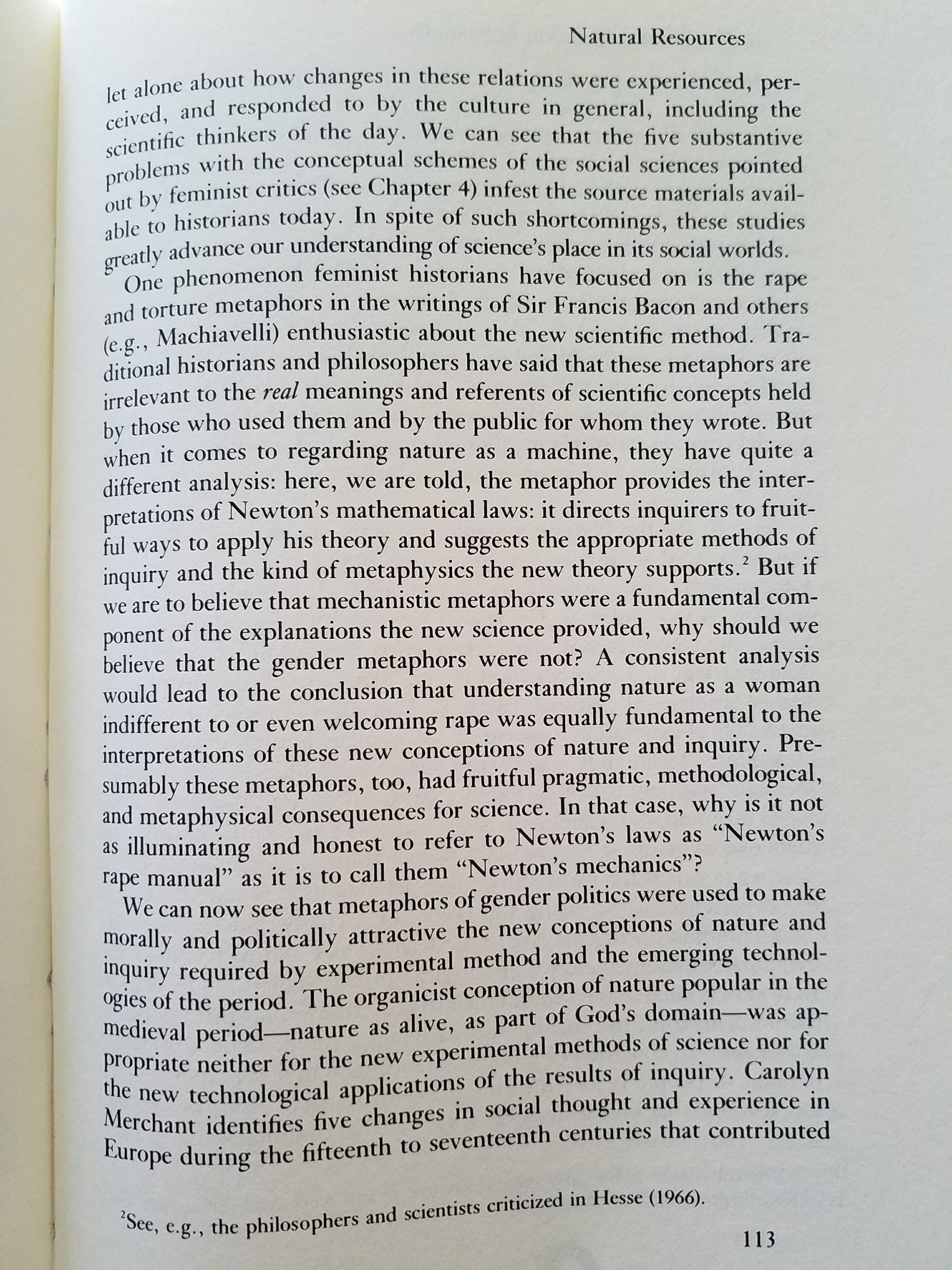
In its most elaborate form, EDI subjects science to the same treatment as has already been meted out to the Western literary canon: a relentless deconstructionwhereby each axiom, value, and commitment is presented as infected by cultural imperialism. This method of criticism has led, for example, to such oddities as feminist philosopher of science Sandra Harding’s suggestion that Newton’s laws might be accurately referred to as “Newton’s rape manual.” These critiques were once confined to social commentary that was distinct from the actual work of scientists. As I’ve learned first-hand, that may be changing.
Andrew T. Walker has a piece at Christianity Today entitled "Bostock Is As Bad As You Think." He says that to think that the Religious Freedom Restoration Act will protect faith-based institutions from the encroachment of tyranny is dangerous wishful thinking:

On Thursday, Senate Democrats attempted a voice vote to pass the Equality Actlegislation profoundly hostile to religious liberty. To do this by “unanimous consent” only signals that Democrats, with the wind at their backs, have little desire to defend religious freedom and are advancing a take-no-prisoners approach in their culture war victory.
In a move that demonstrates just how cowed Republicans are in wanting to spend any political capital on defending religious liberty, only three Republican Senators rose to challenge it: Senators Josh Hawley, Jim Lankford, and Mike Lee. Were it not for these three Senators, the Equality Act would surely become law. Even still, given Monday’s ruling, it seems that the spirit of the Equality Act has indeed become law, and all that awaits are its future entailments elsewhere in federal law.
A lesser-known feature of the Equality Act undermines the argument that RFRA will sufficiently protect religious dissenters. To understand why the Religious Freedom Restoration Act is not the permanent salve some declare it to be, consider that a provision of the Equality Act aims at specifically undoing RFRA of its provisions where they come in conflict with sexual orientation and gender identity. The firewall heralded as the last preserve of religious liberty is already on the chopping block.
Toxic legislation with little resistance is not a good sign for religious liberty’s future. And yet, here we are.
The Left's desire to stomp God-based living into oblivion has been made quite explicit:

In 2016, Harvard Law professor Mark Tushnet infamously compared those with traditional views about sex and gender to racists and Nazis. He was more than honest about what victors in the culture war ought to do: Give them no quarter. Writes Tushnet,
For liberals, the question now is how to deal with the losers in the culture wars. That’s mostly a question of tactics. My own judgment is that taking a hard line (“You lost, live with it”) is better than trying to accommodate the losers, who – remember – defended, and are defending, positions that liberals regard as having no normative pull at all. Trying to be nice to the losers didn’t work well after the Civil War, nor after Brown. (And taking a hard line seemed to work reasonably well in Germany and Japan after 1945.) I should note that LGBT activists in particular seem to have settled on the hard-line approach, while some liberal academics defend more accommodating approaches. When specific battles in the culture wars were being fought, it might have made sense to try to be accommodating after a local victory, because other related fights were going on, and a hard line might have stiffened the opposition in those fights. But the war’s over, and we won.
“No normative pull at all.” What does that mean? It means the Judeo-Christian understanding of sexuality and gender are not remotely persuasive or deserving of protection. It means to leave no room for it to flower or grow, especially if it is a hindrance to social justice. This hypothesis is what a lot of us have been saying for some time: Nothing within the internal logic of progressivism explains why there should be robust protections for those holding beliefs deemed harmful to society.

Are we really to believe that cultural elites so brazenly contemptuous of historic Christian belief will have the magnanimity to leave cultural and public space for those who they liken to racists to continue in their bigotry? We can hope, but I am not optimistic.
The unredacted version of Bolton's book makes clear just how unfit to be president Donald Trump is:

Vanity Fair has seen unredacted pages from the book and it’s clear why the White House tried to keep Trump’s words secret: they are deeply embarrassing and illustrate Trump’s naked politicization of America’s foreign policy.
According to an unredacted passage shown to Vanity Fair by a source, Trump’s ask is even more crudely shocking when you read Trump’s specific language. “Make sure I win,” Trump allegedly told Xi during a dinner at the G20 conference in Osaka, Japan last summer. “I will probably win anyway, so don’t hurt my farms.… Buy a lot of soybeans and wheat and make sure we win.”
The Very Stable Genius is solely driven by self-glorification:

Bolton writes that Trump told Xi on a phone call ahead of their G20 meeting: “I miss you,” and then said, “this is totally up to you, but the most popular thing I’ve ever been involved with is making a deal with China.… Making a deal with China would be a very popular thing for me.’”
The you-don't-have-to-dismantle-our-departments-we're-bailing trend in the law enforcement field is present in DC:

Nearly three-fourths of Washington's Metropolitan Police Department said in a poll that they are considering leaving the force amid a police reform bill recently passed by the D.C. Council
The proposal would require law enforcement body camera footage to be released to the public more quickly following a police-related shooting and would restrict when officers can use lethal force. It also would prohibit the department from purchasing military-style equipment from the federal government. 
Local lawmakers stopped an attempt by one council member at large who proposed to limit the size of the force and cap it at 3,500 from its current size of 3,863. However, several hundred on the force revealed to the D.C. Police Union, which represents 3,600 Washington officers, detectives, and sergeants, that they are looking to leave anyway. 
According to the survey of 600 local law enforcement members, of the 71% considering leaving, 25% may retire earlier than planned, 35% are seeking jobs at other law enforcement agencies, and 39% are considering leaving law enforcement altogether.
For the first time in more than eight years, Iran is obstructing inspections of its nuclear facilities.  


Wednesday, June 17, 2020

Bolton

For someone who has always been a what-you-see-is-what-you-get kind of guy, controversy seems to follow John Bolton. His 2005 nomination to be US ambassador to the UN drew opposition not only from Democrats but Republican Senators George Voinovich and Richard Lugar. Bush wound up having to make a recess appointment. And then there was the recent stint as national security advisor to Trump. It seemed to start our well enough. Trump praised Bolton and during that period when there was so much shuffling of personnel in the foreign policy area of the administration, said that he wanted to find a place for Bolton in it.

But things went south and reached a nadir with the Ukraine affair. Bolton likened it to a drug deal and summoned his team to his office to express his displeasure at what was going down.

Of course, the Ukraine situation led to Trump's impeachment. There was much hue and cry within the conservative-but-opposed-to-Trump camp - "never Trumpers," if you will (disclosure: that would be my bunch) - that he didn't testify before the House. He did state that he was willing to testify before the Senate, but that body never called any witnesses. The accusation was that he'd refrained from testifying to maximize sales of his upcoming book. Just today, I saw a tweet from a writer I otherwise pretty much agree on everything with that called Bolton a mercenary and a coward.

I think that kind of swift dismissal of a long-time public servant is symptomatic of the current tendency to write people off on the basis of recent moves that may still be explained satisfactorily, to render people one-dimensional figures whose score cards don't pass muster. Such a view doesn't take in the full measure of the person.

I'm more inclined to see Bolton as John Podhoretz does in a September 2019 Commentary piece entitled "Bolton's Integrity":

John Bolton has never trimmed his sails in pursuit of power or authority. He is who he is and always has been. He believes in the efficacy of American power and the need to project it to make America safer and improve its position in the world.
 He was steeped in conservatism from an early age. He ran his high school's Students for Goldwater campaign in 1964. He was law-school friends with Clarence Thomas. The reason for the dustup surrounding the Bush appointment was that Bolton clearly had his head on straight concerning what the United Nations was really all about.

Well, now the book is printed and bound. Copies are stacked in warehouses, awaiting a June 23 release.  Given that it was written so shortly after Bolton's tenure, and that the administration it discusses is still in office, it had to undergo a prepublication review. Bolton's lawyer, Charles Cooper, explains how exhaustive that was in a Wall Street Journal column:

Round one began on Jan. 23, as the impeachment trial was under way. Ms. Knight wrote to me that Mr. Bolton’s manuscript contained “significant amounts of classified information” and that she would provide “detailed guidance regarding next steps that should enable you to revise the manuscript and move forward as expeditiously as possible.”
A few days later Vanity Fair reported that “the president is out for revenge against his adversaries.” The article stated that the president “has an enemies list,” that “Bolton is at the top of the list,” and that the “campaign against Bolton” included Ms. Knight’s Jan. 23 letter. It also reported that the president “wants Bolton to be criminally investigated.”

On Feb. 7, two days after Mr. Trump’s acquittal, Ms. Knight suggested that “to further the iterative process, it would be most efficient for me to meet with [Mr. Bolton] to review each instance of classified information in detail.” Meantime, the White House had acknowledged that NSC staff briefed White House counsel Pat Cipollone about the book while Mr. Cipollone was leading the impeachment defense.

Mr. Bolton and Ms. Knight met on Feb. 21. That same day the Washington Post reported that Mr. Trump had “directly weighed in” on the prepublication review, “telling his staff that he views John Bolton as ‘a traitor,’ that everything he uttered to the departed aide about national security is classified and that he will seek to block the book’s publication.” The Post also reported that Mr. Trump vowed to a group of television news anchors: “We’re going to try and block publication of the book.” The president added, “After I leave office, he can do this.”

Mr. Bolton’s meeting with Ms. Knight lasted four hours. She later wrote that they “reviewed the preliminary results of three chapters in the draft manuscript in detail.” Mr. Bolton took five pages of handwritten notes as they discussed her specific concerns. Three days later, Ms. Knight wrote that the meeting had been “most productive,” and that “it would be most helpful to the process if we hold one or more following meetings . . . to discuss the remaining portions of the draft manuscript.” 

They met three more times in the first week of March for more than 10 additional hours. They meticulously reviewed each of Ms. Knight’s concerns in the remaining 11 chapters, producing 34 more pages of handwritten notes. Following her guidance and his own notes, Mr. Bolton revised his manuscript. By March 9 he had resubmitted all 14 chapters to begin the second round of the iterative review.

Mr. Bolton didn’t hear from Ms. Knight again until Friday, March 27, when she wrote, “I appreciate your efforts to address the classification concerns in the latest draft version you submitted. Many of the changes are satisfactory. However, additional edits are required to ensure the protection of national security information. To assist in making the additional required changes, I will provide a list of required edits and language substitutions to guide you in this next stage of revising the draft.” 

Her list amounted to 17 single-spaced pages of typed comments, questions, suggestions of specific alternative language, and citations to publicly available source material. Mr. Bolton worked through the weekend and responded in full on March 30, accepting the vast majority of Ms. Knight’s suggestions and proposing alternative solutions to others.

The third round of the review occurred in an April 13 phone conversation when Ms. Knight provided a much shorter list of remaining concerns after reviewing Mr. Bolton’s March 30 revisions. They agreed on these language changes, which were delivered to Ms. Knight on April 14.

During the April 13 call, Ms. Knight said she would review the full manuscript one more time, to recheck resolved issues and ensure she hadn’t overlooked anything. That final review resulted in two further phone calls, on April 21 and 24, in which she conveyed her final round of edits. Mr. Bolton promptly responded with the revisions by April 24. On April 27, after clarifying one previously discussed edit, Ms. Knight confirmed “that’s the last edit I really have to provide for you.” The lengthy, laborious process was over.
Yet when Mr. Bolton asked when he would receive the letter confirming the book was cleared, Ms. Knight cryptically replied that her “interaction” with unnamed others in the White House about the book had “been very delicate” and that there were “some internal process considerations to work through.” She thought the letter might be ready that afternoon but would “know more by the end of the day.” Six weeks later, Mr. Bolton has yet to receive a clearance letter. He hasn’t heard from Ms. Knight since May 7.
We did hear from the White House on June 8. John A. Eisenberg, the president’s deputy counsel for national security, asserted in a letter that Mr. Bolton’s manuscript contains classified information and that publishing the book would violate his nondisclosure agreements. 
Feeling that all the "i's had been dotted and "t"s crossed, Simon & Schuster let the presses roll.

The Very Stable Genius and his attorney general William Barr - who also had distinguished himself earlier in his career but is now indeed looking like he's had a big gulp of the sycophancy Kool-Aid - are fit to be tied:

Mr. Trump said he considers any conversation he has with another official “highly classified.” Presidents have claimed the authority to classify national security information and direct subordinates to do the same, but no president has claimed the total authority to prevent former employees from speaking about non-national security matters—and typically the First Amendment would protect such speech, experts say.
“Maybe he’s not telling the truth,” Mr. Trump said of his former national security adviser. “He’s been known not to tell the truth a lot.” He didn’t detail what he was referring to.
Attorney General William Barr, speaking alongside the president on Monday, said Mr. Bolton “hasn’t completed the process” of clearing the book. He didn’t respond to questions about why Mr. Bolton’s lawyer said the NSC had told him the process had been completed.
Mr. Bolton’s lawyer and a spokeswoman didn’t immediately respond to a request for comment.
At this late date and with no real grounds for stopping it, I'd say that the book will be in stores next week.

It will be interesting to see how Trump responds once the ship has sailed. His Twitter feed will be lively, no doubt.

His nervousness about book releases is surely compounded by the upcoming publication of a book by his niece, which is not going to be flattering.  


Monday, January 27, 2020

John Bolton

In Trump-era fashion, he now becomes the latest figure about which we must have a hot take.

As I said the other day, I think it would be enlightening for our nation to have him on the stand in the Senate. I think so even more now that some content from his book manuscript is becoming public knowledge due to leaks by somebody or other.

And now, to Twitter Trumpists, he's a RINO and a traitor. Federalist editor Sean Davis says that Bolton was "fired . . for trying to start new wars."  Jim Hoft, Dan Bongino and Jack Posobiec have had a busy morning.

The Pavlovian instantaneousness with which this bunch has staked out its position is unsurprising. They're keen to shepherd impeachment through to a Senate acquittal with as few complications as possible. The common theme to pretty much all of today's attempts to dismiss Bolton's impact is a president's prerogative in hiring and firing diplomatic, military and intelligence-gathering personnel as needed to support his policy vision. The problem is that, at least in the case of Ukraine, this business of policy vision is exactly what's being looked at. There's some pretty strong evidence out there that Donald Trump didn't much care about that particular nation, beyond its usefulness in gaining political advantage.

The Trumpist take is specious at best. If anybody has exhibited consistency over the years and shown that his career's been driven by a core set of principles, it's Bolton. John Podhoretz stated it well in a Commentary piece from last September:

John Bolton has never trimmed his sails in pursuit of power or authority. He is who he is and always has been. He believes in the efficacy of American power and the need to project it to make America safer and improve its position in the world. And he believes that we should confront antagonists rather than seek to find common ground with them.
He was this person the day before Donald Trump appointed him national security adviser, and he remained that person throughout his tenure. He argued internally for exactly the policies and ideas he had advocated before he was installed in the West Wing.
Love his views or hate his views, isn’t this what we want from our public servants—what might be called “intellectual transparency?” Those who disagree with Bolton’s worldview are right to celebrate his departure, but they only know they are right because Bolton is not a prevaricator or a careerist. I have had my differences with him in the past. In 2007, he spoke at a COMMENTARY dinner at which he went through the possibilities of salutary American military action in the Middle East without bothering to confront the argument that the mess in Iraq pretty much precluded any further action along the lines he was laying out.
That said, consider the difference between Bolton’s White House tenure and that of, say, Samantha Power—a person who rose to prominence arguing heatedly and with the zeal of an Old Testament prophet that failure to stop genocides was the moral stain of our age and who then sat there like a tower of Jell-O in the Obama White House as a genocide went on in Syria.
From what we can tell, Bolton never stopped pushing his positions on American strength and not coddling our enemies, on the reasonable assumption that this was what he was there for. Or perhaps because, as a man of integrity, he could do no other. At a time when people are twisting themselves into ideological pretzels to keep their jobs and stay in good with the boss, John Bolton kept his honor and his integrity. And in the end, what else does a public intellectual have but those?
The guy ran his high school's Students for Goldwater group in 1964.

At Yale Law School, his fealty to conservative principles was palpable according to a classmate:

 In his memoir, Justice Clarence Thomas credits Bolton with pushing him to question his liberal beliefs. "John was known as a conservative while I still thought of myself as being far left of center (when I wasn't just being cynical)," Thomas writes. He explains how Bolton challenged him. During one argument, Bolton said, "Clarence, as a member of a group that has been treated shabbily by the majority in this country, why would you want to give the government more power over your personal life?" Though it didn't instantly make Thomas a conservative, the justice writes, "John's question reverberated in my mind for a long time to come."

After some law-firm work, he joined the Reagan administration and over the next several years served in the departments of State and Justice, as well as at USAID. His foreign policy approach became well known. He understood the folly of appeasing rogue regimes like those in North Korea and Iran. He viewed the United Nations as basically worthless, which didn't help him at his acrimonious Senate confirmation hearings when President George W. Bush nominated him to be UN ambassador. Bush felt strongly enough about sending Bolton to the UN that he made a recess appointment when the Senate failed to confirm him.

Trump was keen on finding a place for Bolton in his administration, too. When he did, Bolton went right to work, reshaping the National Security Council, requesting the Pentagon to fashion a plan for striking Iran. He quite vocally castigated the International Criminal Court.

His alarm at what was happening regarding Ukraine - Guliani's shadow policy team, the Trump-Zelensky phone call - was of a piece with his positions through the years. In John Bolton's worldview, you strengthen alliances and thwart adversaries' designs.

The idea that he's just out to peddle his new book doesn't wash. He sincerely feels strongly about this. That said, he probably would tread very carefully under oath, not wanting to be the agent for bringing about the end of the administration that had zapped Suleimani.

An honest examination of his life, career and positions doesn't leave room for either of the characterizations that Trump-world is peddling: that he gets a gratuitous kick out of war, or that he's just another opportunistic Beltway bureaucrat hustling his own brand. He's a person who has thought hard and deeply about what would really keep America secure, and what would most effectively support the flourishing of freedom in the world.

Getting all worked up about the prospect of Bolton testifying at the Senate trial indicates a desire to gloss over what is plain even before we hear from Bolton: that Trump used his office in impeachable ways.

Harping on this the-president-has-the-right-to-hire-and-fire-executive-branch-personnel argument is a tacit acknowledgement that so many administration figures have left because they knew Trump's course, such as it is, was reckless. That's the essence of the matter that Trumpists don't want anyone contemplating for very long.


Monday, December 23, 2019

Unprecedentedly bracing candor from John Bolton

Since he resigned as national security advisor, the speculation about when John Bolton would let loose with his real views on national security and world affairs has been ratcheted up considerably. We now have the first taste of that with an interview he did with Axios. I think that with North Korea's talk about a "Christmas present," he feels the pressure of time to speak up.

In his sharpest criticism yet of his old workplace, John Bolton suggested the Trump administration is bluffing about stopping North Korea's nuclear ambitions — and soon might need to admit publicly that its policy failed badly. 
Driving the news: Bolton told me in an interview that he does not think the administration "really means it" when President Trump and top officials vow to stop North Korea from having deliverable nuclear weapons — "or it would be pursuing a different course."
Why now? The president's former national security adviser, who served until September, is speaking out ahead of an end-of-year timetable. If Kim Jong-un follows through on his threatened Christmas provocation, Bolton says the White House should do something "that would be very unusual" for this administration: admit they got it wrong on North Korea.
  • "The idea that we are somehow exerting maximum pressure on North Korea is just unfortunately not true," Bolton said.
  • For example, he said, the U.S. Navy could start intercepting oil that is illegally being transferred to North Korea at sea. 
  • As Bolton sees it, the administration now has more of a "rhetorical policy" that it's unacceptable for North Korea to have nuclear weapons that could hit America or its allies.
  • If Kim thumbs his nose at the U.S., Bolton said, he hopes the administration will say: "We've tried. The policy's failed. We're going to go back now and make it clear that in a variety of steps, together with our allies, when we say it's unacceptable, we're going to demonstrate we will not accept it."
  • Bolton described his concerns about Trump's North Korea strategy in an interview with Axios late last week. He went significantly further than any of his previous remarks since leaving the administration.
Why it matters: Kim is back on his white horse, and the North Korean nuclear threat may be greater than ever, analysts say.
  • North Korea has intimated it will test some kind of advanced weapons in the coming weeks — weapons it's developed as Trump has tried to woo Kim.
  • Trump's top envoy to North Korea, Deputy Secretary of State Stephen Biegun, said recently that if North Korea follows through on that threat, it would be "most unhelpful in achieving a lasting peace on the Korean Peninsula."
  • Bolton called Biegun's statement "a late entry but a clear winner in the Understatement of the Year Award contest."
Bolton, who has advocated for a more aggressive North Korea strategy, also criticized Trump for sayingearlier this year that Kim's short-range missile tests don't bother him.
  • "When the president says, 'Well, I'm not worried about short-range missiles,' he's saying, 'I'm not worried about the potential risk to American troops deployed in the region or our treaty allies, South Korea and Japan.'"
The big picture: The imminent threats from North Korea seem a world away from June 2018, when Trump returned from his Singapore summit with Kim to boast, "There is no longer a nuclear threat from North Korea."
  • In reality, Kim has expanded his nuclear arsenal since then, analysts say.
  • Using data from analysts and governments around the world, Japan's Nagasaki University estimatedin June that Kim now has as many as 30 nuclear warheads. That's on the lower end of estimates, and it's up from as many as 20 warheads in the same study last year.
  • "Even though they're not testing right now, they're operating at full tempo," said Victor Cha, the National Security Council director for Asia under President George W. Bush and Korea chair at the Center for Strategic and International Studies.
  • The Trump administration declined to comment.
As the House portion of the impeachment proceedings were underway, there was a lot of clamor on Twitter - from my bunch, conservatives who find Trump objectionable in the extreme, those who frequently get labeled "Never Trumpers - for Bolton to testify. The elephant in the room concerning that was that he had to be subpeonaed, and that didn't happen. I guess he could have stepped forward and said, "I sure would like to come before one of these House committees; I have a lot of important information to share," but I'm guessing his attorney was involved in deciding against that course of action.

Some felt his integrity hinged on it. His track record is that of a man of impeccable integrity. I was confident that he'd be speaking up when he felt the moment was right. He'd already spoken at that Gatestone Institute luncheon a couple of days after leaving the White House. I knew more would be forthcoming soon.

And, as important as nailing down the particulars of Ukraine policy in the Trump era - to what degree, if any, was Trump motivated by trying to hobble Biden politically for the 2020 race? - this issue - North Korea - is the one that is pressing from the standpoint of trying to head off potential calamity in the short term.

Thank you, Ambassador Bolton.

Friday, November 15, 2019

Um, yes there was quid pro quo

The skinny on Ukraine's response to the VSG's signals about what he wanted to see happen:

One of the central Republican talking points in the Ukraine scandal has been that the Ukrainian aid package was ultimately released without President Trump getting his requested announcement from President Zelensky that Ukraine was opening an investigation into Hunter Biden and Burisma. If Ukraine got its aid without submitting to Trump’s demand, the president’s defenders argue, then how could there have been a quid pro quo? The answer was not always readily apparent, but, as more information comes out, the inner workings of the secret deal are becoming known.
For example, at first, it appeared that the quid pro quo for aid might relate solely to the July 25 phone call between the two presidents. After testimony from numerous Trump-appointed State Department officials, however, it now seems that trading aid for political favors had been official Trump Administration policy for weeks, if not months.
Likewise, light is also being shed on the Ukrainian side of the deal. The New York Times reported last week that, after the Ukrainians initially protested to Bill Taylor that they “did not want to be used as a pawn in a U.S. re-election campaign,” they bowed to pressure and became willing to make the announcement to get the US aid they needed to fight Russia-backed rebel forces. Accepting Trump’s demand to make an announcement would have risked jeopardizing future aid by politicizing the Ukrainian war, but the Zelensky government felt that it had no choice.
“I said that resumption of the U.S. aid would likely not occur until Ukraine provided the public anticorruption statement that we had been discussing for many weeks,” Ambassador Gordon Sondland testified to Congress.
Per the Times report, President Trump wanted Zelensky to make the announcement on CNN, but, aware that Trump considered CNN to be “fake news,” the Ukrainians were concerned that an appearance on the network work would further alienate Trump. But Trump had also tweeted in August that Fox News “isn’t working for us anymore.” The Ukrainians finally scheduled an interview with CNN’s Fareed Zakaria on Sept. 13 in which the announcement would have been made.
As Bill Taylor testified last week, “Ambassador Sondland said that this conversation concluded with President Zelensky agreeing to make a public statement in an interview on CNN.”
Zakaria confirmed that an interview agreement was close, saying, “Things picked up around August and September, I went to Kiev to meet with him. It seemed it was confirmed. And then it fell apart.”
But why did the Zelensky interview never happen? On Sept. 9, the inspector general of the intelligence community notified Democrats and Republicans of the House intelligence committee that he had received the whistleblower complaint and found the information credible. The Trump Administration released the aid package two days later on Sept. 11.
Even at that point, it isn’t clear that President Trump authorized release of the aid. Bloomberg reported last week that, because September was the last month of the federal fiscal year, the aid money had to be spent by Sept. 30 or else it would have to be reappropriated by Congress. To spend the money by the end of the month, it had to start moving around the middle of the month because of a two-week notification requirement for Congress.
National Security Advisor John Bolton, an outspoken critic of Trump’s extortion plan, stepped up in early September and authorized the State Department to spend the money. The move reportedly took the White House by surprise. A week later, Bolton resigned.
In the end, the Republican claim of “no harm, no foul” falls apart unless you think that incompetence is an adequate defense for abuse of power. President Trump clearly intended to a quid pro quo that would have benefited his reelection campaign by smearing Joe Biden, the likely Democratic nominee. That the scheme fell apart before it came to fruition is not a credit to the president’s ethics and morality. Rather, the Republican argument that an unsuccessful crime is not a crime at all is reminiscent of Sideshow Bob’s claim that he was imprisoned for a crime that he did not commit.
More 5-D foreign policy chess from the VSG: put an ally in the most extremely uncomfortable position possible, all because you want some dirt on a political rival.

Tuesday, November 12, 2019

It's not been a good day in Trumpland

There's the undeniable damage of this:

damning email dump from former Breitbart editor Katie McHugh points to Miller simply being a racist who hates immigrants. 
For years, Miller shared stories from white nationalist news sources. McHugh, who has since disavowed her alt-right sympathies, alleges that Miller cited with familiarity work from American Renaissance, the pseudoscientific white supremacist website run by racial segregationist Jared Taylor. Miller also reportedly shared a story from VDARE, yet another white nationalist site that published the likes of Taylor and Steven Sailer, as well as Infowars, the conspiracy-mongering website run by 9/11 and Sandy Hook truther Alex Jones. 
This information has been laundered through the Southern Poverty Law Center, so you can't take it seriously beyond the source material itself. For example, Miller's embrace of a bad immigration policy from the Coolidge era probably doesn't stem from the fact that Adolf Hitler liked the same policy, as the SPLC tries to put it. But the SPLC's contribution here is almost irrelevant, unless the emails are fabricated. The fact is that a Senate staffer who worked his way into the upper echelons of the White House was egging on McHugh to bring unabashedly racist online narratives about immigration into a more mainstream publication. 
Interns have been fired for less than this. We can't say with certainty what hate is or isn't in Miller's heart, but we know that he was happy enough to use the work of hatemongers and kill the GOP's last shot at immigration reform, apparently because it would help predominantly Mexican immigrants. It's long past time for Trump to dump Miller.
As Tiana Lowe of the Washington Examiner says in the excerpt above, the dump has SPLC's fingerprints on it, and that outfit long ago squandered its credibility as a watchdog with integrity, but there is the source material.

And John Bolton is inching ever closer to a definite break with Trumpist world-affairs perspectives:

Former national security adviser John Bolton derided President Donald Trump’s daughter and son-in-law during a private speech last week and suggested his former boss’ approach to U.S. policy on Turkey is motivated by personal or financial interests, several people who were present for the remarks told NBC News.
According to six people who were there, Bolton also questioned the merits of Trump applying his business acumen to foreign policy, saying such issues can’t be approached like the win-or-lose edict that drives real estate deals: When one deal doesn’t work, you move on to the next.
The description was part of a broader portrait Bolton outlined of a president who lacks an understanding of the interconnected nature of relationships in foreign policy and the need for consistency, these people said.
Condoleeza Rice is no longer in government, but she is considered pretty much of an elder states person in both foreign-policy circles and the Republican Party, someone not given to hot takes and reflexive conclusions. She has weighed in on the Ukraine mess:

Former secretary of state Condoleezza Rice said Monday that reports detailing the involvement of President Trump’s personal lawyer Rudy Giuliani in the White House’s Ukraine policy were “deeply troubling.”
“What I see right now troubles me. I see a state of conflict between the foreign policy professionals and someone who says he’s acting on behalf of the president but frankly I don’t know if that is the case,” Rice said at a conference in Abu Dhabi. “This is just not a good thing. The world shouldn’t get confusing messages from the United States of America.”
Multiple witnesses have alleged in house testimony that Giuliani conducted his own investigative work without regard for the administration’s formal policy.
William Taylor, the former top American diplomat in Ukraine, whose testimony was released last week, asserted that Giuliani was actively undermining U.S. foreign policy.
“The irregular channel seemed to focus on specific issues, specific cases, rather than the regular channel’s focus on institution building,” Taylor said, according to the transcript. “So the irregular channel, I think under the influence of Mr. Giuliani, wanted to focus on one or two specific cases, irrespective of whether it helped solve the corruption problem, fight the corruption problem.”
Earlier Monday, news broke that Lev Parnas, an associate of Giuliani, will tell investigators that Giuliani attempted to leverage an official visit from Vice President Mike Pence to coax Ukraine into announcing an investigation into Joe Biden’s son Hunter’s business connections to Burisma.
Rice also said she thought Trump’s mention of former vice president Joe Biden and his son Hunter, who served on the board of Ukrainian gas company Burisma, during the call was “out of bounds.”
“The call is murky, it is really murky. I don’t like for the president of the United States to mention an American citizen for investigation to a foreign leader,” Rice said.
These items in their sum total just reinforce problems that were inherent in a Trump presidency from the time Trump made his bid for the job.

Without a core set of principles, you can't smell the hot-dog-ism that has followed a guy like Miller since Miller's college days. You also have no basis for seeing the conduct of foreign policy as anything beyond "cutting deals" and striking while the personal-loyalty iron is hot, rather than basing decisions on historic alliances and strategic interests.

None of this will give Trump pause. In fact, I'd bet that he has a barrage of defensive tweets lined up for release before the day is over.


Tuesday, October 15, 2019

John Bolton knew it didn't smell good at all

It's no wonder he was given his walking papers by the Very Stable Genius. He understood fully what was happening and tried to counter it:

Former national security adviser John Bolton was so disturbed by the efforts to get the Ukrainians to investigate President Donald Trump’s political opponents that he called it a “drug deal,” former White House official Fiona Hill reportedly told Congress on Monday.
Hill, the former top Europe expert in Trump’s White House, testified that Bolton told her he wanted no part of the effort that involved acting White House chief of staff Mick Mulvaney, a person in the room for Hill’s testimony told NBC News. Bolton also was said to have referred to Rudy Giuliani as a "hand grenade."
Giuliani has acknowledged in recent interviews that he had asked a Ukrainian prosecutor for information about former Vice President Joe Biden.
The New York Times first reported details of Hill's testimony Monday night.
Trump fired Bolton in September.
Hill testified that Bolton told her to report the situation to the top lawyer at the National Security Council, John Eisenberg, according to the person in the room for Hill’s testimony during the closed-door hearing.
Hill told lawmakers she considered what was happening to be a clear counterintelligence risk to the United States, the person said.
Giuliani said that he was disappointed to learn about Bolton's reported comments.
"I always liked and respected John," the president's personal attorney said after hearing about the testimony. "I’m very disappointed that his bitterness drives him to attack a friend falsely and in a very personal way. It’s really ironic that John Bolton is calling anyone else a hand grenade. When John is described by many as an atomic bomb."
Rudy, before riding too far on your high horse, you might want to consider the value of some circumspection in this situation. Federal prosecutors are looking into your Ukraine dealings.  

Tuesday, September 24, 2019

Some noteworthy new information in the Ukraine situation

I still hold to the view that, given that there are two aspects to the overall situation - how Joe Biden behaved toward Ukraine as Vice President and how Trump has been behaving toward Ukraine more recently, and given that hot takes meant to defend the turf of each party's tribalists based on incomplete information come pouring in with each revelation or seeming revelation, firm conclusions are still out of our grasp.

But Trump telling Mulvaney to hold up on the aid, and telling Zelensky to work with his personal attorney don't smell good at all. And someone of the foremost integrity, John Bolton, felt like this was no way to proceed:

Former White House national security adviser John Bolton reportedly pushed President Trump to release military aid to Ukraine that the administration withheld until earlier this month.
At least a week before Trump is said to have pressured Ukrainian President Volodymyr Zelensky in a July 25 phone call to work with his personal attorney Rudy Giuliani to investigate Joe Biden's son, Hunter, who did business in Ukraine while his father was vice president, the president ordered his acting chief of staff Mick Mulvaney to place a hold the $400 million in funds, according to the Washington Post.
Trump says he was concerned about "corruption" in Ukraine and a senior administration official denied there was any "quid pro quo" to withhold the money unless Ukraine agreed to investigate Trump's potential rival in the 2020 election.
But other officials in Trump's administration were alarmed, partly because they were worried the block might be illegal. Bolton advocated for the release of the money to help Ukraine counter Russian-backed separatists in the eastern part of the country and a meeting between Trump and Zelensky.
Bolton is said to be shopping around for a book deal. Now, there's one that instantly goes on my to-read list.

Tuesday, September 10, 2019

Bolton's departure

Surprising in some ways, not in others. It actually looked like a doomed arrangement from the start. Bolton has a set of core principles that drive his policy positions, and his boss - well, we know that he's driven by his craving for self-glorification.

But the fronts on which the rift widened had been increasing for a while:

Back in May, with tensions rising between the U.S. and Iran, Trump’s Fox buddy Tucker Carlson began taking hard shots at him on the air for his hawkishness. It got worse in June when Trump canceled a bombing strike on Iran at the last minute against the advice of Bolton, among others; Carlson took to telling Fox viewers that Bolton was a “bureaucratic tapeworm” and Trump reportedly lamented to a confidant about his own natsec advisors, “These people want to push us into a war, and it’s so disgusting.” A few weeks later, Bolton was conspicuously absent from Trump’s big photo op with Kim Jong Un at the DMZ, having been tasked with a visit to Mongolia at the time instead. (Ironically, Carlson did accompany Trump, albeit as part of Fox’s team.)
Things seemed to deteriorate from there. The most hardcore Republican Bolton critic in Congress, Rand Paul, was deputized by Trump in July to try to broker negotiations with Iran. (Paul is already celebrating Bolton’s termination on Twitter today.) More recently reports being bubbling up that Bolton had been sidelined from the peace process in Afghanistan and was being excluded from meetings. Rumors began circulating that his relationship with Mike Pompeo, a Trump favorite, had collapsed, with natsec deputies unsure who was actually steering the diplomatic ship between the more negotiation-minded Pompeo and the more hardline Bolton.
The final straw may have been Bolton reportedly (and correctly) urging Trump to resist his instincts to invite the Taliban to Camp David for peace talks. If anything finished him off in Trump’s eyes, it may have been the public perception over the last 48 hours that his NSA was right about that and showed “toughness” and judgment that Trump lacked. In fact, Trump may have suspected Bolton or his team of leaking the fact that Bolton opposed Trump’s idea and chose to axe him for that reason. The president hates when his aides get the glory that he thinks he deserves, as Steve Bannon might tell you.
Regarding the above-mentioned set of core principles, adherence to such a thing comes as such a shock to most people in our relativistic, situational age that it's axiomatic that references to Bolton in news stories are going to preface his name with the adjective "hawkish." What that means, as applied to Mr. Bolton, is that he understands this: You never legitimize rogue states or groups. It's folly of the highest order. North Korea, Iran and the Taliban are deadly serious about destroying the United States and imposing an order on the world that would be the antithesis of Western liberalism.

Trumpists employ the term "endless wars" with predictable frequency. But as Andrew McCarthy points out in a piece at National Review today, the fact that the US has been in Afghanistan 18 years does not by itself mean anything:

Afghanistan is not the war. The war is against the jihadist forces of sharia supremacism. We have to fight them wherever they work to stage attacks against the United States, our allies, and our interests.


Per the first excerpt above, Pompeo seems more inclined to see possibility in negotiation, but that may be due to the nature of his current job. I don't think there's a gaping amount of daylight between Bolton and Pompeo in terms of basic worldview. I certainly don't have a fly on the wall reporting back to me from either the White House or the State Department, but it wouldn't surprise me at all to see Pompeo leave under some kind of circumstances sooner rather than later.