It's important that I don'r frame this in some kind of boneheaded hot-take way.
A quick conclusion would be easy to draw, and it wouldn't be entirely off the mark.
But let's be thorough about this. If our ultimate goal is a society with more heart, a culture that's not myopic, we need to consider every aspect of this.
I'm speaking of the role of guns in our assurance - as individuals, as families, as communities - that there is sufficient public order for us to feel basically safe.
Four recent news items:
Sunday evening, at a large shopping mall in Greenwood, Indiana, a contiguous suburb on the south side of Indianapolis, a shooter armed with a rifle and many rounds of ammunition fired into the food court, killing three and wounding several others. He was then shot by a young man who was carrying a concealed handgun, which is perfectly legal under Indiana law. The awkward element in this scenario is that the mall has a clearly stated no-weapons policy. But what was mall management supposed to say in response to what transpired? The obvious had to bee acknowledged:
A spokesperson with the mall issued a statement Monday morning. In part of the statement, they said they were grateful for the “heroic actions of the Good Samaritan who stopped the suspect.”
We grieve for the victims of yesterday’s horrific tragedy in Greenwood. Violence has no place in this or any other community. We are grateful for the strong response of the first responders, including the heroic actions of the Good Samaritan who stopped the suspect.
In Minneapolis, Black Lives Matter got an earful from a woman who, along with her kids, had come under fire from a shooter who was taken down by police snipers:
Did police abuse their power? Black Lives Matter organizers think so and organized a demonstration outside of the apartment building yesterday. They got a counter-demonstration in response — from the woman whose children came under Sundberg’s fire:
What started as a rally for a man shot and killed by Minneapolis Police quickly took a turn after the mother of two nearly hit by bullets while inside her apartment showed up to share her story on Saturday afternoon.
Arabella Yarbrough was cooking food for her children Wednesday night when she says Tekle Sundberg fired bullets into their home, nearly hitting them. Police responded and helped Yarbrough escape when according to police, Sundberg also fired at officers. That led to a six-hour standoff outside the building that lasted until MPD snipers killed the 20-year-old early the next morning.
“I literally had five minutes to live while he had six hours to choose life or death. The police stated they did not want to kill him,” Yarbrough told Fox 9.
She confronted activists at a protest for Sundberg and against police violence on Saturday. A Fox 9 news crew was at the scene.
Yarborough took offense at the protest, andmade sure everyone knew it. “This is not a George Floyd situation” she declared, telling protesters to go home. “This is not OK!”
Good question. Does BLM routinely protest intracommunity violence, or only law enforcement-related violence? I think we know the answer to that — and Yarbrough certainly knows it herself. That was an entirely rhetorical question.
And we know this by some of the responses Yarborough got that are clearly heard in this videos. Instead of acknowledging that Sundberg was a real and active threat to her and the other residents in the building, they scoffed at her protest. “You’re alive!” shouted one, while another shouted, “Shut up!” Yet another one scolded Yarbrough that “this is not the time or the place,” which is rather ironic considering the circumstances.
That last response - "this is not the time of place" - is particularly rich.
Nearly 400 law enforcement officials rushed to mass shooting that left 21 people dead at a Uvalde elementary school but "systemic failures" created a chaotic scene that lasted more than an hour before the gunman was finally confronted and killed, according to a report from investigators released Sunday.
The nearly 80-page report, obtained by multiple media outlets, was the first to criticize both state and federal law enforcement, and not just local authorities in the Texas town for the bewildering inaction by heavily armed officers as a gunman fired inside a fourth-grade classroom .
The report — the most complete account yet of the hesitant and haphazard response to the May 24 massacre at at Robb Elementary School — was written by an investigative committee from the Texas House of Representatives and released to family members Sunday.
According to the Texas Tribune, which reviewed the report ahead of its scheduled release to the public later in the day, the overwhelming majority of responders at the school were federal and state law enforcement. That included nearly 150 U.S. Border Patrol agents and 91 state police officials, according to the Tribune.
Does the glaring point that a massive failure to establish security need to be elaborated on? It's screamingly obvious, is it not?
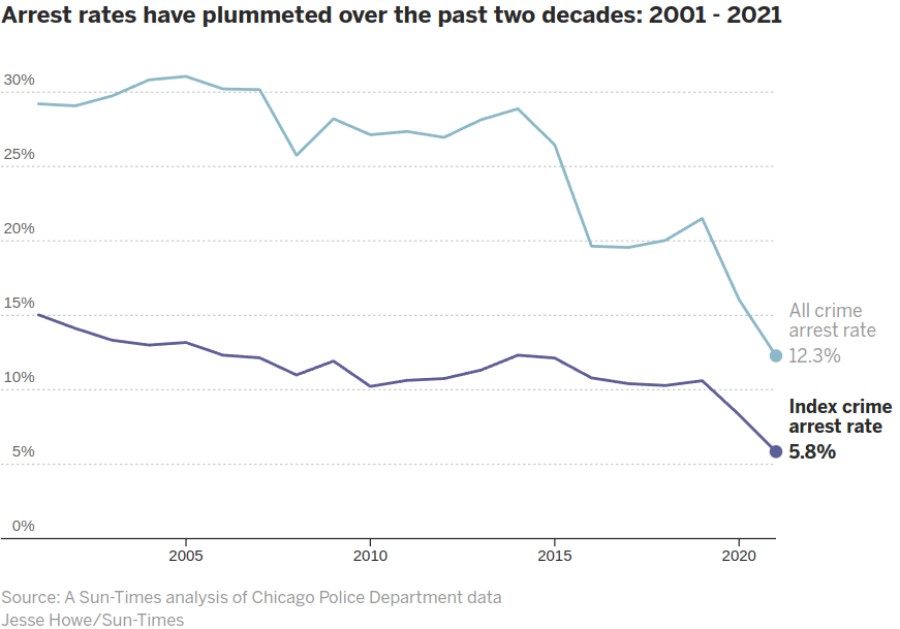
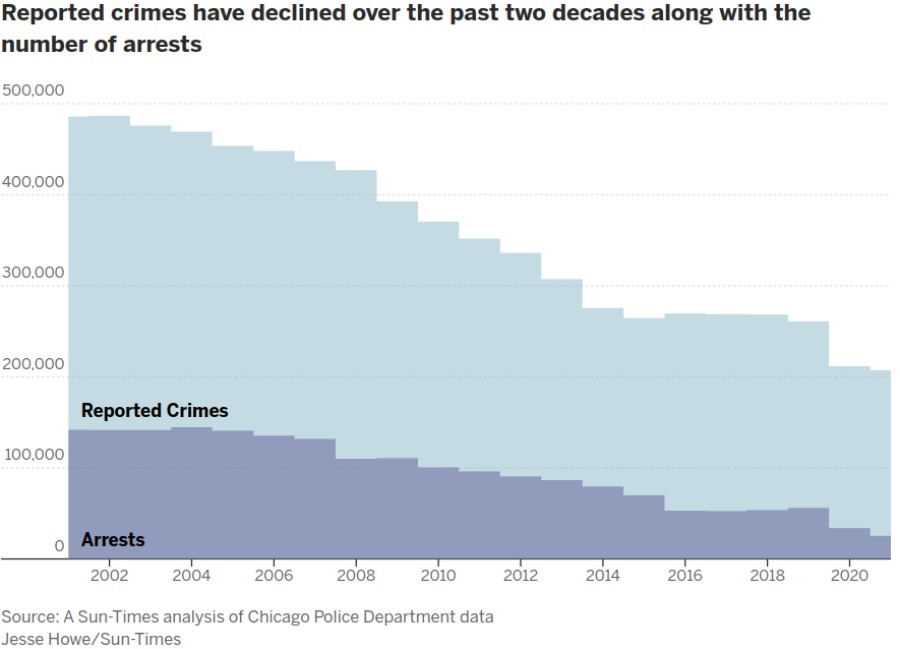
The police have made arrests in just 12% of crimes reported last year, according to a Chicago Sun-Times analysis. That’s the lowest level since at least 2001, the first year the data was made publicly available.
The overall arrest rate peaked at nearly 31% in 2005 and has dropped steadily.
The decline in arrests mirrors a drop in nearly every category of police officers’ activity tracked by the Chicago Police Department. The numbers of traffic stops, tickets and investigative stops— in which pedestrians are patted down or searched by officers on the street — all have plummeted. The number of investigative stops dropped by more than half between 2019 and last year, falling from 155,000 citywide to 69,000.
And fewer crimes overall are getting reported — by victims and by the police, who used to produce many crime reports themselves while patrolling their beats.
The slowdown amounts to a pullback by police officers as the city has experienced its most violent years in decades, a rise also seen in other major U.S. cities during the coronavirus pandemic and in the wake of the 2020 death of George Floyd at the hands of a Minneapolis police officer.
Rank-and-file police who patrol the streets and even top brass say officers are doing less.
Even just the suggestion that this was the case was once controversial. Former Mayor Rahm Emanuel caused a minor scandal in 2014 when he told a gathering of big city police chiefs and Justice Department officials that cops had “gone fetal” in response to growing public scrutiny.
John Catanzara, president of Fraternal Order of Police Lodge 7, even says officers aren’t as active as they once were.
Contributing factors include:
The pandemic.
Dramatic shifts in strategy from the top.
Increased scrutiny of the police.
Cops saying they increasingly feel that making an arrest isn’t worth risking their lives, their jobs or becoming a viral news villain.
There also was a plunge in the number of arrests are for so-called index crimes, which include homicide, sexual assault, robbery and aggravated battery.
Officers made arrests in fewer than 6% of those crime categories that were reported last year, the lowest level since at least 2001, the Sun-Times analysis of Chicago police data found. The trend has continued this year, according to figures through early June.
For the early years covered by the data, arrest rates are higher for killings, shootings and sexual assaults because detectives have had more time to solve those cases.
Still, arrests typically are made in the month or year that a crime was committed, law enforcement officials say. The data analyzed by the Sun-Times doesn’t show when an arrest took place — whether it was in the year a crime was committed or later on.
Cops admit pulling back
In 2019, as the overall arrest rate continued to fall,City Hall agreed to a federal consent decreeaimed at overhauling the police department following the killing by a police officer of 17-year-old Laquan McDonald in 2014 on the Southwest Side.
The department has since made reforms aimed at changing how officers do their jobs, including a stricter vehicle pursuit policy and a new foot pursuit policy.
Also, cops have been told to stop enforcing some low-level offenses, including the possession of small amounts of marijuana, which was legalized in Illinois as of the start of 2020.
But the number of arrests for possessing harder drugs, like heroin, also has fallen significantly. Those arrests peaked at 7,753 in 2001 but dropped last year to 929.
Current and former police officers — who agreed to speak on the condition they not be identified — say cops have been pulling back for other reasons.
A former commander says officers who regularly have had days off canceled are avoiding making some arrests because they don’t want to wind up in court during their time off.
A beat cop who patrols downtown says prosecutors’ high threshold for approving felony charges has made officers second-guess whether to engage “criminals with guns” — a sentiment the former commander echoes.
The beat cop says high-profile attacks on officers such as last August’s shooting in West Englewood that left Ella French dead and her partner Carlos Yanez critically wounded — “make us take a step back and think: Who really cares about us at that point?
“We can only support each other at the lowest ranks,” the officer says. “And if that means going out there and not doing anything, then that means going out there and not doing anything.”
Rank-and-file officers, sergeants and detectives also say they feel they have a target on their backs. They point to the consent decree, which requires the city to reform its policing policies after the Justice Department found officers engaged in civil rights violations.
Veteran cops say they used to go out of their way to make arrests when they saw suspicious activity but that they’re less likely to now for fear of getting into trouble and being fired or even arrested.
“In the past, I might see a guy with a gun in his waistband, and I’d jump out and chase him,” one decorated officer says. “No way I’d do that now.”
As I said at the outset, the obvious conclusion is that if we had more Elisjsha Dickens (the civilian at the Greenwood mall who took down the shooter there), we'd be safer, given the reality of the demoralized scaredy-cats we pay to protect us failing to do so.
But is that really a tidy package in which we can wrap this all up and move on to other topics?
I suggest that we need to look at the acceleration of the whole cycle of phenomenon-and-backlash that characterizes pretty much everything in our society anymore.
It's certainly been the case regarding gun rights, the defense of which in some quarters has turned into an ostentatious fetish.
And there's also the sociological reality that pretty much every case of either mass shootings in public spaces or gang warfare, with its all-too-frequent collateral casualties, has as a common element the rootlessness - often meaning fatherlessness - in which those inflicting death and injury have come of age.
A lot of people are dismissive of a causal connection between the products of popular culture - video games, music, movies - and the formation of rootless young men's characters and worldviews. Come on. Is it really possible that output so raw, so vulgar, so devoid of anything that seventy years ago was recognized as art, has no effect on those who steadily consume it?
To tie all this together, a lot of young males in our society have not signed onto that. Of course, neither have they become men, if we're going define that as a male person who understands what responsible stewardship of this powerful face that is his masculinity entails. We used to call those who did understand it gentlemen.
Rather, these young males, in their starvation for basic appreciation, decide that they're gonna go out and gets guns and make a statement, by God. The the-world-won't-soon-forget-me mindset does not motivate them to contributions to society's betterment, but rather desperado last stands that serve as nothing but testaments to their nihilism.
I found this a right-between-the-eyes piece about spree killers. I'll excerpt at length, but I have some thoughts of my own to add.
It finds a common theme among such individuals, discussion of which is unavoidable:
Rampage shooters tend to be losers. The archetype of the modern school shooter, Eric Harris, frequently wrote in his diary about his feelings of alienation and resentment over his lack of social success. “I just want to be surrounded by the flesh of a woman,” begins an entry dated five months before the Columbine shooting, which later devolved into psychopathic fantasies of torture and mutilation. But in an entry from five days later, written after purchasing his first guns, Harris is exuberant. “I am fucking armed. I feel more confident, stronger, more God-like.”
Elliot Rodger, the 2014 Isla Vista shooter whose “manifesto” was a laundry list of complaints about his loneliness and sexual rejection, felt particularly resentful toward his female classmates, whom he saw as “mean, cruel, and heartless creatures that took pleasure from my suffering”. Unable to attract a girlfriend, he settled on revenge. “If I cannot rise above them,” he wrote, “I will destroy them.” When Rodger finally buys a handgun, he is happy for the first time since childhood. “I brought it back to my room and felt a new sense of power. I was now armed. Who’s the alpha male now, bitches?”
We don’t know yet what motivated Salvador Ramos, the teenage gunman who killed 21 people in Uvalde, Texas, last week, but we do know that like most shooters, he was a misfit and social outcast. Early reporting suggests that he spent recent months harassing teen girls on social media, “repeating girls’ names until they paid attention to him”, and expressing to them his desire to get his “name out there” like the Canadian murderer Luka Rocco Magnotta. The Buffalo shooter, Payton Gendron, was also an oddball with a history of making threats, although his immediate motives seem to have been more ideological than social or sexual. Even so, in the course of his white supremacist diatribe, he blamed “weak” “European men” for the degeneracy of the West and concluded that “strong men are needed to fix it”.
Whatever the nominal motivations behind them, rampage shootings are nearly always a product of wounded masculinity. “They are the most masculine of crimes,” says Ralph Larkin, a criminologist at John Jay College who has studied mass shootings for decades. “Can you think of more than four or five female mass shooters? There aren’t any.” Shooters, Larkin says, are “marginal males who feel they have been wronged by society, and so they pick up a gun. There is always a sense of violated entitlement, and I don’t care whether it’s school shootings or racist shootings.”
The phenomenon has its origins in that fabled decade, the1960s. The impact of the upheaval wrought by that ten-year period, while already written about seemingly exhaustively, is not going to be fully comprehended for some time, if ever.
Modern mass shootings, according to Larkin, began in 1966, when Charles Whitman, a former Marine with an undiagnosed brain tumour, murdered his wife and mother before climbing to the top of a tower in downtown Austin, Texas, and shooting 14 people to death. Larkin speculates that the sudden rise in these shootings was a reaction to the sexual liberation of the Sixties and the corresponding rise in the status of women — a point on which some of the more historically minded murderers would no doubt agree. “We’re talking about toxic masculinity here.”
The boldface in the following portion is mine:
Toxic masculinity, of course, is a somewhat slippery concept. Colloquially, it refers to the elements of traditional masculinity — competition, stoicism, aggressiveness, physical strength, a willingness to resort to violence — that fit awkwardly or not at all into modern liberal culture. A 2019 explainer in the New York Times defined it as “a set of behaviours and beliefs” that men are socialised into from a young age, including “suppressing emotions or masking distress”, “maintaining an appearance of hardness”, and “violence as an indicator of power”. More than a few articles have flagged toxic masculinity, combined with Americans’ easy access to guns, as one of the causes of mass shootings.
These elements of masculinity can no doubt be “toxic” in the wrong circumstances — the problem is with the assumption that they are purely a product of cultural scripts, rather than reflections of something inherent in men. Francis McAndrew, a psychologist who has studied mass shootings, told me that while socialisation plays a role in encouraging some forms of male violence, it does not create it out of thin air. This is particularly true for young men, who are ultra-sensitive to status competition, which historically would have determined their ability to attract women and form alliances with other men. Young men, McAndrew says, have been selected to regard adolescent social hierarchies as a matter of life and death.
“Today, you can go to college or move to a new city,” McAndrew says. “But when we were evolving, whatever happened during adolescence was a life sentence. And if you established yourself as a bad dude that nobody messed with, that could work to your advantage. Our minds are still stuck in that past of needing to be paid attention to. And the guys who don’t get that experience all kinds of dark emotions. They feel left out, they feel like losers, they feel desperate, and they need to make a statement.”
Truth right there. Before I found my niches in writing and music, to which I was driven in no small part by this need to establish for myself some kind of substantive masculinity, I tried sports, specifically, ninth-grade football and track. It went badly. It put me squarely into the most blatant pecking-order environment possible.
But there's also a generational aspect to this, at least in a lot of cases. My relationship with my dad was fraught and complex, a subject into which I could be tempted to digress beyond the scope of this post. Suffice it to say that raising a son was a task he undertook with the greatest intensity. When I started running in the evenings in late summer before football practice got underway, I remember him telling a neighbor - the father of two boys, who had very set notions of what a solid guy was - "That boy wants to play football so bad he can taste it." No, Dad, I was just looking for a way to get noticed by girls.
Macdougald, in this UnHerd piece, points out that there's irony in modern society's search for individuation, for its inclination to venerate the original. Our DNA winds up grouping us anyway:
Everyone is supposed to be an individual, and all individuals are respected equally. Yet beneath this injunction and guarantee are all the typical modes of conformity and hierarchy we would expect of a human society. The beautiful, the talented, the athletic, the funny, and the interesting rise above the ugly, the clumsy, the anxious, the introverted, the boring, and the resentful.
These relative statuses, for the losers, are all the more painful for being nothing other than a reflection of who and what they actually are. “Individuality” is wonderful when your true self is a tall and handsome swimmer with an unexpected love of classical cello, or a beautiful girl who likes to go backpacking with her friends. But who, really, is someone like Salvador Ramos, an odd-looking boy who disturbs nearly everyone he talks to, whose hobbies include shooting people with BB guns and throwing dead cats at strangers’ houses? Does anyone, really, want someone like that to be himself? I doubt it.
I'd already been thinking along these lines this morning when I ran across this piece, and I'll further flesh out those thoughts, probably in a piece over at Precipice. So many of us in modern society are clamoring for some way back to a time of stability and reliable norms. On the other hand, we disparage much about those times - before the above-mentioned 1960s - because there seems, from our twenty-first century perspective, much about life then that was stultifying and repressive and damping to the imagination.
I'd wager that the situation is more complicated.
As I say, I think I'm going to have more to say about it.
For now, I'd just point out that exercising responsible stewardship over this thing called masculinity is both necessary and difficult.
Would it be grabbing at the low-hanging fruit to say, "I'm guessing that this guy was chronically the last to be picked for gym-class teams"?
University of Rhode Island (URI) professor published a book chapter in September focused entirely on New England Patriots quarterback Tom Brady and his supposed relationship to white supremacy.
URI English professor Kyle Kusz also dabbles in gender and race theory, as evidenced in a chapter, a full copy of which was obtained by Campus Reform, that the professor authored in a recently published book titled The Palgrave Handbook of Masculinity and Sport.
Titled “Making American White Men Great Again: Tom Brady, Donald Trump, and the Allure of White Male Omnipotence in Post-Obama America,” the chapter attempts to provide evidence to back up Kusz’s suggestion that, like President Donald Trump, New England Patriots quarterback Tom Brady has gained popularity due to the “latest wave of white rage and white supremacy” that he says developed since the Obama presidency alongside a “disturbing racial reaction among white conservatives in response to the idea that a black man would be [president].”
The professor’s work analyzes Brady in two ways: his representation in the media and his “relationship with Trump,” seeking to determine what these factors can “tell us about the specific ways that white masculinity is being re-coded and re-centered in post-Obama American culture.”
Kusz zeroes in on “the complex racial, gender, and class meanings that have been articulated with Brady’s body and his performances of white masculinity in the context of a backlash against the Obama presidency” and of “Trumpism,” which he claims is also rooted in both race and gender.
In addition to Brady’s representation as the epitome of “omnipotent, white masculinity” in his various media appearances, advertisements, and movie cameos, Kusz also focuses on Brady’s public image as it relates to what he calls “American myths of meritocracy and individualism,” which he says are “commonly used in sporting adverts.” Among other media appearances, he specifically cites Brady’s appearance in a 2015 Under Armour commercial, which he claims “would not seem out of place in Leni Reifenstahl’s infamous Nazi propaganda film, ‘Triumph des willens,’” because of its military references and red and black colors.
Kusz told Campus Reform that it was this commercial that drove him to investigate Brady’s whiteness further. “I decided to research Trump and Brady's public performances of their white masculinities and how they connect with broader debates about race and gender politics after a student in one of my classes brought the UnderArmour commercial to my attention and it piqued my interest,” the professor said. Kusz also took issue in the chapter with a Beautyrest mattress commercial in which the camera angle is pointed upward at Brady so that the “viewer is compelled to see him as superior,” as well as Brady’s partnership with “upscale companies” like UGG and Aston Martin. “In each of these sites, Brady is figured as an unconflicted and unapologetic embodiment of upper-class white exceptionality and manly omnipotence.” Kusz also points to the “myths” of meritocracy present in “The Brady 6,” a documentary about the quarterback and his rise to stardom. “By subtly coding Brady as a version of the 97 lb weakling in ‘The Brady 6,’ his subsequent transformation into Brady—the five-time Super Bowl champion and ‘G.O.A.T’—enables him to be easily read as an athletic variation of the self-made man,” Kusz writes, adding that “the self-made man is [a] seductive and potent ideological figure of American liberalism long used to mask the systemic privileges afforded to, and enjoyed by, white men, especially those with economic means.” The professor also asserts that Patriots fans who backed Brady during the infamous “Deflategate” scandal were angry with NFL commissioner Roger Goodell for “breaking the unspoken bonds of white brotherhood to leverage the NFL’s institutional authority” against Brady. The “Free Brady” T-shirts sold by barstoolsports.com at the time combined humor with “reverse racism” and “political dissidence,” according to Kusz. In addition to the media’s representation of Brady being “figured through conventional codes of upper-class elitism that are often exclusively associated with, and embodied by, white men,” Kusz also takes issue with the company Brady chooses to keep, mainly focusing on the quarterback’s relationship with Trump, but also pointing out the fact that Brady often takes “boys only” trips with “white majority groups” to the Kentucky Derby.
In each of the attempts at substantiation for his argument, this Kusz person makes an instant presumption that the connection is obvious without considering other possible explanations and employing rational arguments for rejecting them. Maybe he fleshes this out in his book, but on what basis does he assert the existence of this "white rage"? Has he researched why the marketing people at Under Armor or Beauty Rest constructed their commercials the way they did? And how can somebody articulate complex race, class and gender whatever with his body? And I daresay that scientific polling would indicate that a lot of predominantly white (and I'll bet predominantly black as well) groups of men attend the Kentucky Derby.
But this guy's seething resentment for meritocracy and individualism is the really creepy aspect of this. I think it's safe to say he's a fan of participation trophies. The University of Rhode Island is paying this guy to be an agent of the obliteration of excellence.
Good piece by the American Enterprise Institute's Michael Rubin in The National Interestentitled "There's Nothing Progressive About a Multipolar World." Many have waxed rhapsodic about such a notion since the end of the Cold War. Madeleine Albright spoke of “a multipolar world of diversity and creativity among cultures, nations, and economies—is the world we believe we can build, one that will enrich our lives, and thrives on habits of peace and creative competition.” But if the United States doesn't continue to lead morally, economically, diplomatically and militarily, less scrupulous players will step up to the task.
. . . it is nonsensical to suggest that any alternate pole—Moscow, Beijing, Tehran, or Ankara—would make the world a more peaceful place or better respect the evolving international human-rights regime. The one thing revisionist states have in common is that they tolerate neither debate nor dissonance. That is a lesson Uighurs, Ukrainians, and Kurds have discovered, as have Meng Hongwei and Turkey’s imprisoned journalists. It is time American and European progressives recognize it as well, for the stakes are far greater than simply American power.
Give Cuomo credit for being an honest voice of reason. Cuomo would later call the border-wall standoff a “farce,” so he’s not exactly a fan of the idea, but the proposal isn’t “propaganda,” he says in rebuke to Lemon. A president has a “right” to make the argument, Cuomo points out, even if it’s a bad or easily debunked one:
LEMON: Do you think there should be — I don’t know, a delay of some sort? And then you can — because people believe, the president will say what he has to say, people will believe it whether the facts are true or not. I guess that’s the chance you take with any president —
CUOMO: Yeah!
LEMON: — but this one is different. And then, by the times the rebuttals come on, we’ve already promoted propaganda, possibly, unless he gets up there and tells the truth.
CUOMO: He has his right to make the argument to the American people. And by the way, wanting barriers along the border is not propaganda.
LEMON: No, no, no —
CUOMO: It’s not immoral, it’s not wrong.
Here’s a question that Lemon doesn’t offer. If the media should put a delay on Trump, shouldn’t they also put a delay on the official Democratic response too, to prevent having “promoted propaganda”? After all, Trump’s not the only one in Washington who has trouble with the truth. Would Lemon suggest tape delays if Hillary Clinton was in office, for instance? The magic 8-ball says “Don’t count on it.”
David French at NRO takes on the toxic-masculinity notion in a great piece entitled "Grown Men Are the Solution, Not the Problem."
So now we've gone the step beyond campus indoctrination programs in "toxic masculinity" and are seeing the emergence of an academic field called "masculinities." Plural. You see, there is not only a gender continuum along which masculinity and femininity are mere points, there are now gradations of at least one of what used to be recognized as the two and only two sexes and the natures of each.
Stony Brook University in Long Island, New York, will soon become the first college in the nation to offer a master’s degree in the emerging field of “Masculinities.”
The center counts feminist icons such as Gloria Steinem, Eve Ensler, and Jane Fonda among its Board of Directors, and it is led by Michael Kimmel, a feminist academic who most recently wrote a book on “angry white men” suffering from “aggrieved entitlement.”
Speaking to PJ Media, Kimmel said Thursday that the degree will likely launch September of 2019, pending state approval. The proposal for the degree is “now working its way up the SUNY ladder to Albany having passed all Stony Brook screens,” Kimmel explained.
It's going to be based to a significant degree on "intersectionality," so that presumably there will be a look at how masculinity plays out differently within different races and ethnicities and socioeconomic strata.
With a broad of directors including the figures enumerated above, we can safely say from the get-go that this new master's degree will not be free from agenda.
Goldberg's works are the wonkiest of deep dives, but mere casual observation offers a convincing confirmation of his basic point. There is no society anywhere that has ever been organized in any other fashion. The rest of the animal kingdom provides further proof of an overwhelmingly demonstrable pattern. Males compete for an alpha position within herds and the reward for their effort is first dibs in mating.
Let's look at religion from a historical standpoint. The founders of the world's durable systems of formalized spiritual questing have, to a person, been men. The ones among them that take the approach of viewing God as a sovereign being characterize God as male.
I went straight to the religion example, bypassing other realms of human endeavor I could have mentioned - political and military leaders, scientists and discoverers, writers, musicians, philosophers - for a reason.
There is only one religion that explains the fact that the ideal that man-woman relations is designed to emulate is to be found on the divine level. In the others, there is no reference point beyond the human race itself. In Christianity, however, the relationship between husband and wife is to be modeled on that between the Lord and His church. We are His bride.
To be sure, Christianity does draw upon the basic principles given to us by ancient Judaism. When Jesus says in Matthew 19 that in a marriage, the two become one, he is echoing what God decreed in Genesis 2.
And consider what Jesus has to say about his relationship with His Father. He is in complete obedience to him. Now, there is nothing impulsive about His Father. Jesus need not be skittish about suddenly getting some command that runs counter to the pattern of what he has heard from him. He can have complete and utter confidence that anything his Father tells him to do or say is going to be consistent with what He knows about him.
Jesus includes this point in the prodigal-son parable as well. When the older son waxes resentful at the fatted-calf party being thrown for the younger son, the dad reassures him that "all that is mine is yours."
Now, it's at this point that a couple of questions arise that feminists may be the first to raise, but that could be raised by any number of people inquiring into this whole matter. One is, given that every and all human beings are fallible, and that that means that human husbands and fathers are going to fall short of the ideal, sometimes in tyrannical and even brutal ways, where is a woman to be assured of safety when she pairs up and assumes the roles of wife and mother? The other, more basic question is, where is her voice in all of this? Doesn't this deny her even the most basic type of agency as an autonomous person?
To the first we can say that this is yet another reason for tireless evangelism. The more people who know about, are convinced of, and seeking to emulate the perfect example of the husband and father roles, the more safe and fair it is for the world's women.
As to the second question, recall that Jesus said a man and woman become one. They engage the world as a single unit. They are of one accord - ideally concerning everything.
And consider that, just as Jesus could be confident that His Father was not going to go off and change the nature of his mission impulsively, a wife in a Godly marriage can be sure that her husband is not asking for her alignment with him so he can blow the family savings on an extravagant speedboat, or so that he can become a negligent workaholic, absent from the home, in pursuit of a powerful position in the world. A good husband and father crafts a mission for his family based on prayerfully discerning what God sees as that family's calling.
Yes, the world is full of examples that provide a field day for what-about-ists. Again, what that points up is the urgency of the situation. We need more and more families emulating the divine design.
Look at the humbleness with which Jesus regards His Father. An earthy father is to have an equally humble heart. That attitude will infuse his dealings with his wife and children. He knows that, given his fallen nature, and that of the others in the family, part of demonstrating grace is to bring humor, quiet forbearance, wisdom and affection to his roles. Ultimately, he is their servant, since it is not his own wants that drive the family dynamic, but what God intends. He's merely there to facilitate, in the unique ways that husbands and fathers are designed to do.
The project of a happy family does not get off the ground without lots of love, and the best way to find out more about how to be a practitioner of love is to look to the only example we have that never fails us.
Will the Stony Brook master's program get into this? Don't bet on it.
Occasionally, my pastor knocks it out of the park with his sermon.
Such was the case with his Father's Day message today.
It was richly multileveled. He spoke of his relationship with his own father, how the latter had led and taught through quiet example far more than overt lecturing or hammering home of formal standards. (He even got a little choked up when he noted it was the second Father's Day without his dad.) He cited the statistics tying social ills - drug abuse, violent crime, educational failure - to the absence of a father in a male's life. He made note of the fact that Jesus consistently referred to God as his Father, rather than calling him Lord or any other characterization found elsewhere in scripture.
But it was his distillation of the panoply of qualities that go into making a good father down to three that really gave shape to his remarks. These are providing, protecting and teaching. He then spoke of the sense of balance that a father needs to bring to each role. Overemphasis on providing can lead to the classic absence of the workaholic who misses the games, recitals, graduations and birthdays that are the milestones of his children's lives. Giving protection an outsized role leads to hovering and smothering and denying a child the space to fail and learn from it. Being too focused on teaching can lead to a child tuning out and thereby missing valuable lessons.
He then touched on the ways in which post-American culture elevates the undeniable virtues of the feminine mode of being human in a zero-sum context, as if that can't be good without maleness being bad. In other words, what happens is that masculinity gets disparaged. Hence we get university workshops on "toxic masculinity."
This, he ventured, is why we now hesitate to depict Jesus, who was a carpenter circa 20 AD, when such a tradesman was routinely slinging around large timbers and stones and using tools that required considerable strength to bring to bear on such materials, as manly. We want him unwaveringly gentle, with pretty hair and soft facial features. We want him exquisitely tolerant.
But that's not who he was. Yes, he made it clear that he was here to maximize the number of found sheep. The lost and the dead were his first priority. But he made it clear that their hearts were indispensable parts of the equation. If someone refuses to be found by Jesus, he has no choice when the hour of no sunset and no dawning arrives but to say, "I never knew you." When he encountered broods of vipers, he called them as much.
Just over 60 percent of millennials say that Christianity is “judgmental,” and 64 percent say that “anti-gay” best describes most churches today.
Just how important is the kind of example-setting that a committed father can do to the health of our culture? Well, if enough men with offspring slack at it, role models become ever-fewer:
Many youth have had no -- or very limited -- exposure to adult role models who know what they believe, why they believe it, and are committed to consistently living it out.
Authenticity is a term that can be used for good or ill. Employed in the service of some kind of "people-ought-to-just-be-themselves" ethos, it encourage narcissism and even infantile self-absorption. But a dignified authenticity - of a type nearly synonymous with backbone - is a precious commodity.
Father's Day presents those of us who are males, even if we don't have children, with a call to nobility. Male and female He created us, and He saw that it was good.
Manliness is not celebrated by the antics of singers in bro-country videos, or even action movies featuring some squinty-eyed, machine-gun-wielding protagonist with his back to the wall.
At least not nearly as well as by the example of a dedicated father, who, even in his inevitable sinfulness, perseveres in his effort to demonstrate qualities he understands to be good, right and true.
Of course, it's best celebrated by the Nazarene carpenter who said that his words came from his Father and nowhere else.