Showing posts with label character and virtue. Show all posts

Wednesday, May 10, 2023

The Republican Party is still the bitch of the most vile person to ever enter American politics

 A civil-case jury found the Very Stable Genius liable for sexually assaulting a woman. 

A man who wished to project even a modicum of honor, who had any desire to appeal to the sense of decency of the citizens whose votes he wanted, a man who had one subatomic particle of character, would have shown up in the courtroom to state what he knew in his heart to be the truth. Except that Trump's heart, to the extent he has one, knew that Carroll had the truth on her side.

No, he sat for a taped deposition. The one in which he was shown a photograph in which Carroll and his second wife, Marla Maples, both appear, and got them confused. The one in which he had these disgusting responses to his interrogator:

“She’s not my type… it’s not politically correct to say it. I know that, but I’ll say it anyway,” Trump said.

He later turned to Carroll’s lawyer, Roberta Kaplan.

“You wouldn’t be a choice of mine either,” Trump said to her face.


In the video, which was shown to the nine-panel jury, Trump was forced to rewatch the infamous leaked 2005 Access Hollywood tape in which he boasted about abusing his celebrity status to sexually assault women because you can “grab ‘em by the pussy.”

Kaplan, who kept her cool and didn’t respond to Trump’s repeated personal attacks against her, asked him if he felt that stars could actually grab women “by the pussy.”

“Historically that’s true with stars. If you look over the last million years, that’s largely true, unfortunately—or fortunately,” he said.

Kaplan followed up by asking if Trump considers himself a star.

“Yeah,” he acknowledged.

Still - and yes, you've seen this point made before at LITD, but the spread keeps increasing - he is overwhelmingly the Republican favorite among 2024 presidential possibilities:

The gap between former President Donald Trump and Florida Gov. Ron DeSantis in polling on the 2024 GOP presidential nomination has widened as both men noticeably step up their campaign efforts – both official and unofficial.

Trump surged to a 41-point lead over the governor in a poll of a hypothetical Republican field released Tuesday from Morning Consult. The lead is the largest ever seen in the survey, which has been regularly tracking potential GOP primary voters’ preferences since late last year.

Trump netted 60% of support in the poll, while DeSantis earned 19% – both Trump’s highest level of support and DeSantis’ lowest in any Morning Consult survey so far.

DeSantis has not yet officially announced his 2024 bid but is expected to do so in the coming months.

Other official candidates – including South Carolina Gov. Nikki Haley and entrepreneur Vivek Ramasway – and those said to be weighing bids, like former Vice President Mike Pence, have been vying in the last several months for the very modest slice of support not lended to either Trump or DeSantis, with some fluctuations.

Trump’s lead in the Morning Consult tally is one of the largest seen so far in the still-early contest, eclipsed only perhaps by an April poll from Emerson that saw Trump up 61% to DeSantis’ 16% – a 46-point gap.

The polls are aligned with a general and persistent trend across reputable polls that has seen the gap between the two men continue to grow.

Unless you're up to your eyeballs in Kool-Aid, you have no doubt that

More generally, this is the guy who

The ate-up cult followers who show up at his rallies, put Trump bumper stickers on their cars and run Trump flags on their flagpoles are beyond hope. It's fool's errand to try to reach them.

The elected legislators who lionize him and have similarly dissolute personal lives are now a Republican feature, not a bug.

Other Republican elected legislators and prominent politicians - think Mitch McConnell, who, after having place responsibility for January 6 on Trump, responded to the question of whether he'd support him in 2024, said that if he was the GOP nominee, yes, or Kevin McCarthy, who is, rightly, receiving kudos for standing firm on wanting to negotiate with Biden about the debt ceiling, but who made the Mar-a-Lago pilgrimage mere weeks after January 6 - have shown that when push comes to shove, they are nothing but cowards and sycophants, are of no use.

The public intellectuals who unequivocally got on his bandwagon - Roger Kimball, Victor Davis Hanson, Bill Bennett, Charles Kesler, etc. - have completely delegitimized their previous contributions to our societal discourse.

Townhall, RedState, The Federalist and American Greatness have ruined the whole idea of fusionist conservatism, perhaps irreparably. 

The Bulwark, Principles First and the this-means-we-have-to-vote-Democrat crowd generally have drifted from any kind of original mission that remembered what conservatism was prior to 2015.

Which brings me to the matter that will surely be my principal point of engagement with my fellow citizens on a political level going forward. Good-intentioned people - those who I know personally and those with whom I find myself engaging with online - will respond, as they have since 2015, with the question, "What is the country to do, then? We're only going to have two choices in the next election."

 There is a third choice. Stay home on election day. It's a choice I've made a couple of times now. 

Your soul is involved here. There are no stakes for the country high enough to compel one to vote for either of two parties that are equally rotten.

Yes, I am aware of how poisonous ESG and DEI are. I'm aware that Biden is administering an opiate to the country by not having a word to say about the relationship between the looming debt/deficit crisis and the unfunded liabilities of Social Security and Medicare. I'm aware that the Democrat push to have all petroleum-powered vehicles off the road in less than a decade is not only tyranny but economic madness. I'm aware that our cities are being consumed by murder and addiction.

But the Republican Party is of no use as a countervailing force. 

It doesn't give a flying f--- about character, the essential element for any restoration of a truly conservative proposal for reviving post-America. 

To those who would say, "There are a lot of local-level Republicans with good hearts who are trying hard to improve their communities," I would say, "Look each one of them in the eye and ask them the question that Mitch McConnell answered so abysmally: If Trump's the nominee, are you going to vote for him?"

I'm thinking about character a lot these days. I'd like to learn more about how to cultivate it in myself. This is a subject I intend to explore in my next Precipice post.

But I had to get this reaction to the present political moment off my chest, and I thought LITD was the appropriate venue for that.

Nothing about our political life is any better than it was eight years ago.

It keeps getting worse.


Tuesday, July 19, 2022

Some thoughts on the relationship between civilization's fragility and the use of force

 It's important that I don'r frame this in some kind of boneheaded hot-take way. 

A quick conclusion would be easy to draw, and it wouldn't be entirely off the mark. 

But let's be thorough about this. If our ultimate goal is a society with more heart, a culture that's not myopic, we need to consider every aspect of this. 

I'm speaking of the role of guns in our assurance - as individuals, as families, as communities - that there is sufficient public order for us to feel basically safe. 

Four recent news items:

Sunday evening, at a large shopping mall in Greenwood, Indiana, a contiguous suburb on the south side of Indianapolis, a shooter armed with a rifle and many rounds of ammunition fired into the food court, killing three and wounding several others. He was then shot by a young man who was carrying a concealed handgun, which is perfectly legal under Indiana law. The awkward element in this scenario is that the mall has a clearly stated no-weapons policy. But what was mall management supposed to say in response to what transpired? The obvious had to bee acknowledged:

A spokesperson with the mall issued a statement Monday morning. In part of the statement, they said they were grateful for the “heroic actions of the Good Samaritan who stopped the suspect.”

We grieve for the victims of yesterday’s horrific tragedy in Greenwood. Violence has no place in this or any other community. We are grateful for the strong response of the first responders, including the heroic actions of the Good Samaritan who stopped the suspect.

In Minneapolis, Black Lives Matter got an earful from a woman who, along with her kids, had come under fire from a shooter who was taken down by police snipers:

Did police abuse their power? Black Lives Matter organizers think so and organized a demonstration outside of the apartment building yesterday. They got a counter-demonstration in response — from the woman whose children came under Sundberg’s fire:

What started as a rally for a man shot and killed by Minneapolis Police quickly took a turn after the mother of two nearly hit by bullets while inside her apartment showed up to share her story on Saturday afternoon.

Arabella Yarbrough was cooking food for her children Wednesday night when she says Tekle Sundberg fired bullets into their home, nearly hitting them. Police responded and helped Yarbrough escape when according to police, Sundberg also fired at officers. That led to a six-hour standoff outside the building that lasted until MPD snipers killed the 20-year-old early the next morning.

“I literally had five minutes to live while he had six hours to choose life or death. The police stated they did not want to kill him,” Yarbrough told Fox 9.

She confronted activists at a protest for Sundberg and against police violence on Saturday. A Fox 9 news crew was at the scene.

Yarborough took offense at the protest, and made sure everyone knew it. “This is not a George Floyd situation” she declared, telling protesters to go home. “This is not OK!”

Good question. Does BLM routinely protest intracommunity violence, or only law enforcement-related violence? I think we know the answer to that — and Yarbrough certainly knows it herself. That was an entirely rhetorical question.

And we know this by some of the responses Yarborough got that are clearly heard in this videos. Instead of acknowledging that Sundberg was a real and active threat to her and the other residents in the building, they scoffed at her protest. “You’re alive!” shouted one, while another shouted, “Shut up!” Yet another one scolded Yarbrough that “this is not the time or the place,” which is rather ironic considering the circumstances.


That last response - "this is not the time of place" - is particularly rich.

An investigators' report on the Uvalde, Texas school shooting reveals that 400 law enforcement officers, representing local, state and federal levels, were present at the scene:

Nearly 400 law enforcement officials rushed to mass shooting that left 21 people dead at a Uvalde elementary school but "systemic failures" created a chaotic scene that lasted more than an hour before the gunman was finally confronted and killed, according to a report from investigators released Sunday.

The nearly 80-page report, obtained by multiple media outlets, was the first to criticize both state and federal law enforcement, and not just local authorities in the Texas town for the bewildering inaction by heavily armed officers as a gunman fired inside a fourth-grade classroom .

The report — the most complete account yet of the hesitant and haphazard response to the May 24 massacre at at Robb Elementary School — was written by an investigative committee from the Texas House of Representatives and released to family members Sunday.

According to the Texas Tribune, which reviewed the report ahead of its scheduled release to the public later in the day, the overwhelming majority of responders at the school were federal and state law enforcement. That included nearly 150 U.S. Border Patrol agents and 91 state police officials, according to the Tribune.

Does the glaring point that a massive failure to establish security need to be elaborated on? It's screamingly obvious, is it not?

In Chicago, police morale has eroded to this point: 

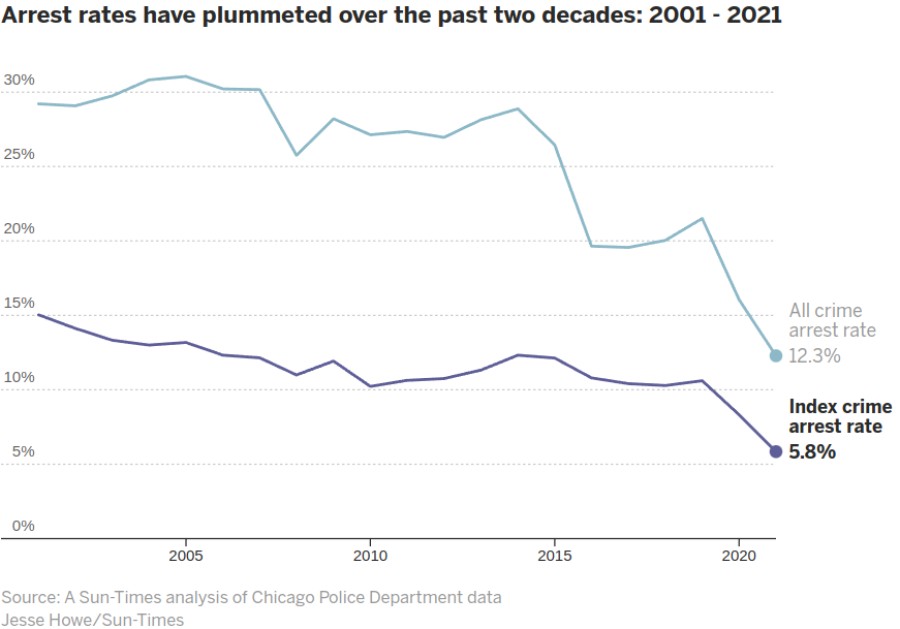
The police have made arrests in just 12% of crimes reported last year, according to a Chicago Sun-Times analysis. That’s the lowest level since at least 2001, the first year the data was made publicly available.

The overall arrest rate peaked at nearly 31% in 2005 and has dropped steadily.

A line chart shows arrest rates have dropped since the year 2001, from just under 30% to 12% today. Index crime arrest rates dropped from 15% to under 6%.

The decline in arrests mirrors a drop in nearly every category of police officers’ activity tracked by the Chicago Police Department. The numbers of traffic stops, tickets and investigative stops — in which pedestrians are patted down or searched by officers on the street — all have plummeted. The number of investigative stops dropped by more than half between 2019 and last year, falling from 155,000 citywide to 69,000.

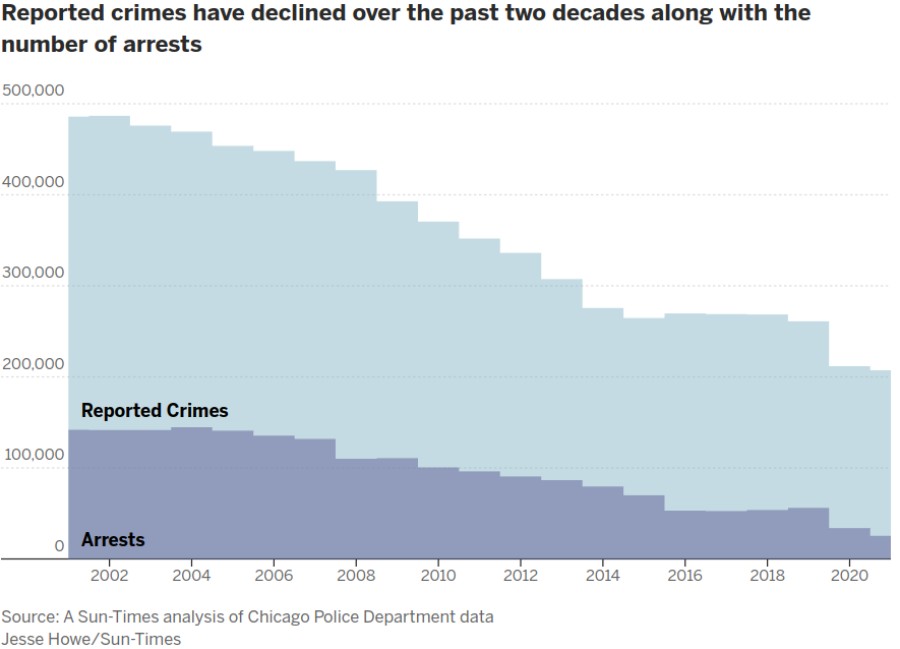
And fewer crimes overall are getting reported — by victims and by the police, who used to produce many crime reports themselves while patrolling their beats.

A stacked area chart shows the number of reported crimes has fallen from just under half a million in 2001 to just over 200,000 today. Arrests have fallen from 141,000 in 2001 to 25,000.

The slowdown amounts to a pullback by police officers as the city has experienced its most violent years in decades, a rise also seen in other major U.S. cities during the coronavirus pandemic and in the wake of the 2020 death of George Floyd at the hands of a Minneapolis police officer.

Rank-and-file police who patrol the streets and even top brass say officers are doing less.

Even just the suggestion that this was the case was once controversial. Former Mayor Rahm Emanuel caused a minor scandal in 2014 when he told a gathering of big city police chiefs and Justice Department officials that cops had “gone fetal” in response to growing public scrutiny.

John Catanzara, president of Fraternal Order of Police Lodge 7, even says officers aren’t as active as they once were.

Contributing factors include:

  • The pandemic.
  • Dramatic shifts in strategy from the top.
  • Increased scrutiny of the police.
  • Cops saying they increasingly feel that making an arrest isn’t worth risking their lives, their jobs or becoming a viral news villain.

There also was a plunge in the number of arrests are for so-called index crimes, which include homicide, sexual assault, robbery and aggravated battery.

Officers made arrests in fewer than 6% of those crime categories that were reported last year, the lowest level since at least 2001, the Sun-Times analysis of Chicago police data found. The trend has continued this year, according to figures through early June.

For the early years covered by the data, arrest rates are higher for killings, shootings and sexual assaults because detectives have had more time to solve those cases.

Still, arrests typically are made in the month or year that a crime was committed, law enforcement officials say. The data analyzed by the Sun-Times doesn’t show when an arrest took place — whether it was in the year a crime was committed or later on.

Cops admit pulling back

In 2019, as the overall arrest rate continued to fall, City Hall agreed to a federal consent decree aimed at overhauling the police department following the killing by a police officer of 17-year-old Laquan McDonald in 2014 on the Southwest Side.

The department has since made reforms aimed at changing how officers do their jobs, including a stricter vehicle pursuit policy and a new foot pursuit policy.

Also, cops have been told to stop enforcing some low-level offenses, including the possession of small amounts of marijuana, which was legalized in Illinois as of the start of 2020.

But the number of arrests for possessing harder drugs, like heroin, also has fallen significantly. Those arrests peaked at 7,753 in 2001 but dropped last year to 929.

Current and former police officers — who agreed to speak on the condition they not be identified — say cops have been pulling back for other reasons.

A former commander says officers who regularly have had days off canceled are avoiding making some arrests because they don’t want to wind up in court during their time off.

A beat cop who patrols downtown says prosecutors’ high threshold for approving felony charges has made officers second-guess whether to engage “criminals with guns” — a sentiment the former commander echoes.

The beat cop says high-profile attacks on officers such as last August’s shooting in West Englewood that left Ella French dead and her partner Carlos Yanez critically wounded — “make us take a step back and think: Who really cares about us at that point?

“We can only support each other at the lowest ranks,” the officer says. “And if that means going out there and not doing anything, then that means going out there and not doing anything.”

Rank-and-file officers, sergeants and detectives also say they feel they have a target on their backs. They point to the consent decree, which requires the city to reform its policing policies after the Justice Department found officers engaged in civil rights violations.

Veteran cops say they used to go out of their way to make arrests when they saw suspicious activity but that they’re less likely to now for fear of getting into trouble and being fired or even arrested.

“In the past, I might see a guy with a gun in his waistband, and I’d jump out and chase him,” one decorated officer says. “No way I’d do that now.”


As I said at the outset, the obvious conclusion is that if we had more Elisjsha Dickens (the civilian at the Greenwood mall who took down the shooter there), we'd be safer, given the reality of the demoralized scaredy-cats we pay to protect us failing to do so. 

But is that really a tidy package in which we can wrap this all up and move on to other topics?

I suggest that we need to look at the acceleration of the whole cycle of phenomenon-and-backlash that characterizes pretty much everything in our society anymore. 

It's certainly been the case regarding gun rights, the defense of which in some quarters has turned into an ostentatious fetish.

And there's also the sociological reality that pretty much every case of either mass shootings in public spaces or gang warfare, with its all-too-frequent collateral casualties, has as a common element the rootlessness - often meaning fatherlessness - in which those inflicting death and injury have come of age.

A lot of people are dismissive of a causal connection between the products of popular culture - video games, music, movies - and the formation of rootless young men's characters and worldviews. Come on. Is it really possible that output so raw, so vulgar, so devoid of anything that seventy years ago was recognized as art, has no effect on those who steadily consume it?

Then there is also the growing achievement gap between females and males. As a society, we've emphasize the empowerment of women at the cost of considering how it affects the prospects of boys and men. Part of this process has involved focusing on what are customarily regarded as female priorities - feelings, seeing that everyone can feel good about himself or herself - as Christina Hoff Summers noted in her book that really got that conversation rolling, The War Against Boys.

And in recent years, yet another layer has been added to the situation, one which has the imprimatur of the US government: We have obliterated the inherent and divinely designed basic architecture of the universe.

To tie all this together, a lot of young males in our society have not signed onto that. Of course, neither have they become men, if we're going define that as a male person who understands what responsible stewardship of this powerful face that is his masculinity entails. We used to call those who did understand it gentlemen. 

Rather, these young males, in their starvation for basic appreciation, decide that they're gonna go out and gets guns and make a statement, by God. The the-world-won't-soon-forget-me mindset does not motivate them to contributions to society's betterment, but rather desperado last stands that serve as nothing but testaments to their nihilism.

I have no ready answers here. Of course, as a man of faith, however wobbly, I feel confident in recommending that path as the basis for a solution, but it's more challenging than it's ever been in America to point young men, or indeed anybody, to a church that will provide real guidance and support. 

I guess the way to conclude is to say that we ought to be very careful about coming to hard-and-fast conclusions about what to do. 

And we'd all better value our sanity and cultivate our maturity with vigilance. 


Saturday, July 2, 2022

Holiday weekend kickoff Saturday roundup

 We have a three-day respite from routine and toil stretched out before us. It's going to be sweltering. You'll no doubt want to be at a pool, or a beach, or at least in an air-conditioned environment. Herewith some reading recommendations to add some enrichment to your state of leisure. 

Lee Trepanier has a piece at Public Discourse entitled "An Aristotelian Defense of Ownership in the Age of the Sharing Economy." His premise is that private property - a clear understanding of what is yours and what is mine - hones our character and also better suits us for membership in a community.

Take, for example, the modern attitude toward popular culture, and what it has done to that realm:

Of course, companies like Netflix or Apple are not representatives of the political community since they are private entities. In fact, a good case could be made that the streaming service industry itself is an oligopoly. However, the ability to stream implicitly asks whether private property is necessary for one’s entertainment. Except for the hipsters who collect LPs, many consumers in this new world of streaming would say no. Socrates, I suspect, would be smiling at this, while Aristotle would recoil.

When popular culture is distributed as private property, it creates the possibility for voluntary sharing from one person to another. In Aristotle’s world of private property, when I want to share my experience of watching a television show, I must decide whether I want to give that DVD in the first place; and if so, to whom. This creates the opportunity for me to practice the virtue of generosity. By contrast, in Socrates’ world of common property, I just have to tell the person the name of the show and let him stream it. Since there is no transaction between us, there is no virtue.

As Aristotle correctly observed, the scarcity of something makes it more valuable, leading people to take care of the item and to share it, if they wish. This makes possible the virtues of moderation and generosity, and the maintenance of civil society itself.

At The Daily Beast, Bonnie Kristian invites us to take a view of what Ron DeSantis represents within the Republican Party - namely, per the title of her article, the rise of incoherent folk libertarianism.

At Religion News Service, Karen Swallow Prior deals with a subject about which I've written here at LITD: the report on sexual corruption within the Southern Baptist Conference. She says that any needle-moving response to it is going to require a hefty dose of humility:

Humility is obedience — obedience to the point of death.

Just as true humility is rare, false humility is common. False humility seeks to manipulate and control in service to self rather than others.

With declining numbers not only in the SBC but in the church in America as a whole, with more and more people deconstructing their faith and even deconverting, we who remain must cling to obedience and humble ourselves. In so doing, we get ourselves out of the way in order to fully reveal the mercy and justice of a holy God.

On the Wall Street Journal opinion page, Phil Gramm and Mike Solon call student loan forgiveness what it is: a bribe:

Advocates for student-debt forgiveness are open about their political motivation. “It is actually delusional to believe Dems can get re-elected without acting on filibuster or student debt,” Rep. Alexandria Ocasio-Cortez tweeted in December. Rep. Ayanna Pressley said in May: “Democrats win when we deliver, and we have to deliver in ways that are impactful, tangible and transformative, like canceling student debt.” A headline on an April column in the Los Angeles Times read “Elizabeth Warren knows how Democrats can win the midterms. It starts with canceling student loan debt.” The New Republic signaled its agreement: “Biden’s Only Good Pre-Midterm Play: Cancel Student Debt.” 

The debate has centered on how debt forgiveness will play politically because no other justification exists. The average student loan borrower leaves college with a debt of $28,400. What do students get for that debt? Over the course of their earning lives, those with only some college gained a lifetime earnings increase relative to someone who only completed high school that is 10 times the average debt incurred. On average a graduate with a bachelor’s degree earns 40 times as much; a graduate with a master’s earns 53 times; and a doctoral graduate earns 80 times as much as the debt. Law and medical degree holders earn almost 100 times as much. Even as the share of the population with a college degree has tripled to 30.7% from 10.5% in 1967, the value of that degree has grown. The wage premium for having a college degree has grown to 96.2% today from 55.9% in 1967.

Brian Gitt, a former advocate for play-like energy forms, details at Real Clear Energy his growth into an understanding of what is really required for human advancement:

I went to work in construction to build energy-efficient homes, and I started a company that built composting systems for cities and businesses. I became executive director of an organization that championed green building policies and became CEO of a consulting firm that commercialized clean energy technologies and ran energy-efficiency programs. I then founded a software startup to help promote green home upgrades, and I led business development for a company making wireless power technology.

But by 2008, I started to see cracks in my beliefs. The Obama administration had earmarked billions of dollars in federal funding to create jobs in the energy sector, and my company won multi-year contracts valued at over $60 million. Creating jobs and making buildings more energy-efficient were worthy goals. But the project was an utter failure. It didn’t get anywhere close to achieving the goals that the government had set. But what was really shocking to me was how the government refused to admit the project had failed. All of its public communications about the project boasted about its effectiveness. 

I started to realize that I had accepted as true certain claims about energy and our environment. Now I began to see those claims were false. For example:

  • I used to think solar and wind power were the best ways to reduce CO2 emissions. But the biggest reduction in CO2 emissions during the past 15 years (over 60%) has come from switching from coal to natural gas. 

  • I used to think that the world was transitioning to solar, wind, and batteries. This, too, was false. Trillions of dollars were spent on wind and solar projects over the last 20 years, yet the world’s dependence on fossil fuels declined only 3 percentage points, from 87% to 84%. 

  • I used to believe nuclear energy was dangerous and nuclear waste was a big problem. In fact, nuclear is the safest and most reliable way to generate low-emission electricity, and it provides the best chance of reducing CO2 emissions.

It’s now clear I was chasing utopian energy. I was using green energy myths as moral camouflage, and I was able to believe those myths as long as I remained ignorant about the real costs and benefits of different energy sources. 

At National Affairs, Andy Smarick explains the importance of subsidiarity to family policy:

. . . if some American families need support — and they do — what is the right way for public leaders to engage on the issue?

The principle of subsidiarity can be of enormous help on this question. It recognizes the family as the cornerstone of society while offering a coherent vision of the duties and authorities of the government and other institutions. This includes the aid that different social bodies owe to one another as well as the limits on such support. From subsidiarity, we can derive six governing rules of thumb that will enable us to appreciate such things as what the New Deal and the Great Society got wrong, why the welfare reforms of 1996 were so valuable, why state family-focused policies that operate through non-profits are sound, and why today's proposals for child allowances and a universal basic income are misguided.

He specifies three ways in which subsidiarity can meet family needs:

Limiting the state doesn't mean that important needs must go unmet, however. Subsidiarity ensures this in three ways. First, it asserts that all entities have non-transferable duties they are obligated to carry out. Individuals, for example, are expected to behave ethically and to participate in family and public life. Such participation — which is "inherent in the dignity of the human person" — begins by "taking charge of the areas for which one assumes personal responsibility." John XXIII observed that the individual is "primarily responsible for his own upkeep and that of his family." By obliging people to work and care for themselves and their families, subsidiarity situates some social responsibilities at the individual level.

Second, subsidiarity requires individuals and other lower-order entities to resist interference by higher-order ones. As Hochschild puts it, lower-order associations have the "burden of responsibility...to keep proper functions from being taken over by higher associations." By limiting the need for state intervention, subsidiarity keeps social arrangements in balance.

Third, subsidiarity recognizes that all entities occasionally need help. But instead of directing them to turn to the state for assistance, subsidiarity obligates these entities to help one another, and explains how this web of support should operate.

In her piece "Against Pro-Life Triumphalism" at Plough, Jane Clark Scharl points to the humane and humble way Christians should proceed in the wake of the Dobbs decision:

In the wake of the Dobbs decision, I have been praying over the scriptural mandate to “rejoice with those who rejoice and weep with those who weep.” The rejoicing here is clear: I can rejoice with everyone who has worked to overturn an unjust law that denied the sanctity of all human life. The weeping is less obvious, but clear enough: most women – and men too – who choose abortion do so in tears, out of a sense of desperation. Hardly anyone delights in abortion. Almost invariably men and women (I include men here because conception, pregnancy, abortion, and birth are not only women’s issues; the illusion that they are is a large part of the catastrophe we are in today) choose abortion in grief, confusion, or dismay. They choose it because they feel alone and ill-equipped; because they cannot imagine juggling a baby and full-time work; because their parents or partners give them an ultimatum.

This is where pro-life activists must begin the difficult work of addressing the root causes of abortion, cultural, moral, or economic. This last may be where we can have the greatest impact in the lives of others, but that will require acknowledging how intractably entangled those roots are with capitalism.

And I always like an essay that steers me to a book I'd been unacquainted with but that now goes on my must-read list. Such is the case with one she mentions in the next paragraph;

I use the word “capitalism” with trepidation, for there are few flags of brighter red than this one, few totems of greater mystic value in the West. When I say “capitalism,” I mean the undergirding ideology of a society that values humans primarily in terms of productivity and consumption. In his 2015 book The Burnout Society philosopher Byung-Chul Han writes, “Twenty-first-century society is no longer a disciplinary society, but rather an achievement society.” Within such a world, only achievement is valued. And the lower one is in the social hierarchy, the greater the marginalizing effect of “lack of achievement.”

What I mean by that jargony sentence is quite simple: it is harder for a lower-class woman to take time off for maternity leave than for a higher-class woman. The “lost achievement” is greater, and its ripple effect is wider. It is also harder for a woman who already has children and has clawed her way back into a career to step out again for maternity leave, or even barring leave, for the inevitable mental and physical fatigue that comes with the first eighteen months of caring for a new human. Then there are the expenses of paying for childcare, or the lost earning potential while caring for one’s own children. And there are few financial benefits to having children to compensate for all this – because in an achievement society, children are a detriment.

"My Morality," a recent post at Daren Jonescu's blog, sums up what strikes me as the proper way to go about establishing a criterion for a system of values:

The voices of the modern world tell us every day that we should “live for our desires,” but they really mean we should live to satisfy our desires, which means to end them or erase them through pleasure and comfort. As much pleasure and comfort as possible, as easily gained as possible. This, they think, will reduce the pain of lack and need, and therefore make us “happy.” (That is the progressive formula which Nietzsche identified as “the last man,” and which Huxley encapsulated, in Brave New World, with his apt descriptive phrase “twenty piddling little fountains.”)

When they say “happy,” they merely mean comfortable, free of the pains and struggles associated with desire and deficiency. But the painful experience of desire and deficiency is life, understood in the sense of one ascending from profound depths — the sense which has been judged antithetical, even offensive, to our age of surfaces without depths. Thus, when modern voices tell us to “live for our desires,” they are really telling us to stop living.

I refuse to stop living. I refuse to be modern in their way. I refuse to mistake satisfaction for meaning. I refuse the easy escape from the pain and need of purposeful living into the pleasure and comfort of insensitive existence. I choose to suffer with the pain and need, struggle with them, dig deep into them to find the beautiful, although it sometimes hurts — or rather because it sometimes hurts, inasmuch as some forms of pain may be the surest signs of life in an incomplete being.

I want to find the ultimately desirable, to observe it, to study all its surprising levels of being, to suffer through struggling to attain it, and (to borrow the great Platonic metaphor) to give birth to ideas and understanding through these labor pains. Thus, everything that helps me find the object I seek, or that reminds me of it, or that keeps me focused on the search, is good. Everything that merely relieves this discomfort, or helps me “forget,” is evil. That is my morality. All proper morality, in the end, is about living without the perfection we seek. The plausible differences between moral frameworks come down to whether, in that definitional phrase, one places one’s emotional emphasis on the word “without” or the word “seek.”

Anyone who would deprive me of my form of spiritual agitation, or try to weaken it, is aligned with evil, in the sense of being harmful to me. Today, the human world taken as a whole contrives and conspires to divest me of my beneficial and enriching pain, “for my own good” as they say in their more progressive moments. This makes the human world, in its current form, a particular existential threat, a nemesis, to be resisted at all costs. 


And, finally, I've been busy over at Precipice. 

There's my piece on turning 13 in the year 1968.

And one entitled "In Pursuit of a Conservatism That's not Spiritually Ugly."

And my latest, "Spirituality Without a Lodestar Inevitably Comes Up Empty."


Thursday, November 11, 2021

Thursday roundup

 Great Desiring God piece by Jon Bloom entitled "Laziness Ruins Happiness: What Makes Diligence A Virtue."

Not all the early National Review editors marched in lockstep. That's what made - and continues making - the magazine indispensable. It's been the crucible in which the definition of conservatism has been refined out of the elements that became synthesized to birth it. This 1962 essay by L. Brent Bozell, who represented the fealty-to-tradition element, is a response to Frank Meyer, who brought the libertarian component to the table. The question they are hashing out is whether freedom or virtue is the higher priority for the conservative project:

rank Meyer has labored earnestly in recent years to promote and justify modern American conservatism as a “fusion” of the libertarian and traditionalist points of view. His “Twisted Tree,” though it read out of the movement that curious breed of anti-anti-Communist recently spawned by nihilistic libertarianism was essentially a restatement of the thesis that a symbiosis of the two schools, if the contribution of each is properly understood, is not only possible but necessary. Meyer has been by no means alone in trying to keep order in conservatism’s divided house. While he was perhaps the first to identify the contenders generically, and to name the terms for peaceful coexistence, he has been ably seconded by others, notably Stanton Evans, who has made Professor Morton Auerbach’s allegations of right-wing schizophrenia (“Do-It-Yourself Conservatism?” NR. Jan. 30) his special concern. Still others, less persuaded than Meyer and Evans of the theoretical cogency of fusionist apologetics, have helped, too — by bearing their misgivings in silence for the sake of conservative unity.

Now I venture no prediction about the political fate of the Meyer-Evans effort — either as to its ability to hold the conservative movement together, or, more to the point, as to whether it will succeed in midwifing the movement to power. After all, the Liberal collapse is creating a power vacuum into which almost anything might move. I do question, however, whether the libertarian-traditionalist amalgam, as the fusionists defame it is worth bringing to power. For I doubt whether a movement dominated by libertarianism can be responsive to the root causes of Western disintegration. And we should not make any mistake about this. A movement that can accommodate libertarianism’s axiom is dominated by it: if freedom is the “first principle” in politics, virtue is, at best, the second one; and the programmatic aspects of the movement that affirms that hierarchy will be determined accordingly.

I think Bozell does a nice job of summing up his camp's position, and in the course of doing so, points up what doesn't work about making freedom the top-tier value conservatives should embrace:

 . . . it will be well to summarize the position we have been content to call “traditionalist”:

1. The goal of man is virtue — the fulfillment of the potentialities of his God-oriented nature. Man’s purpose therefore is to seek virtue. God rewards or punishes depending on how individual man, each judged in the context of his peculiar circumstances, conducts the quest.

2. The chief purpose of politics is to aid the quest for virtue. Man’s corruption necessitates many such aids. The peculiar function of politics is to create a commonwealth whose institutions — one of which is the state — will reflect as nearly as possible the ideal values of truth, beauty and goodness, and so help instill them as real values in the consciousness of its citizens.

3. Political (and economic) freedoms are, in this sense, “institutions” which the prudent commonwealth will adopt in such measure as they are conducive to the virtue of its citizens.

4. Free will inheres in human nature as a condition of each man’s personal quest for virtue. Without it, the quest could not take place — movement toward the goal would be impossible. Without it, no less important, the quest would be unnecessary — the goal would be at hand. Short of the goal, no man will lack opportunity for exercising free will. As the goal approaches, the occasions for exercising it will diminish, as it merges into the will of God.

5. The urge to freedom for its own sake is, in the last analysis, a rebellion against nature; it is the urge to be free from God.

S.E. Cupp interviews Adam Kinzinger for Rolling Stone.  

Daniel Darling at World on the Linda-and-Leo storyboard put forth by the Biden administration:

You might remember the infamous political ad from the 2012 Obama campaign featuring a fictional character named “Julia.” Julia’s life, from start to finish, was defined by a battery of government programs that enabled dependency on it, rather than, say, a family. It was derided then by conservatives as an example of government dependency cloaked as beneficence.

Well, she’s back, but with a new name and the same reliance upon faceless bureaucracies.

Last week, President Biden’s team launched their own version of policy-as-storytelling with an updated version of the Life of Julia. Today she’s Linda, and it’s Linda and her son Leo whose life story is nudged along toward success by the power of the state. 

In the administration’s narrative, a single mother is first buoyed by the Child Tax credit, which enables her to buy groceries and other essentials. Then, when it comes time for Leo to attend daycare, some of those costs are covered by the government, giving way to free pre-kindergarten. Eventually, we see Leo graduate from high school and enroll in community college, made more accessible, of course, because of extended Pell Grants. His training, as the story goes, helps him secure a good-paying job as a wind-turbine operator in a new field filled with thousands of jobs promised by champions of climate legislation. Later in life, as Linda grows older, Leo can care for her hearing issues and afford home care for her, thanks to new government subsidies. 

The storyboarding is, admittedly, well done. It describes a government there for Linda and Leo at every step of their journey. Though faithful Christians might come to differing conclusions on the exact size, scope, and effectiveness of government programs, we can agree that there can be an effective role for the government in creating environments for family stability and human flourishing. But that role is not central. 

What is most dispiriting about the life of Julia and now the Life of Linda and Leo is that their story is not told through the eyes of their communities or the mediating institutions that help shape them, such as church or piano recitals. Instead, it is told through the prism of the state, with the state serving the roles of father and church and community.

If an atomized individualism is harmful to the family, we should also fear a philosophy that sees the state as the savior, benefactor, and guiding hand.

A certain type of rightie (let's spell it out; the Trumpist rightie) has made great hay over Kyle Rittenhouse breaking down on the witness stand at his trial, but Quin Hilyer at the Washington Examiner says it's important to put that in its full context:

He went into Kenosha that night expecting trouble, and he grievously exacerbated the trouble he found.

Rittenhouse was a vigilante. Vigilantism is benighted. He had no business being in Kenosha that evening; indeed, by law, he should have stayed away. He broke numerous laws leading up to the killings, all of which add up to greater moral (if not legal) culpability for the deaths. 

Rittenhouse drove without a license, carried a weapon illegally, and volunteered to protect a business he needed GPS to find on a map and whose owners he didn’t even know and who hadn’t asked for his help. The weapon was not a handgun that someone supposedly providing “first aid” in a riot zone might carry for protection; it was an AR-15-style semi-automatic rifle, hardly a reasonable choice for someone allegedly acting as a self-appointed medic.

And he was not entitled to be there. Town leaders had instituted a curfew for public safety, to deescalate the riot. If you violate a public-safety curfew while carrying an illegal (and highly deadly) weapon in the midst of a tremendously volatile situation, you are like someone running toward a fire while carrying dynamite, a fuse, and a match.

I've written before about the formerly towering conservative intellects and organizations (shall we name some names to offer a sense of what is meant here? Roger Kimball, Victor Davis Hanson, Bill Bennett.) who have imbibed the Trumpist Kool-Aid and badly sullied their reputations and legacies. One particularly dismaying case of this is the Claremont Institute, which has become completely ate up. Christian Vanderbrouk at The Bulwark takes a look at that "think tank's" "79 Days" report:

 . . . a report published in mid-October 2020 by the Claremont Institute and Texas Public Policy Foundation’s (TPPF) called “79 Days to Inauguration,” prepared by “Constitutional scholars, along with experts in election law, foreign affairs, law enforcement, and media . . . coordinated by a retired military officer experienced in running hundreds of wargames.”

Among these luminaries were figures such as John Eastman—lawyer for Donald Trump and author of a memo advising Vice President Mike Pence to unilaterally block certification of Joe Biden’s win in order to buy time for GOP-controlled state legislatures to send competing slates of electors—and K.T. McFarland, who served as deputy national security advisor under Michael Flynn in the Trump White House.

Other participants include Kevin Roberts, then-executive director of the Texas Public Policy Foundation (soon to be head of the Heritage Foundation), Jeff Giesea, “a [Peter] Thiel protégé and secret funder of alt-right causes,” and Charles Haywood, a fringe blogger who anxiously awaits an American “Caesar, authoritarian reconstructor of our institutions.”

And the document they've come up with has an explicit purpose:

To the extent that the Claremont-TPPF report offers recommendations, they are mostly focused on how to emerge victorious from the chaos, including preparation “for destructive urban unrest [with] potential targets includ[ing] ballot counting facilities, government buildings, especially state capitols and city halls, as well as television and radio studios.”

The Claremont task force seems either resigned to—or perhaps energized by—the view that “prudent steps are likely to be spun as preparations for a military takeover or coup and may result in negative consequences either way.”

Either way. It’s as if they’re steering into the violence instead of trying to avoid it.

The message is clear: do whatever it takes to crush your opponents and all will be forgiven in the second Trump term.

Pretty much daily, some smartass progressive puts forth the disingenuous notion that since, at one time, Critical Race Theory's definition could be confined to its original technical meaning - an approach to public institutions with regard to how the law relates to them - it's not being used as a tool of indoctrination in American education at all levels. Nate Hochman at National Review expose this as utter hooey:

On the campaign trail, Democratic gubernatorial candidate Terry McAuliffe repeatedly informed voters that CRT was “not taught in Virginia,” and that the “made-up” term was a “racist dog-whistle.” All that, despite the fact that his state had become the tip of the spear in the national debate over the ideology, and that — as leaked documents showed back in October — the Virginia Department of Education had encouraged schools to “embrace” CRT while McAuliffe was governor. Subsequently, the left-leaning state saw its governor, lieutenant governor, attorney general, and House of Delegates all flip red in the November 2 election, partially as a result of parents of K–12 students turning out for the GOP. “Education” was routinely ranked as one of the top issues in the race, and while that likely encompassed a number of factors — COVID-related school shutdowns, mask and vaccine mandates, school safety and quality — CRT was undoubtedly a major factor in the race. 

But the Left doesn’t seem to have learned its lesson yet. If anything, it’s doubling down. Post-election coverage in the legacy media accused Virginia voters — who had voted for Biden by more than 10 points just a year before — of racism, despite the fact that last week’s race elevated the first black woman and first Cuban-American to the positions of lieutenant governor and attorney general, respectively, in the state. MSNBC declared that Glenn Youngkin’s victory “proves white ignorance is a powerful weapon,” and that — you guessed it — CRT “isn’t real.” CNN is taking the same approach: “Just to be clear, it’s not in the curriculum,” the network’s Brianna Keilar informed viewers. And the New York Times wrote that “by promising at nearly every campaign stop to ban critical race theory, an advanced academic concept not taught in Virginia schools, Mr. Youngkin resurrected Republican race-baiting tactics in a state that once served as the capital of the Confederacy.”

Newsflash: Gaslighting voters — telling them that the curriculum that they’re seeing with their own eyes doesn’t exist, and that they’re racist for thinking it does — backfires. Who would have thought?

While LITD concurs with Bozell with regard to the above-discussed back-and-forth with Frank Meyer, the libertarian component has had, and still has, much to contribute to our understanding of sociocultural dynamics, as Steven Greenhut makes clear in a Reason piece entitled "Politics is Rotting Brains and Making Everyone Mad."

Jason Thacker, chair of research in technology ethics at the Ethics and Religious Liberty Commission, has a piece at his website entitled "Roger Scruton On Art and Morality":

Over this past weekend, Saturday Night Live had a sketch on The Weekend Update with “Goober the Clown”, which was seemingly intended to confront a serious moral issue in our society through the use of humor. The sketch was not only distasteful given the abhorrent realities of abortion and the devastation of women, but even the intended comedic element was completely lost as the writers sought to push a chilling message of pro-choice propaganda and political correctness.

Whether you have seen the sketch or not, the methods used to speak about such a serious matter and the attempt to moralize through art was nothing short of cringeworthy. Over the last few weeks, I have been mulling over the question of art, beauty, and morality after a student mentioned in class that they were writing a paper on the artistic value of many “Christian” movies and the way that art is often manipulated to outwardly push a particular message rather than to communicate certain moral realities through deep aesthetic value. 

In his usual eloquent and punchy style, the late British philosopher Sir Roger Scruton captures this manipulation and hijacking of art to push a moral message in his volume, Beauty: A Very Short Introduction from Oxford Press. He reveals that art can and does indeed carry a moral message but it is best communicated through beauty rather than overt moralizing, where the artistic value connotes truth through richness, depth, and narrative development.

Adam Thierer, writing at Discourse, says "Industrial Policy Advocates Should Learn From Don Lavoie":


Don Lavoie taught economics at George Mason University and wrote extensively on comparative economic systems and the role that knowledge and institutions played in them. Sadly, Lavoie passed away 20 years ago on November 6, 2001, at the height of his career. His legacy lives on, however, both in his lasting scholarly contributions to economic theory and also in the work of the many students and colleagues he inspired and who carry on his academic tradition.

ome of Lavoie’s most important research involved his thorough exploration of national economic planning efforts. He wrote comprehensively about all aspects of state planning and identified the many reasons those efforts were bound to fail. Much of this scholarship focused on variants of Marxist planning practiced by socialist nations, but he also explored industrial policy planning efforts, which were all the rage in many countries throughout the 1970s and 1980s, including the U.S.

Industrial policy advocacy fell out of favor in the United States in the 1990s, especially after the “Japan panic” of that era became something of a joke by the end of the century. For a time, the Japanese model of industrial policy planning was deeply feared by American pundits and policymakers, leading to calls for government-led efforts to develop comparable planning efforts. But Japan’s planning efforts imploded and became viewed as such a costly bust that even the Japanese government itself concluded in 2002 that “the Japanese model was not the source of Japanese competitiveness but the cause of our failure.”

Some failed ideas never die, however, and industrial policy has experienced a rebirth in recent years. New proposals seem to pop up almost weekly. Lavoie’s work can help us make sense of these efforts and explain why they will likely come up short of their lofty ambitions.

Machine metaphors are common in industrial policy discussions. Advocates of state-led planning efforts often imagine government planners are using dials and levers of a computer or device to finely calibrate innovation and growth in certain sectors.


Lavoie believed that such metaphors fail to explain the actual workings of an economy and end up doing more harm than good. “The point is that such relations between the health of different sectors of a modern economy are so intricate and complex that it is the height of pretense to claim that any single agency could take them all into account in its decisions to reallocate credit to certain sectors,” he argued. Moreover, “any argument for offering subsidies in the form of cheap credit to some favored industries, whether old or new, is also an argument for penalizing other (possibly unidentified) industries.”

Lavoie was highlighting how the so-called knowledge problem haunts economic planning efforts, including industrial policy measures. When governments use public resources to favor one sector or technology (i.e., pick “winners”), how might those resources have been better spent? Who does the choosing, and on what grounds? And why should we trust their judgment over that of market actors?

Another great Desiring God piece, this one by Marshall Segal. It says there are four things that love definitely is not. Serving is not love. Neither are knowing, giving or believing. 

Tim Black at Spiked looks at "How the Climate Lobby Crushed Debate."

Another Quin Hilyer piece at the Washington Examiner that I can't recommend enough. LITD readers have probably noticed that I haven't had much to say about COVID vaccination policy. I could never see it as a hill to die on. In fact, most discussion about it bores me to death. But Hilyer gets to the essence of what's going on:

With the United States passing the tragic milestone of 750,000 coronavirus deaths this week, it’s long past time for conservative leaders to stop playing rhetorical footsie with anti-vaccination advocates. 

Why is the supposedly anti-abortion party so apparently blase about a disease that has caused more deaths in 20 months than this nation has suffered in all its foreign wars combined? And most of these aren’t peaceful-in-their-sleep deaths; they are instead marked by long, slow, excruciating, suffocation-like experiences that some describe as “a thousand bees stinging them inside their chest.”

By now, most of these deaths are preventable. The available vaccines keep roughly two-thirds of all recipients from contracting the disease at all, and they keep more than 95% from being hospitalized for it. Nevertheless, more than 1,100 U.S. residents continue to die daily from COVID-19. This is horrifying. It's also, in most cases, the result of a poor decision. 

Aside from some good, strong statements in favor of vaccinations by Senate Minority Leader Mitch McConnell, most Republican officials spend far more time yelling against vaccine mandates than they do urging people to get the inoculation voluntarily.

Yes, of course, most (but not all ) of the government coronavirus mandates, especially from the federal government, are misguided and perhaps unconstitutional . But Republican leaders expend outlandish amounts of energy not just opposing unwise mandates, but tacitly feeding fear of the vaccinations themselves. 

By late September, 90% of Democrats had been vaccinated compared to just 58% of Republicans. The anti-vaccination conspiracy theories are causing people to get sick and die. And those theories are senseless. The same people who say they “don’t want a foreign substance” in their bodies have no problem taking shots or pills to cure them of another, less contagious and less deadly disease without a second thought. And even if you feel they have a right to take that risk, are they right to put others at risk , either by causing a shortage of hospital beds or increasing the likelihood that those who cannot be inoculated will contract the disease? 

Unless you have some specific contraindication, there is no good reason to distrust these vaccines. They are safe, and they work. 

Republican officials should be clear in distinguishing between what the governmentshould require and what individual people should freely choose to do for their own safety and for the common good. Freedom, after all, adds greater personal responsibility for avoiding choices that endanger the broader community or diminish its resources to others’ detriment. 

Too many conservatives are forgetting that last point. The absence of compulsion is not an excuse for selfishness but a call to a voluntary community. In this case, the choice to get vaccinated serves both self and others.

Bulwark publisher Sarah Longwell gets to the essence of why any degree of Trumpist stench will continue to befoul Republican politics:

. . . while there’s no doubt that being Trump-friendly is strategically necessary to win Republican elections, we should spare a moment to consider whether—and to what degree—it’s morally correct.

Why did a tiny minority of professional conservatives—and a relatively large number of suburban Republican-leaning voters—find themselves in opposition to Trump? It wasn’t just the tweets. It wasn’t only a question of style. It was the recognition that having a major political party submit to a conspiracy-minded, amoral opportunist would ultimately corrupt the party by forcing people to excuse and defend the indefensible. And that this corruption of a major party would ultimately create dangers for the country.

Not that anyone is keeping score, but . . . this view has been vindicated—fully, entirely, completely—by history.

So what would turning the Republican party over to DeSantis do, exactly? If it were 2018 and the full corruption of the Republican party had not yet taken place—if the party’s voters and politicians had not yet been forced to defend two impeachments and an insurrection while the vast majority of them decamped to an alternate reality where Trump’s 7 million vote loss was a sacred landslide victory—then maybe DeSantis would be . . . fine, I guess. After all, while he has proven himself to be a craven politician whose ambition is unstaunched even by the deaths of 60,000 of his constituents, at least DeSantis is not nakedly pro-authoritarian.

Not yet, anyway.

And so the folks who are desperate not to have to rethink any of the big questions focus on the small question: Does DeSantis (or does Youngkin) seem likely to attempt to overturn the results of an election? To incite an insurrection? So long as they can tell themselves, “Probably not . . .” then they’re good to go and ready to be everyday players on Team Red again.

And that’s what this is really all about. So many on the Trump-skeptical right seem to be given over to the idea that with Trump no longer in the White House, the tribal rules of political gravity should reassert themselves. Never mind if a candidate aligns themselveswith Trump, gives cover to baseless conspiracy theories, or flirts with the Big Lie. Trump the man was the problem—not any forces he may have unleashed.

But if you want to understand this impulse, consider why so much time is spent rationalizing why Real Conservatives™ should support people like DeSantis but not, say, Liz Cheney. Or Larry Hogan. Or Adam Kinzinger. Or Charlie Baker. We’ve gone from “But the judges” to “Trump may be bad, but the Democrats are extreme socialists” to, now, “DeSantis & Co. are versions of Trump who can win.” By this reasoning, the problem with Trump was ultimately the result: He lost power for Republicans. Therefore, what the party needs is a version of Trump who will win power. And no one ever asks whether the party, as currently configured, ought to be entrusted with power.

Even when the question answers itself.

Matt Lewis says that those of us imposing a Trump purity test are creating a Catch-22 for Republican candidates. He writes: “Either a candidate publicly disavows Trump (guaranteeing they lose) or they don’t (disqualifying them from winning).” Maybe! But let’s move away from the modes of disavowing or embracing and instead talk about something more concrete: saying who won the 2020 election.

In a Republican primary today, can a candidate win if they stipulate that, however lamentable it was, Donald Trump did lose the 2020 election? Or is this statement of fact disqualifying to Republican voters?

We know the answer—that’s why Glenn Youngkin danced around the question throughout his campaign (despite not having to actually face Republican primary voters).

This University of Austin project has me encouraged.