Showing posts with label diciness of the West's prospects for survival. Show all posts

Sunday, January 18, 2026

Post-America has opted to be one of the world's bad actors

 I decided LITD was the appropriate place for this rant. Perhaps some nuggets from it will find their way into a Precipice post, or two or three. 

But I'm not ready yet to frame my reaction to recent events in a nicely laid out argument with a singular theme and perhaps some clever metaphors.

No, presently, I'm horrified and enraged. 

There's no longer any question that the United States, under its current "leadership," has rent asunder not just the transatlantic alliance but the commonly held notion of Western civilization.

The Very Stable Genius imposes a ten percent tariff - that's ten percent above and beyond present tariffs - on any nation that doesn't back the VSG's insane designs on Greenland. 

So the European Union - and this is a good move, but it's sad that it's come to where it became necessary - has forged a free trade agreement with the Mercosur bloc - Argentina, Brazil. Paraguay and Uruguay (and probably new bloc member Bolivia. Europe now views post-America as the kind of nation around which it should do an end run, rather than embrace as a partner.

In Copenhagen,  the normally unruffled Danes made a statement:

The crowd, which included parents with small children as well as older Danes, wore hats in the style of Trump’s MAGA caps but scrawled with “Make America Go Away,” and waved Greenlandic flags and signs saying, “Hands off Greenland.”

And check out how this country is reacting to these tariffs:

 Russian officials welcomed U.S. President Donald Trump's threat to impose tariffs on NATO allies over Greenland, with Kremlin economic negotiator Kirill Dmitriev claiming on Jan. 17 that the move signals the "collapse" of the transatlantic alliance. 

Trump earlier said that Washington would impose 10% tariffs on NATO allies — France, Sweden, Denmark, Norway, Germany, the U.K., the Netherlands, and Finland — until the U.S. reaches a deal to buy Greenland. He has threatened to acquire the island "one way or the other."

"The transatlantic alliance is over," Dmitriev wrote on X, mocking European Commission President Ursula von der Leyen and urging European leaders not to "provoke" Trump.

And now - sheesh - we're back to sending hints about Canada:

 President Donald Trump is privately ramping up his focus on another target in the Western Hemisphere, increasingly complaining to aides in recent weeks about Canada’s vulnerability to U.S. adversaries in the Arctic, according to two U.S. officials, a senior administration official and three former senior U.S. officials familiar with the discussions.

As Trump’s advisers work toward his goal of acquiring Greenland, the president has privately grown more exercised about what he sees as Canada’s similar inability to defend its borders against any encroachment from Russia or China, specifically arguing Canada needs to spend more on defense, the officials said. They said his push has accelerated internal discussions about a broader Arctic strategy and potentially reaching an agreement with Canada this year to fortify its northern border


The VSG is also creating a "board of peace" to oversee Gaza reconstruction. In a characteristically self-aggrandizing move, he'll be the chair. 

If a country wants to sit on the board more than three. years, it will have to pony up to the tune of a billion dollars.

And into what kind of fund or account will this bit of lucre be deposited?

The draft also reportedly suggests that Mr Trump would control the money himself, and that it would allegedly go towards rebuilding Gaza.

And it seems this board's scope of mission will be more broad than just Gaza:


. . . the text of its charter, which does not mention Gaza but stresses the need for a “more nimble and effective international peace-building body”, suggests its scope would be far broader, and that the body — which will be chaired by Trump himself — could be used as a rival to the UN.


“The Board of Peace is an international organisation that seeks to promote stability, restore dependable and lawful governance, and secure enduring peace in areas affected or threatened by conflict,” the charter says, according to a copy seen by the Financial Times.


“Durable peace requires pragmatic judgment, common sense solutions, and the courage to depart from approaches and institutions that have too often failed.”


On the home front, so far, it's been what we'd call federal agents, employees of the Department of Homeland Security, that have been sent to post-American cities, but now we're talking soldiers:

Some 1,500 active duty Army paratroopers have been put on alert for a potential deployment to Minnesota, according to two defense officials.

The soldiers are from the 11th Airborne Division, based at Joint Base Elmendorf-Richardson in Alaska, one of the Army's premier infantry formations and a frontline force in the U.S. military presence in the Pacific, positioned to help deter China. The division is also the military's leading formation for Arctic warfare.

One official said the president had not made a final decision on whether to deploy two battalions. The White House did not immediately respond to a request for comment.

Don't get so overwhelmed by the momentum-gathering cascade of events that you become inured. 

Fully let in, as painful as it might be, that post-America is one of the world's bad guys now. 

So what is to be done? 

I really have nothing concrete beyond not acquiescing. Resist what the country has been transformed into. It's not going to get easier to do so. Quite the contrary. It's going to require an increasing amount of courage.

Okay, that's pretty much it for right now. 

For one thing, I just ate lunch and I don't want to lose it. 


Wednesday, October 9, 2024

Post-America has no use for reading books

 There are three layers to what I'm presenting in this post. 

The first is the cover story in the current issue of The Atlantic titled "The Elite College Students Who Can't Read Books."

I'll let a fairly generous excerpt serve to make the pieces point:

nicholas dames has taught Literature Humanities, Columbia University’s required great-books course, since 1998. He loves the job, but it has changed. Over the past decade, students have become overwhelmed by the reading. College kids have never read everything they’re assigned, of course, but this feels different. Dames’s students now seem bewildered by the thought of finishing multiple books a semester. His colleagues have noticed the same problem. Many students no longer arrive at college—even at highly selective, elite colleges—prepared to read books.

This development puzzled Dames until one day during the fall 2022 semester, when a first-year student came to his office hours to share how challenging she had found the early assignments. Lit Hum often requires students to read a book, sometimes a very long and dense one, in just a week or two. But the student told Dames that, at her public high school, she had never been required to read an entire book. She had been assigned excerpts, poetry, and news articles, but not a single book cover to cover.

“My jaw dropped,” Dames told me. The anecdote helped explain the change he was seeing in his students: It’s not that they don’t want to do the reading. It’s that they don’t know how. Middle and high schools have stopped asking them to.

in 1979, Martha Maxwell, an influential literacy scholar, wrote, “Every generation, at some point, discovers that students cannot read as well as they would like or as well as professors expect.” Dames, who studies the history of the novel, acknowledged the longevity of the complaint. “Part of me is always tempted to be very skeptical about the idea that this is something new,” he said.

And yet, “I think there is a phenomenon that we’re noticing that I’m also hesitant to ignore.” Twenty years ago, Dames’s classes had no problem engaging in sophisticated discussions of Pride and Prejudice one week and Crime and Punishment the next. Now his students tell him up front that the reading load feels impossible. It’s not just the frenetic pace; they struggle to attend to small details while keeping track of the overall plot.
No comprehensive data exist on this trend, but the majority of the 33 professors I spoke with relayed similar experiences. Many had discussed the change at faculty meetings and in conversations with fellow instructors. Anthony Grafton, a Princeton historian, said his students arrive on campus with a narrower vocabulary and less understanding of language than they used to have. There are always students who “read insightfully and easily and write beautifully,” he said, “but they are now more exceptions.” Jack Chen, a Chinese-literature professor at the University of Virginia, finds his students “shutting down” when confronted with ideas they don’t understand . . . 

The second layer is a National Review piece by Ian Tuttle which expands on the larger cultural implications of what the Atlantic story presents.

Tuttle begins with a look at precipitating factors on the education level. What he comes up with is a damning indictment of what post-America considers education to be:

Horowitch notes, correctly, that the problem begins long before college. “In 1976, about 40 percent of high-school seniors said they had read at least six books for fun in the previous year, compared with 11.5 percent who hadn’t read any. By 2022, those percentages had flipped.” Reading for pleasure is even seen as a niche interest: “A couple of professors told me that their students see reading books as akin to listening to vinyl records — something that a small subculture may still enjoy, but that’s mostly a relic of an earlier time.”

No single cause is behind such a trend, but it is not hard to see that nearly every aspect of our educational culture discourages patient, attentive reading. High schools and middle schools have spent years phasing out books, often in response to the imposition of standardized testing. (As one teacher tells Horowitch: “There’s no testing skill that can be related to . . . Can you sit down and read Tolstoy?”) This trend is abetted by the widely adopted “college- and career-ready” educational program that has left many students prepared for neither.

And then there is post-American society's warped notion of "getting ahead":

Among students headed to elite colleges, there are additional pressures. Ferocious competition for acceptance to prestigious institutions, driven by a sense that long-term success is impossible without an Ivy League degree, promotes GPA obsession. For the same reason, students are subjected, often beginning in elementary school, to a punishing regime of extracurricular activities in the attempt to compose a résumé that can survive the gimlet eye of the nation’s last true gatekeepers: admissions counselors.

But, okay, why is reading dense books such a big deal?

Reading, a bit like faith, admits of many justifications — it increases empathy, enhances imagination, provides pleasure — but none of them is especially compelling to the nonreader. Yet we tend to take seriously what we see the people we love or respect taking seriously. Which is why Horowitch’s article is not primarily a story about kids but about adults. The observation that students, even at elite institutions, are struggling to read books implicates not just a few schools or school systems but an entire educational culture, along with families and parenting practices that, albeit well meaning, have trained students in a narrow, instrumentalist view of education.

That's right. Mom and Dad - and K-12 teachers -  are major factors:

The students Horowitch writes about are not failed learners. On the contrary: They have learned exactly what they were taught. Children are growing up, perhaps more than ever before, in environments where reading books is simply not a priority. At school, their teachers assign only excerpts from books and of necessity “teach to the test.” Children come home to parents who spend much of their leisure time responding to after-hours emails, scrolling their phones, or watching television. Their own leisure — what little they have after clubs, practices, rehearsals, volunteering, tutoring, and the rest — is easily co-opted by the distractions and addictions of TikTok and YouTube.

We prioritize what we see being prioritized. And for many, that is the grinding labor of getting ahead. Where thoughtful, attentive reading cannot be bent to this task, it goes by the wayside. But estrangement from that kind of reading makes it even more difficult to see that this all-consuming economy of achievement is ultimately intolerable to the soul, which exists in a different economy altogether.

Tuttle's mention of the soul is of paramount importance. He fleshed it out further:

Reading literature is one point of entry to a world not judged by test scores and résumé items. But teachers and parents and mentors must be the ones to make that invitation attractive. We can say to students, “Tolle, lege!” But we have to do it ourselves, first.

Okay, now for the third layer: my own observations.

The whole families-don't-sit-down-to-dinner-anymore conversation has been happening for decades, and for good reason. For reasons enumerated by Tuttle above, families with school-age kids are pressed for time.

I've written before about how my relationship with my father was fraught. He was a willful, demonstrative, and pretty much absolutist man. Because I was raised right on the cusp, right when the tectonic shift took place in our society, I bristled at what he was trying to impart.

But he also had an intellectual bent. Our family had quite an impressive book collection, which I've inherited. (Great record collection, too.) He was the first to expose me to the giants of Austrian economics - Mises, Hayek - and the letters of Lord Chesterfield to his son. He also impressed upon me why pivotal points in history were so. 

Our dinner table conversations were more often than not about the Big Ideas. Those repasts were an essential element in my formation, I now realize. They honed my reasoning powers and my commitment to taking all facets of a situation into consideration before drawing a conclusion. 

There are still undoubtedly some family dinner hours that are enriching in that manner. But it's pretty clear they are now a rarity.

I'm not an elite-institution professor. I'm an adjunct lecturer in jazz history and rock and roll history at the local campus of our biggest state university. But I'm experiencing what the sources in the Atlantic piece had to say. 

And even beyond my students' poor compositional skills or obvious lack of acquaintance with reading full-length books, what dismays me is the blank looks on their faces. It's clear they cannot just sit still and solely focus on my lecture or presentations. They look uneasy, as if they can't wait for the hour and fifteen minutes to be over. They don't exude the kind of social comfort on which a stable classroom environment is predicated. 

Reading - and other forms of communication and expression, such as music, visual art and drama - are how we humanize ourselves. 

Maybe there ought to be a mandatory high school course, taught in the junior year, when students are first looking at what comes after graduation, called "Why Would the Brass Ring Be Valuable?"

It seems to me to be rich with possibilities. It could be the door-opener to what the great minds of Western history have had to say about how we ought to go about appraising possible paths for our lives.

What we can say is that this is a problem that bodes very ill for our prospects. 


Friday, January 19, 2024

It is morally imperative that the West see that Ukraine defeats Russia

 Look, the $34 trillion national debt is a very real thing, indeed, arguably a crisis. Or at least on the verge of becoming one. Interest on the debt will soon make essentials like military preparedness, diplomacy and intelligence, and basic day-to-day operations of anything and everything unfundable. 

And LITD has pointed out, with some frequency, that the root cause of this scenario is the unwillingness of any politician, elected or aspiring to election, to say that this is what happens when the Madisonian vision of government's scope is abandoned, and government gets in the business of addressing the two givens of human life: sickness and aging. Taking on those tasks was always going to require wealth transfers dependent on population growth trends that are impossible to control.  

So Beltway-focused journalists never have a shortage of continuing-resolution battles to report on, and politicians can demagogue about spending priorities, any one of which is only fundable with money that is only real in the sense that it's borrowed. ("My house is about to be foreclosed on, but I have cold, hard cash in my hand. Shall I buy that Lamborghini?") 

But given that that unwillingness drives everything about Capitol Hill and White House conversations, and given that, ever-less solidly, the United States is still regarded as the ultimate guarantor of a world stage in which basic peace and safety is insisted on, we might as well talk about whether we still give a diddly about our leadership role.

Right now that's playing itself out in a tug of war for Mike Johnson's soul - to the extent that an election denier has one:

Republican infighting over government funding has created a minefield for Speaker Mike Johnson (R-La.) as he seeks to avert a shutdown this election year without losing his gavel to a conservative coup.

But the deeper threat to Johnson’s Speakership appears to revolve around a separate debate that’s splitting Republicans in increasingly explosive ways: the fight over new spending for Ukraine.

Johnson, since taking the gavel in October, has vowed to support another round of military assistance for Kyiv, where top officials are warning of dwindling supplies in their long-running fight to repel invading Russian forces.

But the notion of sending additional billions of dollars to Ukraine has fallen sharply out of favor among House Republicans — and the party at large — since the conflict began almost two years ago. 

And Rep. Marjorie Taylor Greene (R-Ga.) is already warning, in no uncertain terms, that she’ll file a motion to strip Johnson of his gavel if the Speaker stages a vote on a Senate-crafted Ukraine bill, which upper chamber negotiators are trying to combine with tougher security measures at the U.S.-Mexico border.

Greene has said she delivered that warning directly to Johnson when the two met in his office last week. And on Wednesday, the Georgia firebrand amplified that threat, telling reporters in the Capitol that the roughly $60 billion in Ukraine aid under consideration in the Senate is not only fiscally irresponsible, given America’s massive debt, but it would be wasted on “a war that is already practically lost.”

“I just told him [Johnson] it’s an absolute no-go,” Greene said. “If he funds $60 billion to fund a war in Ukraine to continue killing a whole generation of Ukrainian men — to continue a war that is a losing war, that [Ukrainian President Volodymyr] Zelensky’s ready for peace talks — yeah, I would introduce the motion to vacate myself.”

The Very Stable Genius is leaning on the Speaker, too. He'd really rather that Republicans stall until he's in office and can get credit for "resolving" both the border and Ukraine issues.

The drool-besotted yay-hoos are quick to employ high-profile instances of Ukrainian corruption at various points since that country's 1991 independence as justification for letting it be subsumed into a reconstructed Russian empire. So wedded are they to this narrative that they see no significance to Ukraine's 2019 election. 

Volodymyr Zelenskyy was best known at the time as the star of the situation comedy Servant of the People as well as several comedic theatrical releases. And he turned in some fine work on those projects. But he was a man of depth and erudition. His father was head of the cybernetics department at Kryvyi Rih State University of Economics and Technology, and his mother was an engineer. He himself earned a law degree and ran an entertainment company. Servant of the People was prescient in the sense that Zelenskyy's character was a high school history teacher whose online rant about government corruption puts him on a course that gets him elected president. As th 2019 election cycle got underway, people at Zelenskyy's entertainment company formed the political party bearing the television program's name. When Zelenskyy decided to run in real life, he did so on an anti-corruption platform.

The larger point is that, since 1945, the United States has led the effort for international bodies to be driven by one overriding principle: that it is not okay for one nation to invade another without provocation, even if the invader claims that there are unresolved territorial disputes. That held pretty well, with some notable violations, until 2022. What happened then was of a scale the world hadn't seen in eight decades. 

With all due respect to the Kissingerian Realpolitik camp, precedents have consequences. Letting Russia get away with what it's done not only gives the finger to the Ukrainian mothers whose children are still in reeducation camps thousands of miles away, and not only hand a significant degree of control to a nuclear-armed rogue state of the global grain trade, it ensures a chaos that will permeate every level of human life.

Admiral Bauer explains:

Civilians must prepare for all-out war with Russia in the next 20 years, a top Nato military official has warned.

While armed forces are primed for the outbreak of war, private citizens need to be ready for a conflict that would require wholesale change in their lives, Adml Rob Bauer said on Thursday.

Large numbers of civilians will need to be mobilised in case of the outbreak of war and governments should put in place systems to manage the process, Adml Bauer told reporters after a meeting of Nato defence chiefs in Brussels.

“We have to realise it’s not a given that we are in peace. And that’s why we [Nato forces] are preparing for a conflict with Russia.

“But the discussion is much wider. It is also the industrial base and also the people that have to understand they play a role.”

Adml Bauer, a Dutch naval officer who is chairman of Nato’s Military Committee, praised Sweden for asking all of its citizens to brace for war ahead of the country formally joining the alliance.

Stockholm’s move, announced earlier this month, has led to a surge in volunteers for the country’s civil defence organisation and a spike in sales of torches and battery-powered radios.

“It starts there,” Adml Bauer said. “The realisation that not everything is planable and not everything is going to be hunky dory in the next 20 years.”

Some 90,000 Nato troops will next week begin the bloc’s largest military exercise since the Cold War.

The Steadfast Defender 2024 operation has more than doubled in size since it was announced last year, and is explicitly designed to prepare the alliance for a Russian invasion.

Britain has committed around 20,000 soldiers, as well as tanks, artillery and fighter jets to the drills taking place across Europe until May.

But senior Nato officials are increasingly concerned that governments and private arms manufacturers are falling behind in preparations on the domestic front.

Stockpiles of weapons and ammunition have been drained by the conflict in Ukraine and will take years to replenish at the current rate of production.

Meanwhile, Russia has tripled its military expenditure to 40 per cent of the entire national budget, while drastically speeding up manufacturing lines.


David Cameron gets it, too:

On Thursday, David Cameron warned against 1930s-style appeasement of Vladimir Putin and promised Britain would keep supporting Ukraine in the “struggle of our generation”.

The Foreign Secretary urged Britain’s allies not to push for peace talks between Kyiv and Moscow, arguing that unifying behind Ukraine was the best way to end the war.

At the World Economic Forum in Davos, Lord Cameron compared the calls for negotiations to the appeasement of Adolf Hitler by prime minister Neville Chamberlain in the lead-up to the Second World War.

“If foreign ministers keep saying ‘Yes, we will support Ukraine but, yes, we must also start a peace process’, they’ll neither get a strong Ukraine nor a peace process,” he told the gathering of diplomats, foreign leaders and executives.

“This is like being a foreign minister or prime minister in the 1930s and fighting that aggression. And what we know from that is, if you appease aggression you get more of it.”

Lord Cameron also nodded as Radoslaw Sikorski, the Polish foreign minister, stood up and said: “There is never a shortage of pocket Chamberlains willing to sacrifice other people’s land or freedom for their own peace of mind. We shouldn’t do it.”

If the future these European leaders foresee is preventable, it will hinge on the United States resolving to no longer be silly. The signals that our "allies" are getting do not encourage them.  


Tuesday, January 16, 2024

Those betting that post-America can work out its problems smoothly do not have the more convincing argument

 Something felt real off to me about this piece by David Masci at Discourse, the culture-and-ideas journal of the Mercatus Center at George Mason University. The title, "A Biden-Trump Rematch Is No Reason To Panic." 

Get the idea?

But he does a pretty lame job of selling the message. He spends the first nine paragraphs going over the current horse-race stuff, and the approaches of both camps. Then, in the last two paragraphs, he tries to convince us of his point, laying out two reasons. 

Reason one:

First, while partisans on both sides talk about dictatorial and criminal behavior on the part of both men and others in their orbit, America’s institutions, while themselves flawed, remain strong enough to keep our democracy secure. Recall that the Jan. 6 riot delayed but did not stop Congress from certifying the election results, leading to the peaceful transfer of power from Trump to Biden. Likewise, President Biden’s unauthorized effort to forgive student loans was overturned in the courts

Well, it wasn't for lack of trying that the MAGA hordes didn't prevent certification on January 6. The Very Stable Genius told them in person that he'd be "very disappointed" if Pence didn't "do the right thing" and when they got to the Capitol they were within seconds of getting hod of the Vice President. And, yes, that was a nice court slap down of a bad Biden policy, but it's overwhelmed by all the, um, successes he's had elsewhere advancing climate alarmism, militant identity politics, wealth redistribution, and running up the national debt.

Reason two:

But a more important cause for hope is the presence of what my mother used to call “horse sense”—in this case, the horse sense of the American people. Yes, Trump’s and Biden’s grip on their parties mean that, despite what most people say they want, we may soon be faced with a choice between two deeply unpopular, uninspiring candidates. But history shows us that the electorate has a tendency to eventually correct its mistakes. After all, following the ineffective tenures of Franklin Pierce and James Buchanan, the American people elected Abraham Lincoln. And the post-Watergate malaise of the Gerald Ford and Jimmy Carter years was followed by the two-term presidency of Ronald Reagan.


"The American people elected Abraham Lincoln. To preside over a friggin' civil war. And America's cultural rot proceeded apace even through the undeniably great-on-many-levels Reagan years, and we all know the statistics we are now living with for marriage rate and family formation collapse, the collapse of acknowledgement of a transcendent order (as evidenced by church attendance statistics, among other metrics), teen depression rates and declines in academic performance. And then there's the polarization.

Am I being overly doom-focused?

Let's ask some folks around the world:

When I asked the European ambassador to talk to me about America’s deepening partisan divide, I expected a polite brushoff at best. Foreign diplomats are usually loath to discuss domestic U.S. politics.

Instead, the ambassador unloaded for an hour, warning that America’s poisonous politics are hurting its security, its economy, its friends and its standing as a pillar of democracy and global stability.

The U.S. is a “fat buffalo trying to take a nap” as hungry wolves approach, the envoy mused. “I can hear those Champagne bottle corks popping in Moscow — like it’s Christmas every fucking day.”

As voters cast ballots in the Iowa caucuses Monday, many in the United States see this year’s presidential election as a test of American democracy. But, in a series of conversations with a dozen current and former diplomats, I sensed that to many of our friends abroad, the U.S. is already failing that test.

The diplomats are aghast that so many U.S. leaders let their zeal for partisan politics prevent the basic functions of government. It’s a major topic of conversations at their private dinners and gatherings. Many of those I talked to were granted anonymity to be as candid with me as they are with each other.

For example, one former Arab ambassador who was posted in the U.S. during both Republican and Democratic administrations told me American politics have become so unhealthy that he’d turn down a chance to return.

“I don’t know if in the coming years people will be looking at the United States as a model for democracy,” a second Arab diplomat warned.

Many of these conversations wouldn’t have happened a few months ago. There are rules, traditions and pragmatic concerns that discourage foreign diplomats from commenting on the internal politics of another country, even as they closely watch events such as the Iowa caucuses. (One rare exception: some spoke out on America’s astonishing 2016 election.)

But the contours of this year’s presidential campaign, a Congress that can barely choose a House speaker or keep the government open, and, perhaps above all, the U.S. debate on military aid for Ukraine have led some diplomats to drop their inhibitions. And while they were often hesitant to name one party as the bigger culprit, many of the examples they pointed to involved Republican members of Congress.

These foreign diplomats have a better understanding of how to make distinctions between domestic and world-stage policy concerns than a whole lot of post-American lawmakers:

In particular, they criticized the decision to connect the issue of Ukrainian aid and Israeli aid to U.S. border security. Not only did the move tangle a foreign policy issue with a largely domestic one, but border security and immigration also are topics about which the partisan fever runs unusually high, making it harder to get a deal. Immigration issues in particular are a problem many U.S. lawmakers have little incentive to actually solve because it robs them of a rallying cry on the campaign trail.

So now, “Ukraine might not get aid, Israel might not get aid, because of pure polarization politics,” said Francisco Santos Calderón, a former Colombian ambassador to the United States.

They're starting to get proactive as a result of their concern:

So the world’s envoys are reconsidering how their governments can deal with this America for many years and presidents to come.

Some predicted that a Republican win in November would mean their countries would have to become more transactional in their relationship with the United States instead of counting on it as a partner who’ll be there no matter what. Embassies already are beefing up their contacts among Republicans in case they win back the White House.

“Most countries will be in defensive positions, because the asymmetry of power between them and the United States is such that there’s little proactively or offensively that you can do to impact that,” said Arturo Sarukhan, a former Mexican ambassador to the United States.

When I asked diplomats what advice they’d offer America’s politicians if they were free to do so, several said the same thing: Find a way to overcome your divisions, at least when it comes to issues that reverberate beyond U.S. borders.

We'd do well to heed the more sober voices beyond our borders. There is much to turn around in post-America, and it's not guaranteed that there's time to do it.


Sunday, December 31, 2023

On the cusp of 2024, a snapshot of a desperately sick post-America

 I guess the task before me in this post is to prove that the title is not just sensationalistic clickbait. I know that New Year's Eve is particularly an occasion when we want to be in it's-going-to-be-fine mode. There's reflecting and partying and personal goal-setting to tend to.

But events confirm, in ever-more undeniable form, that the erosion of guardrails and foundations has reached a critical state:

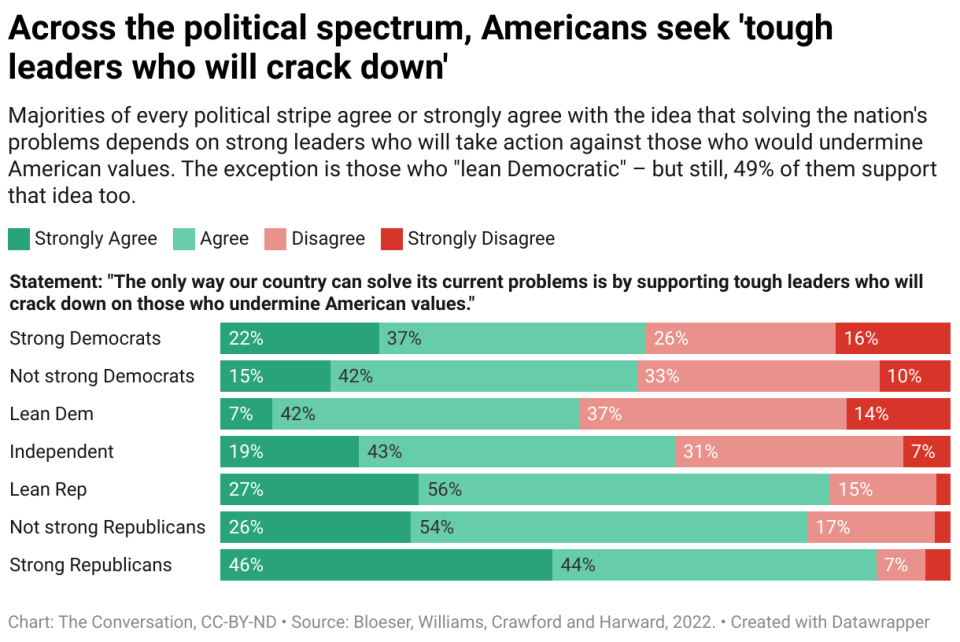
I offer for your consideration two graphs from an article at The Conversation about an Allegheny College poll on how we - post-Americans - view the value of those guardrails and foundations:

and


There is no more important undertaking for the people of this country than to look into how we came to this state of affairs.

That's actually been the impetus behind LITD since 2012, and is baked into the mission statement at my Substack, Precipice:  

[The name] Precipice indicates that America, Western civilization and the world generally are close enough to a yawning abyss to see its terrifying vastness. It’s an abyss with cultural, political, economic and spiritual dimensions.

I so named it knowing the risk that it would come across like yet another Debbie Downer outlet in a world in which happiness is at a premium. But pointing out evidence of my premise is not the aim. The question before us is, on what grounds might we hope?

You won’t find pat answers. I consider myself a Christian - albeit a rather crummy one - but I don’t serve up platitudes, cliches about how since all is well in the eternal realm we needn’t fret about our current juncture, or attempts to recruit the uncommitted.

Rather, I invite you to join me on a journey, a search for genuinely solid ground, on which we can plant our feet and not feel perilously close to free fall. 

If our toes are truly gripping the edge of the precipice, is there time for such a search? 

I’d argue that there is no other sensible use of our time.

Peruse the archives and you'll see that I've zeroed in on various inflection points: the impact of Rouseau's state-of-nature framework, the Enlightenment veneration of rationality, the Romantic poets' turn the other way to the point of immersion in personal feelings, the thinkers behind the fin de siecle wave of Progressivism. I even did a post about turning 13 in the year 1968, titled "On Entering Adolescence During the Tectonic Shift."

I keep thinking about the money line from Kevin Williamson's December 16 Wall Street Journal column titled "You Asked For It, America."  He says, "Sometimes a country is doing so well it can afford a silly season. This is not that time and the US is not that country."

The devaluing of seriousness has serious consequences. In this instance, the consequence appears to be the completion of the squandering of our birthright. 

And here's a way to tell how badly infected you might be with this dismissing of seriousness: If you finish reading this and say, "That's exactly why we need to elect a majority of [pick one of the two major political parties]," you urgently need an antibiotic intervention. 

What we really need isn't remotely on the minds of most of us.

Sunday, November 12, 2023

Neither Biden nor Trump is acceptable to me

 Carlos Lozada, writing at the New York Times, makes about as compelling a case as could be made for why, even though it's incredibly unpopular, a 2024 rematch between the current president and the Very Stable Genius is just what we need:

Only a third of Americans view President Biden favorably, and two-thirds of Democrats and Democratic-leaning voters want to nominate someone else for the presidency (no one in particular, just someone else, please). Trump is the overwhelming favorite to become the Republican nominee for the third consecutive time, but his overall approval rating is lower than Biden’s. And while 60 percent of voters don’t want to put Trump back in the White House, 65 percent don’t want to hand Biden a second term, either. The one thing on which Americans seem to agree is that we find a Biden-Trump 2024 rematch entirely disagreeable.

This disdain may reflect the standard gripes about the candidates. (One is too old, the other too Trump.) But it also may signal an underlying reluctance to acknowledge the meaning of their standoff and the inescapability of our decision. A contest between Biden and Trump would compel Americans to either reaffirm or discard basic democratic and governing principles. More so than any other pairing, Biden versus Trump forces us to decide, or at least to clarify, who we think we are and what we strive to be.

The VSG's Claremont, New Hampshire speech yesterday reinforced this assertion by Lozada:

Trump is running as an overtly authoritarian candidate — the illusion of pivots, of adults in the room, of a man molded by the office, is long gone. He is dismissive of the law, except when he can harness it for his benefit; of open expression, except when it fawns all over him; and of free elections, except when they produce victories he likes. He has called for the “termination” of the Constitution based on his persistent claims of 2020 electoral fraud, and according to The Washington Post, in a new term he would use the Justice Department as an instrument of vengeance against political opponents. We know who Trump is and what he offers.

But he offers weak tea when he frames his reasoning for why Biden is a foil to that:

Biden’s case to the electorate — for 2020, 2022 and 2024 — has been premised on the preservation of American democratic traditions. In the video announcing his 2020 campaign, he asserted that “our very democracy” was at stake in the race against Trump. In a speech two months before the midterm vote last year, he asserted that Trump and his allies “represent an extremism that threatens the very foundation of our Republic.” And the video kicking off his 2024 re-election bid featured multiple scenes of the assault on the Capitol on Jan. 6, 2021. “The question we are facing,” Biden said, “is whether in the years ahead we have more freedom or less freedom.” That is our choice in 2024.

Why do I say that? After all, what happened on 1/6/21 was indeed a major assault in American democracy.

But consider the issue, along with preserving democracy, on which Biden polls better than Trump:

A recent New York Times/Siena College poll that shows Trump leading Biden in five battleground states also asked registered voters which candidate they trust on key questions. Trump won on the economy, immigration and national security; Biden received higher marks on just two issues. The first was abortion, a core priority among Democratic voters and one that proved powerful in last year’s midterms and the off-year elections and ballot initiatives last Tuesday in states like Ohio, Kentucky and Virginia.

My view on abortion boils down to this: If it's a diabolical act, a criminal act warranting the most severe punishment, and a sin against God for me to pop a hole in your skull and vacuum your brains out, why is it any less so if you're not born yet?

As I put it in my latest piece at Precipice, 

The division between those who are pro-life and those who assert the necessity of legalized abortion hinges on the notion of a human soul, and whether one is present from the moment of conception. That’s why the rejoinder to the right-to-make-my-own-decisions-about-my-body argument is to assert that more than one body - and hence more than one soul - is involved when a woman is pregnant.

I’ve never been demonstrative about my own pro-life position, never attended any rallies or dinners or engaged any elected officials about the matter. It may not be the most laudable way to be pro-life, but I’ve reacted to the state of affairs over the last fifty-plus years by being sad. Sad that pro-choicers want to put worst-case scenarios - rape, incest and fathers unwilling to be fathers - first. What a hard and cold way to view human development. What would it take to uphold the ideal of family, that most basic of social units, where, when it’s in a healthy condition, is the environment in which we learn about how to lovingly interact with other people? What about venerating nurturing, guidance, encouragement, team spirit, humor, and generosity?

There seems something bitter at the core of a pro-choice position. Its inclination is to respond to what I’m saying in the above paragraph with, “Yeah, show me an actual family that unfailingly venerates those things, that sustains the happiness of everyone in it, that isn’t fraught with underlying issues.”

If you want to see the playing-out of that particular argument, click the link.

But here I bring up abortion because it's only one element of why I can't vote for Biden, or, more broadly, for Democrats.

Abortion is really a sub-category of identity politics militancy. It sets women up, not as roughly half of the human species, but as an oppressed demographic - alongside people who happen to be black, people with unorthodox sexual attractions, and people who have some notion that they'd find fulfillment in mutilating their crotches and messing with their God-given hormonal balance. 

And then there's climate alarmism. Biden is a full-throated champion of having the federal government interfere in the millions of freely-entered-into agreements on the value of millions of goods and services that take place every day, in the name of weaning society off fossil fuels, which are cheap, dense and readily available, compared to any the play-like energy forms our overlords would impose on us. 

And he endorses wealth redistribution as the cudgel by which he'd bring this agenda to fruition. 

James Madison, the architect of our Constitution, was quite clear on this point. It is not within the proper purview of government to influence people's choices on energy forms, or to mandate preferences in hiring or college admission based on demographics, or to change the thousands-of-years-old definition of marriage, or indulge anyone's insistence on being regarded as the gender opposite what he or she obviously is.

It is wrong to take Citizen A's money to address the particular needs or wants of Citizen B.

Indeed, we ought to insist that government puke all over itself to justify taking the first red cent from any of us, ever. 

So I cannot accept a choice between a cult leader who makes it clear he'll try to jail anyone who is not 100 recent loyal to him, and a candidate who has been steeped all his life in the ever-more-collectivist tilt of the Democrat party.

I have no problem with staying home next May and nest November. 

I will not have the eternal record book showing that I contributed to the final shattering of this country, even if that's inevitable. 


Thursday, June 22, 2023

Thoughts on the massive drop in US middle schoolers' reading and math test scores

 It's been underway for many years, but there's been a recent acceleration of the trend:

American students' test scores in math and reading got significantly worse last year — continuing a decade-long freefall.

Driving the news: The decline in math scores last year was the biggest in the past 50 years, according to newly released federal data.

Details: The findings come from a test known as "The Nation's Report Card" — a continuous, national assessment of 13-year-old students. Results were distributed by the National Center for Education Statistics, a branch of the Education Department.

By the numbers: Math and reading scores began declining in 2012, and average scores are now lower than they were before the pandemic.

  • The average math score for 13 year olds declined 9 points between the 2019-20 and 2022-23 school years.
  • The average reading score for 13 year olds declined 4 points between the 2019-20 and 2022-23 school years.
  • About 8,700 students took the assessments at about 460 schools across the country.

The lowest-performing students scored at levels last recorded in the 1970s, when the assessment began.

  • Scores declined among all racial and ethnic groups, and among both male and female students, and across urban, suburban and rural areas.

Enrollment in algebra dropped from 34% of 13 year olds in 2012 to 24% in 2023.

  • And fewer students said they frequently read for fun, which is associated with higher achievement.

What they're saying: Post-pandemic academic recovery should be addressed holistically, including students' mental health, basic skills and teacher absenteeism, said Peggy Carr, the associate commissioner for assessment for the National Center for Education Statistics.

  • "Students' basic skills were disrupted in a way that we would not have thought before," Carr said. "These data are clear on that point." 

What we're watching: Test results from earlier this year showed that U.S. history scores among middle schoolers are also falling — dropping to the lowest levels ever recorded since the assessment began in 1994. 

  • Reading and math scores of elementary school students also plummeted, demonstrating the far-reaching effects of education changes during the pandemic.
  • "The educational opportunities we give today's students are crucial for their individual and collective success," said Lesley Muldoon, the executive director of the National Assessment Governing Board. "Leaders from federal, state and community levels must act with urgency and prepare students to pursue their educational, career and life goals."

It is accurate to ascribe much of this to "education changes during the pandemic." 

When pretty much everything, certainly including schools, was shut down in March 2020, I was rather vocal about extending grace to those implementing this policy. The virus was an unprecedented phenomenon, and we, as a society, were feeling our way through. I thought at the time that the last thing we needed was one more battlefield on which to further rub raw our already polarized environment. 

But we started learning about what was and was not a public-health threat. One thing we learned is that schools could have opened, certainly by that fall. But vested interests had another agenda

The fault for this educational disaster must also be pinned on our public-health bureaucracy, which constantly exaggerated the danger of Covid-19 to children, and the danger of spread at schools, while underplaying the adverse public-health outcomes of school closures. Particularly galling was the CDC’s taking the non-scientific advice of teachers’ unions while developing guidance on school reopening. America was a strange global outlier in masking children, restricting their movement and play, and shutting down their schooling. The baleful results are only just now being tallied.

Parents and children are owed not just an apology but a strict public accounting of what went wrong and why.

But let's be honest here. This was just the latest manifestation of the cultural rot that has been underway since the tectonic shift of the 1960s.  

The whole reason for the current classical-education movement is that public schools lost sight of what education ought to be for. About the time of the Great Upheaval, the John Dewey vision of what education was about irreversibly predominated. It simultaneously pursued two tracks: preparing students for the work force / job market, and encouraging them to preoccupy themselves with that which was "relevant" at the expense of a grounding of the best that the best minds of Western civilization had contributed to human existence. I saw it firsthand. By 1968, when I was in seventh grade, we were having class-time discussions about rock lyrics.

 As the decades progressed, the educational apparatus focused more and more on social issues. I remember a substitute teaching stint in the 1980s in which a lesson for the day during the health segment had to do with coping strategies for living in a blended family. I thought, in my day, health class was about matters such as here's-where-your-pancreas-is-located. 

As an academic historian, I'm particularly alarmed and saddened by history scores dropping to their lowest level ever. I guess it's to be expected. What kid wants to be guilt-tripped about race and capitalism day after day? 

So let's be sure we don't treat this as an isolated phenomenon. No amount of tweaking of our present approach is going to rectify this plummet. 

There is no level on which our civilization is not in deep trouble.