Michael Beckley and Hal Brands of the American Enterprise Institute, writing in Foreign Affairs, offer a view, well substantiated, it seems to me, of China's role on the world stage going forward that runs counter to common assumptions. The piece is entitled "The End of China's Rise."
True, China has been on the move on many fronts recently, but . . .
. . . if Beijing looks to be in a hurry, that’s because its rise is almost over. China’s multidecade ascent was aided by strong tailwinds that have now become headwinds. China’s government is concealing a serious economic slowdown and sliding back into brittle totalitarianism. The country is suffering severe resource scarcity and faces the worst peacetime demographic collapse in history. Not least, China is losing access to the welcoming world that enabled its advance.
Welcome to the age of “peak China.” Beijing is a strong revisionist power that wants to remake the world, but its time to do so is already running out. This realization should not inspire complacency in Washington—just the opposite. Once-rising powers frequently become aggressive when their fortunes fade and their enemies multiply. China is tracing an arc that often ends in tragedy: a dizzying rise followed by the specter of a hard fall.
The authors review China's history since the First Opium War of 1839, how it went from being exploited and humiliated to coming together under Communist rule, to self-imposed isolation, to opening up, beginning with the Nixon-Kissinger outreach, to the age of accessible markets and exchange of technology, to having an abundance of working-age citizens. The world kind of forgot the foundations of the regime as Western companies set up plants and joint ventures there and China sent students to America's most prestigious business schools.
It would be follow to proceed on the assumption that that is still the state of affairs, though:
But once-in-an-epoch bonanzas don’t last forever. For the past decade, advantages that once helped the country soar have become liabilities dragging it down.
For starters, China is running out of resources. Half of its rivers have disappeared, and pollution has left 60 percent of its groundwater—by the government’s own admission—“unfit for human contact.” Breakneck development has made it the world’s largest net energy importer. Food security is deteriorating: China has destroyed 40 percent of its farmland through overuse and become the world’s largest importer of agricultural products. Partly owing to resource scarcity, growth is becoming very expensive: China must invest three times as much capital to generate growth as it did in the early years of this century, an increase far greater than one might expect as any economy matures.
China is also running out of people, thanks to the legacy of the one-child policy. Between 2020 and 2035, China will lose roughly 70 million working-age adults and gain 130 million senior citizens. That’s a France-sized population of consumers, taxpayers, and workers gone—and a Japan-sized population of pensioners added—in 15 years. From 2035 to 2050, China will lose an additional 105 million workers and gain another 64 million seniors. The economic consequences will be dire. Current projections suggest that age-related spending must triple by 2050, from ten percent to 30 percent of GDP. For perspective, all of China’s government spending currently totals about 30 percent of GDP.
Dealing with these problems will be especially difficult because China is now ruled by a dictator who consistently sacrifices economic efficiency for political power. Private firms generate most of the country’s wealth, yet under President Xi Jinping, private firms are starved of capital. Instead, inefficient state-owned enterprises receive 80 percent of government loans and subsidies. China’s boom was spearheaded by local entreprures of eneurs, but Xi’s anticorruption campaign has scared local leaders from engaging in economic experimentation. His government has essentially outlawed negative economic news, making smart reforms nearly impossible, while a wave of politically driven regulations has squelched innovation.
As China has become more assertive and authoritarian, the world has become less conducive to Chinese growth. Beijing has faced thousands of new trade barriers since the 2008 financial crisis. Most of the world’s largest economies are walling off their telecommunications networks from Chinese influence. Australia, India, Japan, and other countries are looking to cut China out of their supply chains.
China is now dealing with a major economic slowdown. It is home to 50 gleaming metropolises, complete with high-rises and multi-lane expressways that lack the essential component to make them viable: residents. The Communist Party is returning to its Maoist roots. Due to China's expansionist gestures of recent years, its neighbors, from Japan to the Philippines to Indonesia to Vietnam, are becoming increasingly united in seeing the need to stand up to it.
China's leaders see a window closing:
China today checks many worrying boxes. Slowing growth? Check. Strategically encircled? Check. Brutal authoritarian regime with few sources of organic legitimacy? Check. Historical axe to grind and revanchist ambitions? Check and check. In fact, China is already engaging in the practices—the relentless military buildup, the search for spheres of influence in Asia and beyond, the effort to control critical technologies and resources—to be expected from a country in its position. If there is a formula for aggression by a peaking power, China exhibits the key elements.
Many observers believe China is throwing its weight around today because it is so confident in its continued ascent. Xi certainly appears to think that COVID-19 and political instability in the United States have created new possibilities to advance. But the more likely—and much scarier—possibility is that China’s leaders are determined to move fast because they are running out of time. What happens when a country that wants to reorder the world concludes it might not be able to do so peacefully? Both history and China’s current behavior suggest the answer is: Nothing good.
National conversations about government spending go back at least as far as the New Deal. Every so often, they attain front-burner status. but lately we seem to have become so inured to spending's effect on our future and the changing relationship between the state and the individual that even the recent uptick on attention to it doesn't seem to garner much buzz beyond the worlds of news and punditry. It's not exactly coffee-shop fodder.
But government profligacy's steadily gathering momentum under administrations of both major parties gets easier as its enthusiasts are ever-more able to say, quite correctly, that when those who have a record of saying that they want to see a reversal gain control of a branch or branches of government, there is only continued acceleration. This is why Donald Trump's election and the takeover of the Republican Party by Trumpists has been particularly pernicious. They demonstrably don't care about the size, scope, intrusiveness and insolvency of the federal government. One could point to the tax cuts of 2017, but tariffs soon countered the cuts' beneficial effects.
There are several components to the current round of attention to the matter. There's the tax aspect, the debt-and-deficit aspect, the statism-on-steroids aspect, and the inflection point at which Democrats find themselves.
Taxation inherently produces tension in a society founded on the primacy of human freedom. It's considered bad form to bring up the basics of what taxation is; that's for subtlety-lacking libertarian types to chime in with, according to modern perception. But it merits spelling out plainly on occasion: It is government using its monopoly on the legitimate use of force to take that which belongs to citizens and the organizations they form. Obviously, the functions of government envisioned by Madison need to be financed somehow, and healthy debate about how to go about raising that revenue ought to be encouraged.
That's not what we have now. Taxes of various sorts are proposed as a way too demonize certain categories of people and organizations. The broadest target of this effort is "the rich," who are still, at this late date, accused of not paying their "fair share."
According to the latest IRS data for 2018—the year following enactment of the Tax Cuts and Jobs Act (TCJA)—the top 1 percent of taxpayers paid $616 billion in income taxes. As we can see in Figure 1, that amounts to 40 percent of all income taxes paid, the highest share since 1980, and a larger share of the tax burden than is borne by the bottom 90 percent of taxpayers combined (who represent about 130 million taxpayers).[2]
In case you are thinking, “Well, the rich make more, they should pay more,” the top 1 percent of taxpayers account for 20 percent of all income (AGI). So, their 40 percent share of income taxes is twice their share of the nation’s income.
Similarly, in 2018, the top 0.1 percent of taxpayers paid $311 billion in income taxes. That amounted to 20 percent of all income taxes paid, the highest level since 2001, as far back as the IRS data allows us to measure. The top 0.1 percent of taxpayers in 2018 paid a greater share of the income tax burden than the bottom 75 percent of taxpayers combined.
Under current law, the United States statutory corporate tax rate of 25.8 percent (21 percent federal statutory rate plus the average of state and local corporate tax rates) is slightly below the OECD average (weighted by GDP) of 26 percent. The METR [marginal effective tax rate] on corporate investment in the United States, under current law, is 18.3 percent, 2.9 percentage points higher than the OECD average. The AETR [average effective tax rate] in the United States is 23.4 percent, which is roughly in line with the OECD average of 22.8 percent.
The Biden administration has proposed raising the statutory corporate income tax rate to 28 percent, while the House Ways and Means Committee has approved a proposal to raise the corporate tax rate to 26.5 percent. Lawmakers have also proposed reforming the tax treatment of foreign profits of US multinational corporations and repealing or reforming the low tax rate on foreign-derived intangible income (FDII). Their goals are to increase federal revenue, increase the tax burden on capital income, and reduce profit shifting by US multinational corporations.
The Biden and House proposals would raise the statutory and effective tax rates to either the highest or nearly the highest in the OECD (see the table below). Both proposals increase the tax burden on corporate investment, reduce the incentive to invest in the United States, and increase the incentive to shift profits and high-return assets into low-tax jurisdictions.
The central thesis of Treasury’s article is that business owners are the primary source of all tax cheating in the U.S. According to the article, “about half of the individual income tax gap accrues to income streams from proprietorships, partnerships, and S-corporations, where there is either little or no information available to the IRS to verify the veracity of tax filings.” Put differently: Unless the IRS has third-party information to verify the claims made by self-employed people, they will systematically cheat on their tax returns.
This claim is based primarily on IRS audit results; yet as I’ve written in the past, these data are simply unreliable. It is well-documented that the IRS’s audit results are wrong between 60 to 90 percent of the time, depending on the issue. Moreover, because IRS auditors are themselves undertrained in tax law, they often misapply the proper legal standards to their audit decisions. Even worse, auditors routinely use tactics of bluff and intimidation, misinformation, and disinformation, and even outright lie to citizens during audits to coerce taxpayers into accepting audit results that are simply not accurate.
Your government would like you to believe that it is only going to go after "the rich," and that the noble intentions of the non-rich will not be disrespected. Are you buying it?
The author of the article continues to advance the party line that Biden’s tax plan will not affect anyone earning less than $400,000 per year. Consider this statement:
It is important to understand what this improved information reporting proposal is not: It is not about using new financial account information reports to increase enforcement scrutiny on lower-income taxpayers. The Administration has been clear that audit rates will not rise relative to recent years for those with under $400,000 in actual income. Instead, these proposals are about targeting enforcement actions where they belong: on higher earners who do not fully report their tax liabilities.
In light of the claim that the underreporting is attributable to “proprietorships, partnerships, and S-corporations,” it is — to use a kind word — disingenuous to suggest that self-employed individuals operating under one of these entity forms will not be targeted for enforcement action. The vast majority of self-employed people operate under one of these entities, and the vast majority of them earn under $400,000 annually. The reality is that, as a whole, the money in America is largely in the hands of the middle class. You can be sure, then, that’s where the IRS attacks will be targeted.
Propaganda is what it is, and so I was unsurprised to read in the article the claim that we have a “two-tiered tax system.” The author claims that our tax system contains “two sets of rules: one for regular wage and salary workers who report virtually all the income they earn; and another for wealthy taxpayers, who are often able to avoid a large share of the taxes they owe.”
This is not so. There are absolutely not two sets of rules in the tax code. The Internal Revenue Code applies to all taxpayers equally. A person earning a small amount of income must report all of it and pay whatever tax is owed after the application of allowed deductions, credits, etc. The same is true for high-income people.
This is merely a thinly veiled attempt to use class envy as a device to persuade lower-income people that while they must pay through the nose on their taxes, high-income people are permitted to systematically cheat on theirs. In that case, the former will likely countenance any plan to attack the latter without considering the possibility that they also might be harmed. But that’s exactly what will happen since there are simply not enough high-income earners available to raise the revenue needed to support the trillions of dollars in proposed spending and deficits.
There are a number of counter-arguments to be made against the assertion that we could afford all the statist designs of the overlords if the cheats could be brought to heel. It really boils down to one essential point: those statist designs are the problem:
In truth, though, your taxes are high and getting higher for one reason only: Congress spends way too much of your money, without any incentive to stop . . . To suggest that policy-makers engage in some level of intellectual “give and take” over the friction between higher deficits and lower spending is complete nonsense.
Anybody who’s spent any time studying these policy issues knows full well that Congress sets its spending agenda first. That agenda is determined by the social and political issues of the day. It then sets tax policy based on the same considerations. At no point does Congress say: “We have X dollars to spend, so how do we allocate those funds?”
If the $3.5 trillion Democratic reconciliation bill becomes law in anything close to current form — including paid parental and sick leave, universal preschool, some free college, and an annual check to households with younger children — it would be a big step toward turning the United States into a European-style comprehensive welfare state. Many progressive Democrats speak highly of the Scandinavian social democracies, in particular. As Bernie Sanders has put it: “I think we should look to countries like Denmark, like Sweden and Norway and learn what they have accomplished for their working people.”
But those loving glances toward Team Nordic often produce fuzzy vision. They typically miss something really important: how those countries pay for those massive welfare states. As Wall Street Journal columnist Greg Ip notes:
Yet if other countries’ welfare states are a template for American progressives, their taxes aren’t. In Germany, the typical worker pays 49% of her labor compensation in income and payroll taxes (including the employer’s contribution); in France, the proportion is 47%, in Sweden, 43%. In the U.S., it is just 30%. The U.S. alone, among major advanced economies, doesn’t impose a value added tax on consumers of goods and services.
On that last point: Denmark, Sweden and Norway all have VAT rates of 25 percent, according to the Tax Foundation, with each collecting close to 10 percent of GDP through the levy. Yet Democrats have made a big deal about not raising taxes on households earning less than $400,000 a year. (There are some exceptions as Ip notes: “Smokers, for example, will pay a higher cigarette tax, and middle-class stockholders will indirectly bear some of the higher corporate tax rate.”)
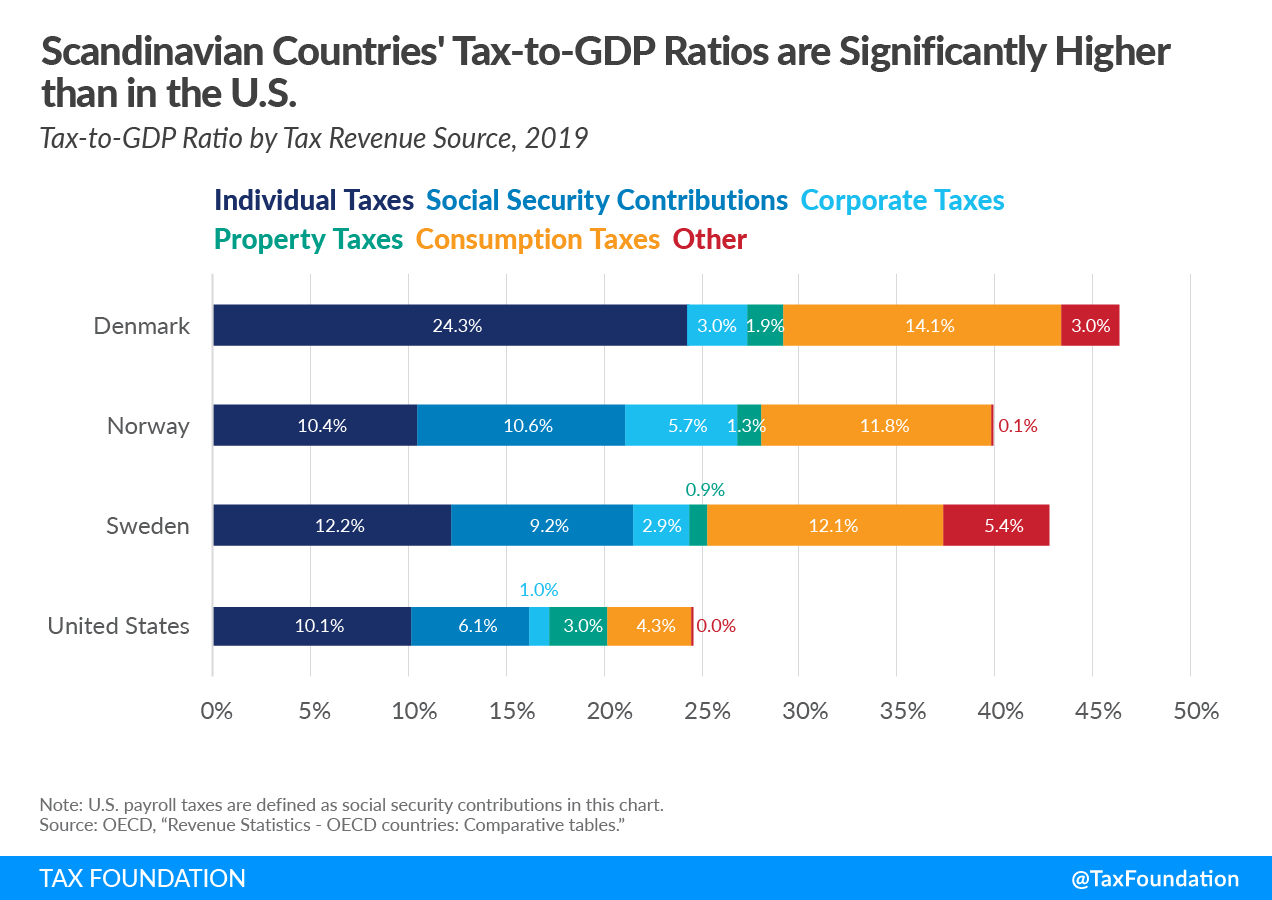
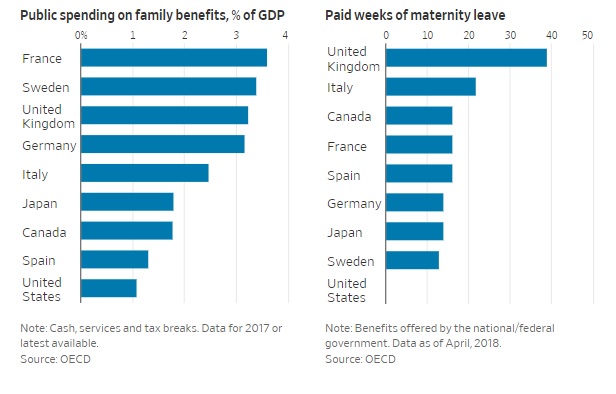
One could argue that there’s still plenty of room to fund more social spending through higher corporate taxes and higher top income-tax rates before talking about an economy-wide VAT. That, especially given higher income inequality in the US. But clearly creating Nordic America is going to require lots of additional revenue, whether through a VAT, carbon taxes, or a combination of both. Again the Tax Foundation: “In 2019, Denmark’s tax-to-GDP ratio was at 46.3 percent, Norway’s at 39.9 percent, and Sweden’s at 42.8 percent. This compares to a ratio of 24.5 percent in the United States.” And these WSJ charts highlight the current gap in social spending and spending commitments between the US and Europe:
It’s hard to avoid the reality — unless you’re a progressive politician, perhaps — of a fundamental mismatch between the left’s spending dreams and the economics of taxation. One caveat, which I point out in a recent The Week column:
Unless of course, Democrats adopt novel theories of macroeconomic policy that suggest significantly less need to pay for government spending. But there’s little evidence that anyone outside deeply left progressive politics or EconTwitter takes such ideas seriously. Certainly there’s no evidence that Federal Reserve Chairman Jerome Powell does, and he’s likely to be renominated for another term as boss of the central bank. If the far left really wants a transformational presidency — whether Biden’s or someone else’s — the lives of all Americans would need to fundamentally change.
Now, to the specifics of the current situation.
Manchin and Sinema have much of the rest of the Democratic Party pulling its hair out.
It's been somewhat amusing to read the columns and essays purporting to ascribe motives such as ego and political calculation to their reluctance to sign onto both an infrastructure bill that, for all its pork and statism, at least addresses actual infrastructure, as that term is commonly understood, and then, on the heels of the passage of that, a $3.5 trillion (hopefully you're not so numb that the magnitude of that figure didn't get your attention) reconciliation bill. According to these theories, they are merely getting a kick out of tweaking progressives' noses, or they are kowtowing to the red-statish inclinations of their constituents with no real convictions on the concerns they raise.
The good news for post-Americans who still prioritize the sovereignty of the individual is that those two Senators are going to make it, for all intents and purposes, impossible for the Democrats to impose this new degree of statist intrusion into our lives and get away with the fiscal peril it entails.
There's still a Herculean task before us, though. Way too many people in this country would be fine with a Nordic model, in which government would take a good half or more of everything someone busts his or her ass to earn, in return for a set of services and benefits in such areas as health care, education, and retirement that government would dispense at a level of quality and within a range of what it deemed suitable for you to choose from.
This is a major step on the way to reducing us to the status of cattle.
There's a reason why the telephone, the airplane, the television and the personal computer all originated in the United States of America. Our government honored ingenuity. It turned loose the basic human impulse to improve one's lot. The more government has moved away from that, the more saddled with debt we've become, and, more to the point, the less we think about the value of freedom.
The US House of Representatives on Thursday approved a stand-alone bill to provide Israel with $1 billion for replenishing the Iron Dome missile-defense system, following two days of contentious debate within the Democratic Party. The vote passed with an overwhelming 420-9 majority, with two Democrats, Reps. Alexandria Ocasio-Cortez and Hank Johnson, effectively abstaining by voting “present.”
Eight Democrats — Reps. Rashida Tlaib, Ilhan Omar, Ayanna Pressley, Cori Bush, Andre Carson, Marie Newman, Jesus Garcia, Raul Grivalva — and one Republican, Rep. Tom Massie, voted against.
The bill is now headed to the Senate, which will need to approve it as well.
Now, I realize that the eight Dems who were thumbs down all represent districts where their fetid views on Israel find resonance. (Massie is a different case. He comes at this from a different - that is, to say, libertarian-ish - motivation for objecting.) But there are a whole lotta folks of various stripes in the people's house who aren't anywhere near such a position.
Tlaib had to subject us to the contents of her pie-hole on the matter:
Rep. Rashida Tlaib (D-Michigan) called the Israeli government an “apartheid regime,” and announced she would oppose the bill. “I will not support an effort to enable and support war crimes, human rights abuses and violence. We cannot be talking only about Israelis’ need for safety at a time when Palestinians are living under a violent apartheid system,” she said.
Israel’s Ambassador to the US and the UN Gilad Erdan rejected Tlaib’s remarks and tweeted, “You know the truth but chose to ignore it. The Iron Dome defends Israel from Hamas’s war crimes, including firing rockets toward civilian population.
“The US recognizes Hamas as a terror organization. Your actions help to protect terrorists,” Erdan added.
“We heard right now from my colleague across the aisle a shocking statement. She opposes this because they have a vocal minority in the majority party that is anti-Israel. That is antisemitic, and as Americans, we can never stand for that.
“I reach out to the majority and I say, condemn what we just heard on the floor, condemn terrorism. This is a defensive weapon system. Stop playing your procedural games,” Fleischmann added.
Rep. Ted Deutch (D-Florida) rejected Tlaib’s comments, as well.
“I cannot allow one of my colleagues to stand on the floor of the House of Representatives and label the Jewish democratic state of Israel an apartheid state. I reject it,” he said. “Today, the House of Representatives will overwhelmingly stand with our ally, the State of Israel in replenishing this defensive system. If you believe in human rights, if you believe in saving lives, Israeli lives and Palestinian lives, I say to my colleague who just besmirched our ally, then you will support this legislation.
“We could have an opportunity to debate lots of issues on the House floor, but to falsely characterize the State of Israel is consistent with those who advocate for the dismantling of the one Jewish state in the world. And when there is no place on the map for one Jewish state, that’s the antisemitism. And I reject that,” Deutch continued. “I stand in support of this important legislation.”
It's heartening, though, to see that so few, relatively speaking, of them go in for that sewage.
Maybe the West is more viable than is often assumed these days when push comes to shove.
France's rage over Australia choosing the US over France to supply some attack submarines has receive abundant coverage. France has recalled its US ambassador. It's caused difficulties with France's relations with Britain as well.
France would have known Australia had “deep and grave concerns” that a submarine fleet the French were building would not meet Australian needs, Prime Minister Scott Morrison said Sunday after the contract's cancellation set off a diplomatic crisis.
France accused Australia of concealing its intentions to back out of the 90 billion Australian dollar ($66 billion) contract for French majority state-owned Naval Group to build 12 conventional diesel-electric submarines.
President Joe Biden revealed last week a new alliance including Australia and Britain that would deliver an Australian fleet of at least eight nuclear-powered submarines.
Morrison blamed the switch on a deteriorating strategic environment in the Indo-Pacific. He has not specifically referred to China’s massive military buildup, which has gained pace in recent years.
“The capability that the Attack class submarines were going to provide was not what Australia needed to protect our sovereign interests,” Morrison said.
“They would have had every reason to know that we have deep and grave concerns that the capability being delivered by the Attack class submarine was not going to meet our strategic interests and we have made very clear that we would be making a decision based on our strategic national interest,” he added, referring to the French government.
France responded to the contract cancellation, which Morrison has said will cost his government at least AU$2.4 billion ($1.7 billion), by recalling its ambassadors from Australia and the United States.
French Foreign Minister Jean-Yves Le Drian on Saturday denounced what he called the “duplicity, disdain and lies” surrounding the sudden end of the contract and said France was now questioning the strength of the alliance.
The fact that the switch results in lost opportunity for many French businesses just doesn't stack up against these concerns, from Australia's perspective. It would be a shame if a major rift in the Western world came down to a mater of protectionism.
Peggy Noonan's column in the Wall Street Journal this morning encapsulates exactly where we are as a civilization. She launches her reflection with a comparison of the unity America experienced in the aftermath of the September 11, 2001 attack and the utter lack of it on the occasion of the twentieth anniversary:
It had to do with a sense that we are losing the thread, that America is losing the thread. We compared—we couldn’t help it, it is in the nature of memory—the America of now with the America of 20 years ago, and we see a deterioration. We feel disturbance at this because we don’t know if we can get our way back. The losing of the thread feels bigger than ideology, bigger certainly than parties. It feels like some more fundamental confusion, an inability to play the role of who we are, and to be comfortable in who we are.
The money line of the whole essay is this:
Just about every large business in America is now run by its human resources department because everyone appears to be harassing and assaulting each other, or accusing each other. Is this the sign of a healthy country?
COVID has served to worsen our fracturing. Concern about our price various financial state has faded to the point of being negligible. That there isn't unanimous alarm about what happened at the Capitol this past January says much about where we are:
And of course it all plays out in a million political and cultural issues. The pandemic came, a once-in-a-lifetime occurrence (we hope) and somehow that shared experience became another opportunity for division. Government had to be deft and persuasive and honest about what it didn’t know and didn’t have, and often failed. But government can always regulate, spend and tax. We’re no deficit hawks in this corner but doesn’t U.S. public debt going toward $30 trillion feel a little . . . high? And dangerous?
When a country has lost the thread it gets a mob breaking into the U.S. Capitol going for the ballots that will ensure and formalize a presidential election. When it’s lost the thread it can no longer maintain a rough consensus—it doesn’t even WANT a rough consensus—on how we vote.
Consider what the Met gala tells us about the flatlining of our culture:
The Met Gala the other night showed the elite of a major industry literally losing the thread. Google the pictures. It was a freak show. There was no feeling of a responsibility to present to the world a sense of coherence or elegance, to show a thing so beautiful it left the people who saw it aspiring to something they couldn’t even name. All this was presided over by a chic and cultivated woman who is cunning and practical. If freaky is in she’s going freaky deaky to the max. Follow the base, even if it’s sick. Do not lead. Leading is impossible now.
The argument is sometimes made that there's still a critical mass of Americans who are solid human beings, safeguarding the thread of which Noonan speaks. But their confidence in anything beyond their personal spheres has waned considerably:
What are regular people doing? My sense is they’re trying to hide from the national, figuring they’ll make strong what they can make strong—the family, the school, the local. They’re not trying to “maintain control” or “retreat,” they’re just trying to make things work. But what does it mean for a country when its most sober and thoughtful people are essentially trying to hide from it? To hide from the accusations and division and the growing air of freakishness, from the whole cultural revolution and the woke regime, trying to enforce boundaries between “that” and “us.” And knowing all the while that, as they say, you may be through with the culture but the culture isn’t through with you.
Strong stuff, but important to take in.
Danielle Pletka, writing at The Dispatch, says that the Taliban's re-ascension to rule in Afghanistan blows up the notion that Sunni and Shiite Muslims can't share goals and cooperate:
The era ushered in by 9/11 made theological terms like Sunni, Shiite, jihad, sharia, and Salafi household words, and birthed a nation of armchair experts on the intricacies of Islamic sectarianism and doctrine. Pretense to expertise is a privilege of living in a free country. Oddly, however, the U.S. government has adopted the same facile analysis of regional and religious dynamics in the Middle East and South Asia, viz. the trope that Shiite Iran is a natural enemy to the Sunni Taliban in Afghanistan. This is, in short, rubbish.
The Taliban victory in Afghanistan is a gift to Iran, nothing less.
How is this playing out?
At the end of the day, what underpins the Iranian relationship with the Taliban (as with al-Qaeda) is the central tenet of Iranian strategic policy overall: instability. While Tehran may have been pleased to aid the U.S. in ousting the Taliban in Afghanistan, it had no interest in seeing a stable, pro-American government to its east. And so, led by the IRGC, it returned to what Iranian strategists perceive as their sweet spot: playing both sides. The Taliban was licensed to open a political office in Iran. Senior Taliban leaders began occasional visits to Tehran to kiss the ring of the supreme leader. Meanwhile, the IRGC continued to support disgruntled Shiites inside Afghanistan. (Indeed, Iran’s support for those Shiites was such that by the time the Arab Spring erupted in 2011, Iran was well-placed enough in Afghanistan to reportedly recruit tens of thousands of Afghan Shiites to fight on behalf of their Syrian puppet Bashar al Assad.)
Nor was Iran’s support for the Taliban purely political. Tehran permitted Taliban training camps inside its borders andprovided“light arms, rifled-propelled grenades (RPGs), and even military training for Taliban forces on Iranian soil.” Later stories made clear that the Iranian government was alsopayingTaliban salaries. Andreportinglast year revealed that Iran was paying the Taliban bounties to kill American troops in Afghanistan.
The United States should revise its response to COVID-19. This is going to be a long explanation of both why and how. This first column will explain why a better response is crucial. A companion column will outline the better strategy.
The tragedy of the U.S. pandemic response is that conservatives tend not to take it seriously enough while liberals overreact with counterproductive solutions. Both responses make matters worse, meaning either more culturally and economically devastating or more deadly. Or both.
For more than six months, many conservatives have been saying the pandemic is effectively finished, especially for the vaccinated. Both the numbers and the nature of viruses show they are dangerously wrong. This contagion is a major ongoing threat .
On Aug. 7, when the rolling seven-day average of U.S. coronavirus daily deaths again rose above 500, alarm bells should have gone off: At that rate, the annual deaths would have been three times worse than even a bad year of ordinary influenza. Since then, the bad numbers have nearly quadrupled yet again. As I write today, the seven-day average of deaths-per-day is at 1,827, the highest since March 2 and still rising. If this keeps up for a whole year, 666,855 more Americans would die in 12 months from COVID-19, on top of the 662,000 who already succumbed in the past 18 months.
Here's a compare-and-contrast for you. Both Andrew Doran, writing at The National Interest, and Janan Ganesh, writing at the Financial Times, posit that there is a pointy-headed class of elites that has made a mess of US foreign policy, but Doran thinks the time may be ripe for putting that class out on its ear, while Ganesh thinks they are permanently ensconced.
Ed Morrissey at Hot Air on how three Supreme Court Justices are pushing back on the notion that the federal judiciary is a political spoils system:
There’s no doubt, though, that the Supreme Court has become one of the main institutions caught in that crossfire. Furthermore, it can’t compete in that polarized-partisan atmosphere. The Supreme Court doesn’t have an electorate, let alone a base to fire up on its own. Decades of judicial activism that preceded recent courts has made it into a political spoil for elections, and the judiciary wars in the Senate over the last two decades are the result.
This year, however, the justices appear to have had enough. One could chalk up Breyer’s public tour as the need to promote his book, but he wrote his new book in large part to fight back against charges of polarization and politicization on the Supreme Court. Barrett and Thomas have now come out on the same theme, putting three of the court’s more controversial members on the campaign trail too, so to speak.
The period between terms has always offered justices the time to engage publicly, and often talk about the collegiality of the court, but this time it feels different. The political environment has changed, and perhaps the justices have decided that it requires a more robust defense of their own institution before it gets gutted by the nihilists, and with it the independence of the judiciary and the rule of law to boot. If so, then Thomas and his colleagues have accurately diagnosed the tenor of our times — and hopefully will continue to push back against it.
Bob Woodward, collaborating with Robert Costa on this one, has a third book on the Trump presidency coming out. Woodward is a standard-setter for investigative journalism, but some question aspects of his pursuit of truth. To my knowledge, though, there hasn't been any credible refutation of the material in the Trump books. If someone - besides the Very Stable Genius himself or any of the drool-besotted members of his cult - had attempted to discredit the gist of Woodward's reportage on that era, it would have made a significant splash.
The pre-release excerpt from Peril, the latest in the series, that is garnering buzz is about Joint Chiefs of Staff chair General Mark Milley's concern about Trump's deteriorating mental state in the last few months of Trump's presidency, and the measures Milley took to mitigate possible policy results.
That Trump was coming unglued is something we were all able to verify with our own eyes and ears. His mega-boorish behavior at his October debate with Biden, his statement in the wee hours of November 4, the phone call to Brad Reffensperger begging him to "find" 11,000 votes, the tweet about how the rally scheduled for January 6 would be "wild," his inaction as the attack on the Capitol unfolded, and his big-baby refusal to attend Biden's inauguration all testify to it. Woodward's book adds some new details, but Trump's dangerousness was already established.
Two wrongs don't make a right, however, and Milley cultivating a back-channel relationship with his Chinese counterpart and assuring him by phone that Milley would give him a heads-up if the US were going to attack China is a violation of the chain of command that warrants immediate investigation. There are procedures in place for countering bad moves being considered by a commander-in-chief; Milley's approach isn't one of them.
So far in the twenty-first century, we have not been electing presidents with the foreign-policy chops this country has needed.
Trump wasted a great deal of time and jet fuel holding summits with Kim Jong-Un. His sleazy phone call to the president of Ukraine got him impeached. He famously insulted leaders of allied nations in person and on the phone.
Barack Obama's apology tour, his entering into a patty-cake agreement with Iran concerning its nuclear ambitions, and shameful little episodes such as letting Hugo Chavez present him with the gift of a Noam Chomsky book in front of the world's cameras all confirmed that he meant what he said about America needing fundamental transformation.
George Bush's naive notion that the Middle East and Central Asia, comprised of decidedly non-Western cultures, were ripe for Westernization did much to undo what he was right about - namely, that the Taliban in Afghanistan, and the Baathist regime in Iraq were rogue entities. He also pursued appeasement with North Korea, repeatedly sending Christopher Hill to East Asia for Six-Way Talks aimed at getting North Korea to change its stripes.
The prospects for righting this state of affairs aren't encouraging. With both of the country's major political parties vying to out-ridiculous each other, it seems unlikely that either will nominate a presidential candidate for the 2024 race that will instill confidence in his or her seriousness about the stakes on the world stage.
The point of my title was that we now had evidence that America's enemies had been emboldened by the humiliating way US military involvement in Afghanistan came to an end.
There's now evidence of a link between the two situations. Taliban spokesman Zabihullah Mujahid has said that "China is our most important partner and represents . . . an extraordinary opportunity for us because it is ready to invest and rebuild our country." There's talk between the two nations about getting Afghanistan in on the Belt and Road Initiative and modernizing Afghanistan's cop[per mining industry.
In a one-paragraph, unsigned order issued just before midnight on Wednesday, the court acknowledged that the providers had “raised serious questions regarding the constitutionality of the Texas law.” But that was not enough to stop the law from going into effect, the court explained, because of the way the law operates. Specifically, the court observed, it wasn’t clear whether the state officials – a judge and court clerk – and the anti-abortion activist whom the abortion providers had named as defendants “can or will seek to enforce the Texas law” against the providers in a way that would allow the court to get involved in the dispute at this stage.
The dissenters, Sotomayor, Kagan and Breyer, based their objection on the legal system's understanding of abortion as a constitutional right, per the Roe v Wade decision of 1973.
Roe is judicially wrought social legislation pretending to the status of constitutional law. It is more adventurous than Miranda and Griswold, other watchwords of judicial activism from its era. It is as much a highhanded attempt to impose a settlement on a hotly contested political question as the abhorrent Dred Scott decision denying the rights of blacks.
It is, in short, a travesty that a constitutionalist Supreme Court should excise from its body of work with all due haste.
Roe has been commonly misunderstood since it was handed down in 1973, in part because its supporters have been so determined to obscure its radicalism. It is commonly thought that Roe only prohibits restrictions on abortion in the first trimester, when it effectively forbids them at any time, imposing a pro-abortion regime as sweeping as anywhere in the advanced world.
The confusion arises from the scheme set out in the majority opinion, written by the late Justice Harry Blackmun.
In the first trimester, the court declared, the right to abortion was absolute. In the second, states could regulate it to protect the mother’s health. In the third, states could restrict abortion in theory, but had to allow exceptions to protect the life or health of the mother, defined capaciously in the accompanying case of Doe v. Bolton to include “emotional, psychological, familial” considerations, as well as “the woman’s age.”
Roe struck down 50 state laws and has made it all but impossible to regulate abortion, except in the narrowest circumstances. More to the point, the argument that its particular set of policy preferences is mandated by the Constitution is flatly preposterous.
Over the years, the decision’s laughable constitutional inadequacy has been widely recognized. Shortly after it came down, Harvard Law School professor John Hart Ely, a supporter of legalized abortion, wrote that “Roe is bad because it is bad constitutional law, or rather because it is not constitutional law and gives almost no sense of an obligation to try to be.”
“Justice Blackmun’s opinion provides essentially no reasoning in support of its holding,” a former Blackmun clerk, Edward Lazarus, has written. “And in the almost 30 years since Roe’s announcement, no one has produced a convincing defense of Roe on its own terms.”
That’s because none is possible. The court in Roe purported to find the constitutional right to abortion in the 14th Amendment, which says that no state can “deprive any person of life, liberty, or property, without due process of law.”
This passage has no obvious or even subtle connection to legalized abortion (in fact, abortion laws were being tightened in the 19th century when the amendment passed). No matter. According to Blackmun, abortion is so central to liberty that no restriction on it can stand constitutional scrutiny.
He is at pains to deny that unborn children are “persons in the whole sense.” As evidence, he points to clauses in the Constitution about persons that don’t have “prenatal application,” e.g., the requirement that persons must be 35 or older to run for president.
This is too stupid for words. Just because clauses like this refer to adults doesn’t mean that minors, or unborn children, don’t have rights.
The best case that can be made for Roe is that it is a mistaken decision on the books for nearly 50 years now, so it has to be honored as a precedent. But the court is not, and shouldn’t be, in the practice of standing by fundamentally flawed decisions. Brown v. Board of Education overturned Plessy v. Ferguson, which upheld segregated education, almost 60 years later. Just last week, the court overturned a labor decision from 1977.
But the Texas heartbeat law is too clever by half in the way it tries to get around the heavy-hand-of-government-preventing-women-from-exercising-a-right argument. In a you-ought-to-read-the-whole-thing piece by Matt Lewis at the Daily Beast entitled "I'm A Conservative Who Hates Abortion; The Texas Law Is A Disaster," Lewis steers clear of side issues and puts his concern for defending fetal Americans' right to life front and center:
I’m not here to quibble with the Supreme Court’s 5-4 decision not to enjoin a Texas law that bans abortions after a fetal heartbeat is detected—that was a complex legal and procedural decision over which reasonable people can disagree. Nor am I here to talk about the political backlash that may result from this, or whether Texas handed Biden “a lifeline” (although that’s entirely possible).
But I am here to suggest that the law hinders my ability to persuade others to value the dignity of life and to create a culture of life. If you care about changing minds and changing the culture, that’s a huge problem.
He says the law greatly hobbles the ability of pro-lifers to convincingly make their case by projecting the image of being vigilantes:
In defense of this law, conservatives are attempting to do something patently unfair to women and anyone who “aids or abets” them.
It also shifts the identity of someone who opposes abortion from being a devout modern-day William Wilberforce to being a glorified Dog the Bounty Hunter.
Roger Severino of the Ethics and Public Policy Center has the entirely opposite view. In a National Review piece, he calls it a stroke of genius:
The abortion industry has stifled pro-life laws by strategically bringing “pre-enforcement challenges” before liberal judges who dutifully prevent the laws from ever going into effect. This tactic upends the normal course of litigation by asking courts to consider what parties might or might not do and to weigh harms that might or might not be experienced, instead of judging concrete facts based on actual events. But in case after case, results-oriented judges have jettisoned legal norms on this point using what Justice Scalia famously dubbed the abortion “ad hocnullification machine.”
Successful pre-enforcement challenges don’t result in laws being literally erased from the statute books. Rather, they work through a legal fiction established in the case of Ex Parte Young that allows federal courts to bar state officials from enforcing the challenged laws. But what if a state allowed private citizens to go to court to enforce violations instead? That’s exactly what Texas did. It passed a law prohibiting abortions of children with beating hearts but left enforcement exclusively to private parties who can sue in court for $10,000 in damages per illegal abortion. Lost in the media panic over this law is the fact that defendants can still prevail if they prove a damage award would pose a “substantial obstacle” to getting an abortion on women served by a clinic defendant.
The concept of private-party law enforcement is more familiar than you might think. Consider a typical small-claims court where disputes range from breach of contract, to slip-and-fall cases, to accidental damage to a neighbor’s property. Or consider someone who sues a landlord under a state fair-housing law for sexual harassment. In each of these cases, enforcement is handled by private parties through the courts, and state prosecutors need not have anything to do with securing plaintiffs any compensation.
You might be thinking that the Texas law differs because it allows private people to sue even when their own rights aren’t directly harmed or at stake. Fair point. However, third parties already sue for the benefit of (indeed on behalf of) the government with some frequency. The False Claims Act, for example, allows Joe and Jane Citizen to sue contractors who have defrauded the federal government. They need not be employed by the government or the contractor, or have anything to do with the contract, yet can receive up to 30 percent of the monies recovered if they prove fraud without any federal-government participation whatsoever.
Texas’s genius was applying these existing legal concepts and frameworks to neutralize the abortion industry’s most potent weapon, the pre-enforcement challenge. Abortion clinics are now in an impossible bind because on the one hand, there is no one to sue because no state official is allowed to enforce the law, while on the other hand, there are too many people to sue because they can’t identify who among the millions of Texas pro-lifers will step forward to enforce the law.
Texas’s giving up its extraordinary prosecutorial power while empowering private citizens is like a stunning queen sacrifice in chess that enables the weaker pawn pieces to spring a trap on an unsuspecting king. As a result of this brilliancy, for the first time since 1973, abortion clinics in Texas are now halting abortions en masse because they are unwilling to stand before a judge to justify every time they stop a child’s beating heart.
What a marvelous check.
A cogent case, but ultimately falls short in light of the considerations raised by the likes of Lewis.
Now, regarding the two main responses we're hearing from the Left, they are old and tired, but merit a word of comment.
The whole my-body-my-choice / keep-governmental-force-out-of-my-uterus line of rage objection, we can begin, as has been the case for fifty years, by pointing out that, even if we are to call a fetus a pomegranate, or a 3/16-inch Allen wrench, the fact is that, dear choice advocate, you were one once, as were all of us. From there we can proceed to a position rooted in Christian doctrine. A new soul has entered the space-time realm at the moment of conception, and it only happens in the body of a female.
And that position leads us to the second response, namely, that pro-lifers seem to care a great deal about embryos and fetuses, but not so much about unfortunate people who are already born, such as the addicted and/or homeless, or immigrants between a rock and a hard place, or domestic violence victims. That one's full of holes, too. It's such a sweeping generalization that it can't be substantiated with numerical data. "Caring" takes all kinds of forms. A truly Christian approach is based on caring for everyone. The apostolic letters and indeed the teaching of our Lord Himself make this clear. If any given person or organization is not following through on this, it's not due to an inadequacy in the teachings. All the above-mentioned dilemmas of already-born people are open to ideas for solutions that may depend, to one degree or another, on public policy. There are all kinds of variables involved not only in each type of situation, but in the case of each individual's life. There are no such variables involved in the question of whether an innocent person ought to be allowed to live.
The idea that there is no higher order than the human capacity to self-invent (or at least indulge the delusion of such a capacity) notched the win with this Texas law, well-meaning pro-lifers' contrary assessments notwithstanding.